
- PRICING
- LIVE QUOTES
- LEARN
- HELP


EN
IPO Prospects|User Friends Network Report: Cloud services account for over 80%, and can AI sign 1.67 billion contracts to support the H-share imagination?
As the largest enterprise software and service provider in China, User Friends Network (600588.SH) is at a delicate turning point — “No. 1 in the industry” with a 3.8% market share above its head, but it is difficult to hide the financial dilemma of losing more than 4 billion yuan for three consecutive years. On July 15, the established A-share software giant submitted a listing application to the main board of the Hong Kong Stock Exchange for the third time, co-sponsored by CMB International and CITIC Securities in an attempt to open the “H+A” dual capital platform.
From betting on YonBIP, a cloud-native platform, in 2020, to launching YongPT, a major enterprise service model in 2023, to releasing the “YonYou BIP Enterprise AI” package in 2025, the determination of Youyou to fully bet on the “AI+Cloud” transformation is clearly evident. However, according to the prospectus, its revenue from 2023 to 2025 was 9.443 billion yuan, 8.817 billion yuan, and 8.862 billion yuan, respectively, and growth was almost stagnant; losses during the same period reached 933 million yuan, 2.07 billion yuan, and 1,351 million yuan, and another loss of 744 million yuan in the first quarter of 2026.
In the wave of AI reshaping the corporate software landscape, whether this industry leader, with a market share of only 3.8%, can use the Hong Kong stock listing to raise capital to increase AI R&D and global layout to break the dilemma of “increasing revenue without increasing profit” will become the focus of market attention.
Expenses were under pressure in both directions during the three-year period when revenue hovered at 8.8 billion yuan
An in-depth look at the financial data of Youyou Network reveals that this financial report is neither simply deteriorating, nor has it reached an inflection point; it is a typical “strategic loss” sample — the scale of revenue stagnated, with a cumulative net loss of over 4.3 billion yuan, but R&D investment bucked the trend and climbed to 25.8% of revenue, and sales expenses began to show signs of contraction.
Let's look at the revenue side first. From 2023 to 2025, the total revenue of Youyou Network was 9.443 billion yuan, 8.817 billion yuan, and 8.862 billion yuan respectively, and growth momentum was basically exhausted. Looking at quarterly data, revenue for the first quarter of 2025 was 1,307 billion yuan, compared to 1,383 billion yuan for the same period in 2026, an increase of about 5.8% year-on-year, showing a weak sign of marginal improvement. Gross margins for the same period were 49.3%, 46.0%, and 48.2%, respectively, showing a fluctuating trend of falling first and then rising. Gross margin in 2024 fell 3.3 percentage points to 46.0% from 2023, a recent low. Although it rebounded to 48.2% in 2025, it has yet to return to pre-transformation levels. The gross margin for the first quarter of 2026 was 42.2%, a significant improvement from 36.5% in the same period last year.
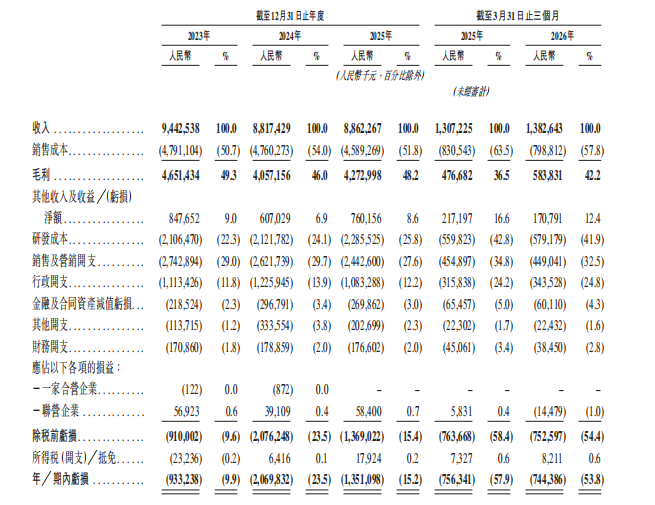
Fluctuations in gross margin reflect the high cost of cloud service delivery — data center operation and maintenance, customer success teams, and cloud infrastructure investment form rigid costs, making it difficult to simultaneously compress when revenue growth slows down. At the same time, competition in the enterprise software market is becoming increasingly fierce. Jindie, SAP China, and many SaaS startups are squeezing the price side, forcing users to make concessions to insurers in some projects, eroding the gross profit space. It is worth noting that the recovery in gross margin in 2025 may be due to the company's active clean-up of low-margin projects and optimization of delivery efficiency, but whether it can continue to stabilize above 48% is yet to be verified in subsequent quarters. However, even if gross margin is fixed, high expenses on the cost side make it almost impossible for the company to transfer improvements in gross profit to the profit level. In particular, the continuous rise in R&D expenses has become a key weight that crushes the profit table.
The cost structure is the part of users' financial data that best reflects the strategic orientation. The R&D expenditure rate increased from 22.3% in 2023 to 24.1% in 2024, then to 25.8% in 2025. The cumulative R&D investment over three years was about 6.514 billion yuan, and the investment intensity increased year by year. This huge amount of money mainly goes to the iterative upgrade of the BIP platform for users, the development of the YongPT enterprise model, and the implementation of the AI application suite, which is the core bargaining chip for the company's “AI+Cloud” dual-engine transformation.
From a strategic perspective, continuing to invest heavily in R&D is an inevitable choice for dealing with the shift in industry paradigms, but from a financial perspective, when the revenue side fails to scale up simultaneously, the rigid increase in R&D expenses directly widens the loss gap. At the same time, the sales and marketing expenses rate fell from 29.0% in 2023 to 27.6% in 2025, and the absolute value was reduced by about 360 million yuan, reflecting that the company has achieved certain results in optimizing the sales system, streamlining channel levels, and improving human efficiency. However, the 27.6% sales expense ratio is still at a high level in the software industry, and high customer acquisition costs are still a long-term problem.
The share of cloud service revenue rose to 81.4%, and the progress of AI commercialization and implementation remains to be seen
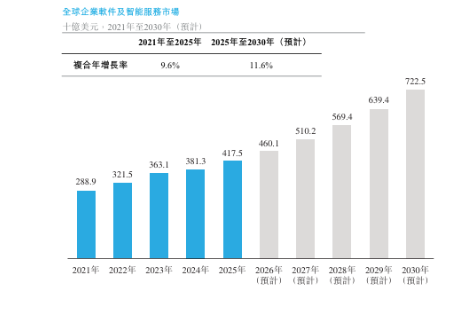
According to Frost & Sullivan's statistics, the global enterprise software and services market size (in terms of revenue) is expected to reach US$7225 billion by 2030, with a CAGR of 11.6% between 2025 and 2030. In this expanding market, in terms of revenue in 2025, Youyou Network ranked first in the industry with a market share of 3.8%. However, its position as a leader in the industry has not given it the resilience to grow beyond the cycle. Under the appearance of this total deadlock, drastic restructuring of the revenue structure is the most noteworthy financial clue.
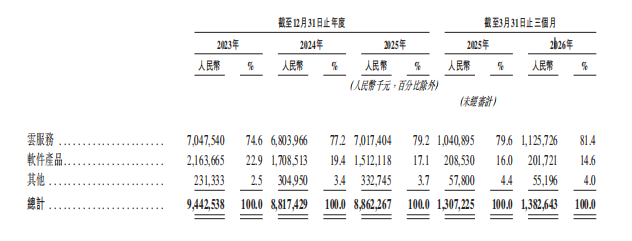
The business segment of User Friends Network can be divided into three categories: cloud services, software products, and others. Cloud service revenue increased from 7.048 billion yuan in 2023 to 7.017 billion yuan in 2025, accounting for 79.2% from 74.6%; in the first quarter of 2026, cloud service revenue reached 1,126 billion yuan, accounting for a further increase to 81.4%. Corresponding to this is the continued contraction of software product revenue — from 2.164 billion yuan in 2023 to 1,512 billion yuan in 2025, reducing the share from 22.9% to 17.1%. This rise and fall reflects a clear outline of the strategic orientation of users: actively shrink the traditional software business with one-time authorized sales, and fully bet on subscription-based cloud services. But this structural transformation has also brought about a fundamental change in how revenue is recognized—traditional software sales can recognize large amounts of revenue in one go at the time of delivery, while cloud service subscription revenue needs to be confirmed in installments during the service period.
From a product perspective, using BIP as the core platform for cloud services plays the role of the main engine for revenue growth. In 2025, BIP achieved revenue of 3.61 billion yuan, a year-on-year increase of 15.1%; in the first quarter of 2026, BIP's revenue was 550 million yuan, further increasing the year-on-year growth rate to 26.8%. Against the backdrop of nearly zero overall revenue growth, BIP was able to maintain a double-digit increase, indicating that core cloud products are supported by demand on the client side. However, BIP's growth is not enough to offset the decline in traditional software business and the drag on other sectors — in 2025, the business revenue of medium-sized enterprise customers was 1.1 billion yuan, a year-on-year decrease of 12.3%, of which software business revenue plummeted by 49.4%. This data clearly shows that users are experiencing a typical “transformation of old and new kinetic energy”: new businesses are growing, but old businesses are shrinking faster, and the net effect is that the total volume is stagnating.
AI is an important direction for users to seek the next round of growth. The company launched YongPT, a major enterprise service model in 2023, and launched the “Yonyou BIP Enterprise AI” application suite in 2025. By the end of 2025, the amount of AI-related contracts signed by the company reached 1.67 billion yuan, and more than 400 customers had been signed. However, the volume of the AI business is still relatively limited, and the driving effect on overall revenue is not obvious, yet continuous R&D investment continues to reduce profit margins — R&D expenses reached 2,964 billion yuan in 2025, accounting for 32.3% of revenue. Whether AI can transform from a cost center to a profit center in the foreseeable future is the market's most central question about the user transformation narrative.
User Network is in a triple superposition period where the enterprise software industry evolves from a license model to SaaS subscriptions and then to AI native applications. The share of cloud service revenue has risen from 74.6% to 81.4%, and the cloud-based business structure has basically been completed; however, stagnant overall growth, insufficient subscription depth, and continued profit losses indicate that “quantitative transformation” is already in place, and “qualitative improvement” will still take time. Under the general trend of the industry's overall evolution towards subscription systems and AI, the core issue facing users is not the correct strategic direction, but rather the balance between execution pace and financial affordability — until the revenue side reaches an inflection point, whether high R&D and sales expenses can continue to be supported will directly determine whether this industry leader can overcome the long journey of transformation.