
- PRICING
- LIVE QUOTES
- LEARN
- HELP


EN
Euro Futures (6E): Consolidation Range Faces a Key Test as Fed and ECB Policies Diverge
Two Central Banks, One Conflict: What Is Driving the Euro
Price action in 6E has been shaped largely by the collision of two central bank paths and a Middle East conflict that keeps rewriting the inflation outlook on both sides of the Atlantic. On June 11, the ECB raised its deposit facility rate by 25 basis points to 2.25%, its first hike since September 2023, after eurozone inflation jumped to 3.2% in May, the highest reading since 2023, driven largely by an energy price shock tied to the Iran war. That hawkish pivot initially offered the euro some support. By June, inflation cooled to 2.8%, and money markets now assign roughly an 88% probability that the ECB simply holds steady at the July 23 meeting rather than tightening further.
On the dollar side, new Fed Chairman Kevin Warsh struck a hawkish tone during his first congressional testimony, pledging a firm commitment to price stability, yet his remarks failed to lift the greenback. That is largely because June's non farm payrolls report landed at just 57,000, a significant miss that cooled expectations for further Fed tightening. June's CPI also slowed to 3.5% year over year from 4.2% in May, reinforcing the case for the Fed to hold at its July 29 meeting.
Layered on top of the rate debate is the more recent turn in the Iran situation. A US Iran memorandum of understanding signed on June 17 had lifted the naval blockade on Iranian ports, reopened the Strait of Hormuz to commercial traffic, and allowed Iranian oil exports to resume, easing the energy driven inflation pressure that had been building through the spring. That calm proved short-lived. On July 7, Iran struck two commercial tankers transiting the Strait, prompting Washington to reimpose sanctions on Iranian oil exports and CENTCOM to launch fresh strikes on Iranian military targets, and by July 12 the IRGC had declared the Strait closed again. With the truce now fraying just weeks after it began, oil markets are back to pricing in supply risk, and 6E remains highly sensitive to how this standoff develops alongside incoming labor and inflation data.
What the Market Has Done
- Market in a sideways consolidation range between 1.187 (Daily level 2) and 1.15 (Daily level 3), since June 2025.
- In June 2026, sellers stepped down offers to 1.166 (consolidation range mid).
- More recently, towards the last week of June, the market was able to break below the 1.15 level, and sellers have been able to hold offers down here. However, buyers seem to be absorbing liquidity at these prices.
What to Expect in the Coming Weeks
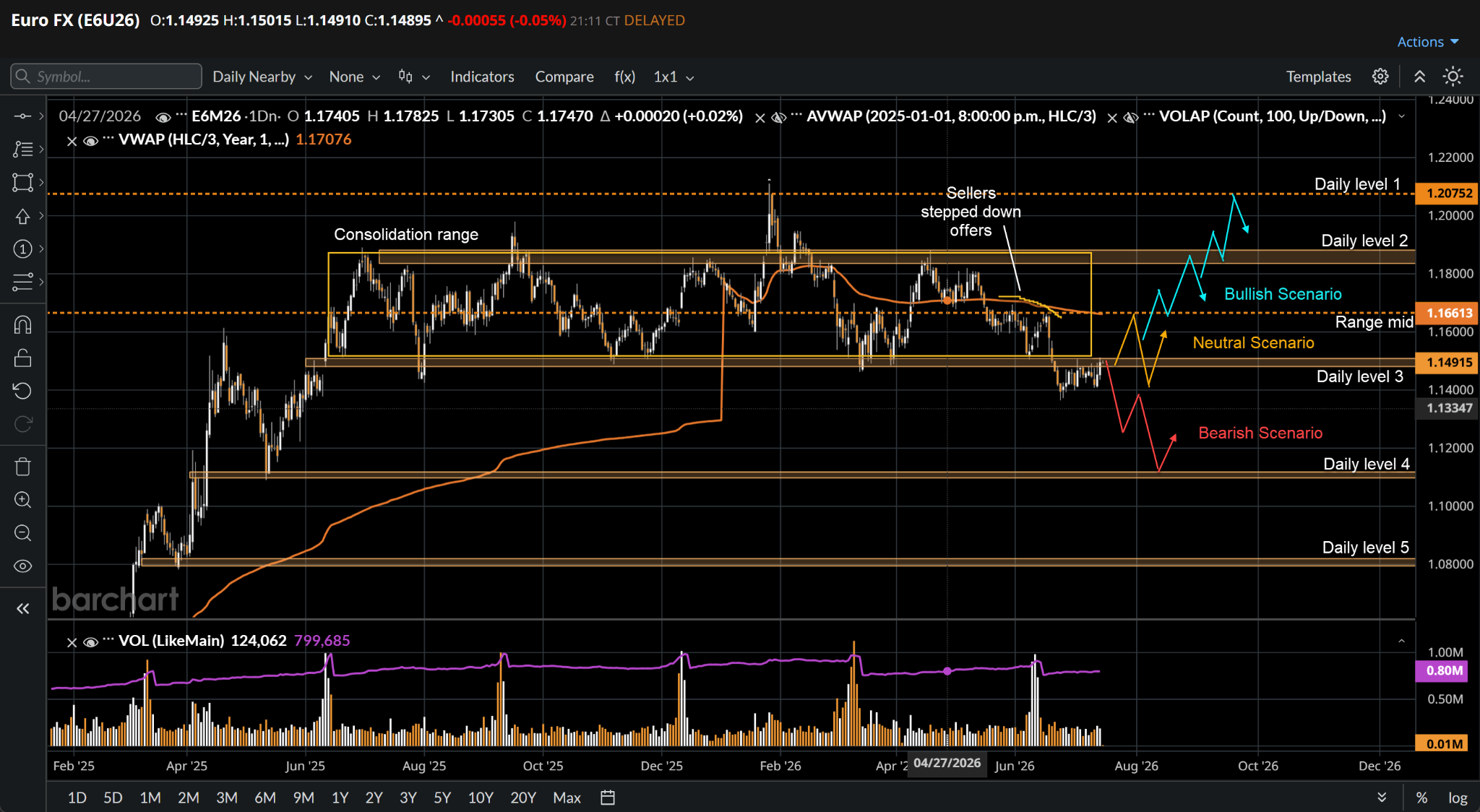
The key level to watch is the 1.15 level (Daily level 2, consolidation range low).
Bearish Scenario:
- If sellers are able to hold offers at the 1.15 level, continued pressure may cause buyers to eventually give up, which would result in price moving down towards 1.13 initially, and subsequently towards the 1.11 area (Daily level 4).
- A possible trigger would be the Hormuz standoff deepening, with the Strait staying closed or fresh tanker attacks keeping oil elevated, pushing the Fed toward a longer hold while the ECB stays sidelined, widening the policy gap in the dollar's favor.
Neutral Scenario:
- If buyers are able to reclaim back above 1.15, expect a move up to 1.166 (consolidation range mid); expect sellers to be present here, which is confluent with the projected yearly VWAP, which would result in a two-way balance, with markets accepting prices lower.
- A possible trigger would be the ECB holding its rate at 2.25% as priced in on July 23, paired with an uneventful Fed hold on July 29, leaving the policy gap little changed and price driven more by incoming data than a clear catalyst.
Bullish Scenario:
- If buyers are able to bid prices back above 1.166 (range mid), after reclaiming back above the 1.15 level into the consolidation range, expect a move back up to 1.187 (Daily level 2, range high); expect responsive sellers here; if not, expect the market to break out above 1.187 and subsequently move to 1.20 (Daily level 1).
- A possible trigger would be further softening in US labor data along the lines of June's 57,000 payrolls print, pulling forward Fed rate cut expectations and weighing broadly on the dollar.
Conclusion
Technically, 6E remains range bound between 1.15 and 1.187, with 1.15 standing as the near term battleground between buyers absorbing liquidity and sellers holding offers below it. A decisive break in either direction should set the tone for the weeks ahead, with 1.166 acting as a pivotal midpoint. Fundamentally, the pair sits at the intersection of a Fed under new leadership that just watched a soft payrolls report undercut its hawkish rhetoric, and an ECB that hiked once in June but now appears content to pause as inflation cools. Add in a still fragile Iran situation that has already swung oil prices sharply this year, and it becomes clear why every central bank statement and Middle East headline is a potential catalyst. Where do you see 6E heading first, a breakdown toward 1.13, or a reclaim back up toward 1.187? Share your take in the comments below.
We built EdgeClear for traders who treat trading as a business. That means low commissions, zero-friction order routing, and free access to EdgeClear Insights—a cloud-based analytics platform that tracks your P&L, discipline, and execution quality in real time. Build your trading business on a foundation that scales with you. Open an Account today.
Disclaimer:
This article is provided for informational and educational purposes only and does not constitute financial, investment, or trading advice. The analysis presented reflects the author’s market observations and opinions at the time of writing and is not a recommendation to buy or sell any futures contract, security, or financial instrument. Futures trading involves significant risk and is not suitable for all market participants. Losses may exceed initial margin deposits, and market conditions can change rapidly.
Any scenarios, levels, or market expectations discussed are hypothetical in nature and are intended solely to illustrate potential market behavior. They do not represent actual trading results and should not be interpreted as guarantees of future performance. Past performance, market behavior, or historical price action are not indicative of future outcomes.
Readers are solely responsible for their own trading decisions and risk management. Always conduct independent research, consider your financial situation and risk tolerance, and consult with a qualified financial professional, if necessary, before engaging in futures or derivatives trading.