
- PRICING
- LIVE QUOTES
- LEARN
- HELP


EN
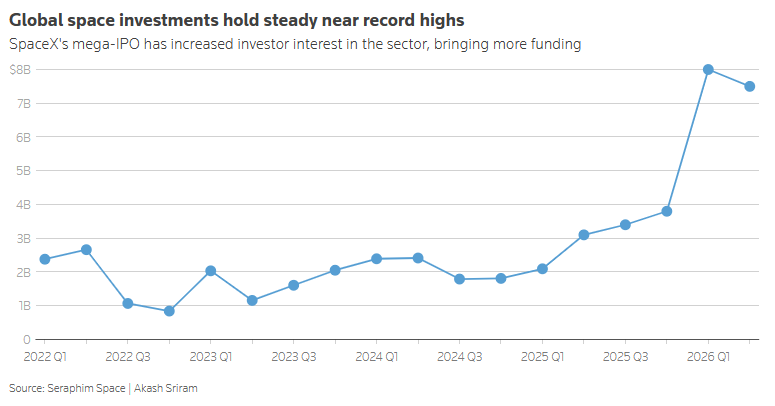
The SpaceX (SPCX.US) listing effect attracted “foreign capital”: space venture capital attracted 7.5 billion US dollars in the second quarter, approaching a record high
The Zhitong Finance App learned that according to a report released by the British investment agency Seraphim Space on Thursday, boosted by SpaceX (SPCX.US)'s landmark IPO of nearly 86 billion US dollars, the financing scale of global space startups in the second quarter of 2026 is approaching an all-time peak.
This iconic listing event not only attracted the attention of a wider range of investors outside of traditional space special funds, but also further consolidated the aerospace industry's market position as a mainstream asset class. At the same time, the IPO also boosted large financing rounds for companies in the fields of delivery systems, satellite networks, defense technology, and other in-orbit infrastructure.
“Over the past year, we have clearly felt a rise in investor interest. SpaceX's IPO was certainly a big help, but the deeper reason is that investors are increasingly aware of the commercial maturity of this industry,” said Lucas Bishop, an investment analyst at Seraphim Space. “We are seeing more and more institutions with little or no previous investment experience in the space sector take the initiative to contact us and hope to set up on this track.”
Bishop pointed out that although the first half of 2026 is an extremely active period of financing, and the quarterly total amount may fluctuate, the overall investment driving force of the industry is still strong.
Investors also said that the focus of the market is increasingly on companies serving defense and national security customers, as well as companies dedicated to developing spatial computing capabilities, reflecting the expectation that government and commercial customers will invest more in these fields.
According to the data, space companies raised a total of about 7.5 billion US dollars in 141 venture capital transactions in the second quarter, which is a slight decrease from the total amount of 8 billion US dollars raised in a record 159 transactions in the previous quarter.
“Today, we see that investors are more inclined to focus their capital on large financing rounds for mature aerospace companies. This means that companies that have completed technical verification, have clear market requirements, and are in a critical phase of scaling up will receive more adequate capital support,” said Felix von Schubert, managing partner at NewSpace Capital.
Next, the market will be watching closely to see if Blue Origin (Blue Origin), owned by Jeff Bezos, can complete its reported financing plan of around $10 billion. If the deal is reached, it will become one of the largest private equity financings in the history of the aerospace industry, and it will also continue an unprecedented cycle of capital expansion in the commercial space sector.