
- PRICING
- LIVE QUOTES
- LEARN
- HELP


EN
At a time when the gold price war is raging for 4,000 US dollars, Fidelity International said, “Fiscal discipline will not return, the gold bull market will not die”, and is taking the opportunity to return to overallocation
The Zhitong Finance App learned that against the backdrop of the US launching a new round of military attacks on Iran and the continuous rise in international oil prices, the gold market is playing a fierce game around the psychological threshold of 4,000 US dollars per ounce. On the one hand, large institutions such as Fidelity International are planning to re-increase their gold positions based on lack of fiscal discipline and the central bank's continued purchase of funds; on the other hand, concerns about inflation and interest rate hikes caused by high energy prices have repeatedly put pressure on the interest-free asset gold.
This leaves market participants in a dilemma: fear of inflation and a slowdown in economic growth. Who will actually be the core macroeconomic narrative that will dominate gold prices in the second half of the year.
Geopolitical smoke resurfaced, and the rebound in gold prices was short-lived
According to the latest data, the price of gold fell 0.9% on Thursday, falling back to around 4,025 US dollars per ounce, taking back the gains previously recorded due to the easing of US inflation data.
The immediate catalyst that triggered the decline was another escalation of the situation in the Middle East — the US has completed the latest round of attacks on Iran, and US President Trump has vowed to step up the bombing until Iran stops attacks in the Strait of Hormuz and agrees to open shipping lanes. The interim peace agreement signed last month has essentially broken down. As a result, the price of Brent crude oil increased to around 85 US dollars per barrel, and the price of refined oil products such as diesel, gasoline, and aviation fuel also reached a level equivalent to 160 US dollars per barrel.
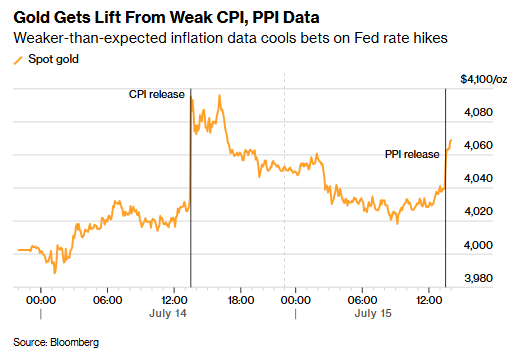
Previously, the price of gold briefly soared by nearly $100, boosted by a weaker than expected increase in the US consumer price index and producer price index, to rise back to 4,100 US dollars per ounce. At the time, traders quickly cut their bets on the Federal Reserve's recent tightening policy. However, the rebound in oil prices and America's new crackdown on Iran soon revived concerns that high energy costs would once again be transmitted to inflation, thus triggering expectations of further tightening of monetary policy. The price of gold fell in response and fell back into the broad consolidation range built over the past few weeks.
Looking at the longer term, gold is still in a major correction channel since turning down from a historical high of close to 5,600 US dollars per ounce at the end of January this year. Gold prices fell by a cumulative total of 14% in the second quarter, the worst quarterly performance since 2013. So far during the year, the price of gold has fallen by about 7%, but it is still up about 20% from the same period last year.
Inflation or recession? Market logic has fallen into a “split”
Currently, it is difficult to establish a one-sided trend in gold prices; the root cause is an inherent contradiction in macroeconomic logic. Under the traditional pricing framework, rising oil prices will boost inflation expectations, thereby supporting US Treasury yields and the US dollar, and increasing the opportunity cost of holding zero-yield gold. This transmission chain was confirmed earlier this week, when US two-year Treasury yields climbed to their highest level in more than a year.
However, Ole Hanson, head of commodity strategy at Saxo Bank, pointed out that the resilience shown by the gold price at $4,000 may suggest that investors may no longer simply focus on the short-term inflationary impact brought about by rising oil prices and consider more about its long-term erosion of economic growth. Continued high energy costs will squeeze consumer spending, erode corporate profit margins, and deter investment. If such recession fears eventually overshadow fears of inflation, the value of gold as a defensive asset will once again dominate.
Hanson believes that the market is currently in a fierce tug-of-war between two macroeconomic themes: concerns about inflation, high bond yields, and a strong dollar; on the other, economic slowdown, fiscal debt problems, and the risk of currency depreciation. Gold is likely to continue to fluctuate between $3,950 and $4,200 until the situation becomes clear. If the price of gold continues to break through 4,200 US dollars, it will mean that the market completely breaks out of the logic of inflation and instead focuses on the broader economic consequences of the energy shock; conversely, if it clearly falls below 3,950 US dollars, it means that inflation narratives and austerity expectations will once again fully control the market.
Disagreements within the Federal Reserve have further deepened market uncertainty. When testifying in Congress, Federal Reserve Chairman Kevin Walsh reiterated his commitment to restoring price stability and said that interest rates are still one of the options for controlling inflation, but at the same time emphasized that patience will be maintained. In his exchanges with lawmakers, he also refuted claims that the artificial intelligence (AI) investment boom is increasing inflation and affirmed his independence several times.
However, the statements of other policymakers are inconsistent: Director Lisa Cook bluntly stated that “if there are no signs of a rapid decline in inflation, we are ready to act,” while New York Federal Reserve Chairman John Williams believes that current interest rates are “in a good position” to achieve the target. This “interlaced pigeon” picture makes the precious metals market extremely sensitive to upcoming economic data and changes in energy prices.
Fidelity: Long-term bullish logic has not changed; take the opportunity to return to overmatch
In addition to short-term fluctuations and mood swings, some large long-term institutional investors are planning layouts on a longer cycle level. Fidelity International's multi-asset fund manager Ian Samson recently revealed that Fidelity has plans to return to oversized gold positions; the only problem is timing.
Samson lowered the gold position of its multi-asset portfolio to neutral between January and February of this year, that is, around the end of a multi-year gold bull market. Looking back at this round of decline, the price of gold began to fall from an all-time high of nearly 5,600 US dollars at the end of January, and accelerated its decline after the outbreak of the Middle East War in February.
“From a tactical point of view, the current bullish and bearish factors in the gold market are almost evenly matched,” Samson said. He expects that by the end of this year, the price of gold will rise slightly from the current level, and the true return of the bull market may take until 2027. In his view, there is only one situation that can substantially shake the long-term bullish logic of gold: “We return to a world where governments have rediscovered fiscal discipline and central banks have made real efforts to keep inflation down. But I don't think we're in this macro environment.”
In addition to the macro-fiscal and monetary environment, Samson is also closely monitoring the subsequent trend of oil prices, the Federal Reserve's interest rate decisions, and the ability of gold itself to accumulate and maintain momentum. On a technical level, the 50-day moving average crosses long-term indicators upward, or the price pushes above $4,300 per ounce, which will be seen as an early bullish sign worth watching.
Purchases from the official sector provided a solid foundation for the long-term center of gold prices. According to a recent survey released by the World Gold Council and YouGov, the number of central banks planning to increase their gold holdings this year reached a record high. Samson said bluntly, “If you have these large-scale structured and strategic buyers, the price of gold will almost certainly be boosted.”
This judgment also echoes changes in positions in the ETF market — Saxo Bank observed that after the previous round of liquidation, gold ETF holdings have basically stabilized, indicating that the aggressive sell-off phase is nearing its end, even though new allocated funds have yet to enter the market on a large scale.