
- PRICING
- LIVE QUOTES
- LEARN
- HELP


EN
AI infrastructure boom brings demand for air transport, and many Asian airlines unexpectedly “lay back and win”: freight revenue hit a three-year high
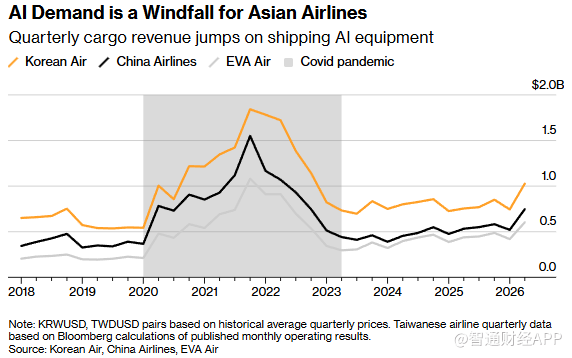
The Zhitong Finance App learned that AirAsia has become the latest beneficiary of the increase in demand for artificial intelligence (AI) servers and computing power chips. This unexpected benefit will help mitigate the impact of soaring aviation fuel costs. The latest quarterly earnings report shows that Korean Air, China Airlines, and EVA Air's cargo revenue reached the highest level in more than three years.
The airlines said the transportation of semiconductors and other equipment is driving a new round of growth in cargo demand. Korean Air and China Airlines recorded their biggest quarterly increase in cargo revenue since 2022, when the COVID-19 pandemic boosted transportation costs and pushed cargo revenue to record highs.
“Cargo has always been a major highlight of Asia Pacific Airlines,” said Nathan Gee, head of Asia Pacific transportation research at Bank of America. He added: “We are optimistic about the fundamental outlook for air cargo in 2027.” He pointed out that the recent rise of the artificial intelligence supercycle, good e-commerce circulation, and tight supply have all “supported strong pricing capabilities.”
The global boom in artificial intelligence data centers and other infrastructure construction is driving a surge in freight demand. Other industries benefiting from the AI boom include manufacturers of engineering equipment, general-purpose energy storage batteries, generator sets, and turbine equipment.
The AI boom is driving a surge in quarterly cargo revenue for several Asian airlines
Taiwan and South Korean airlines have dedicated freighter fleets and are therefore in an advantageous position. South Korea's SK Hynix and Samsung Electronics are the world's leading manufacturers of artificial intelligence chips, while TSMC is Nvidia's main OEM.
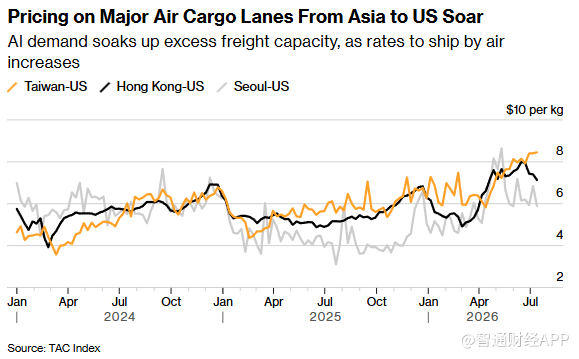
According to the TAC Index, in recent weeks, freight rates on major air routes from major regions such as Hong Kong, Seoul, and Taiwan to the US have risen to the highest level since 2022.
Freight rates on major cargo routes from Asia to the US have risen sharply
Earlier this week, Korean Air reported operating profit that exceeded analysts' expectations by more than four times. The company attributed the nearly 50% increase in freight revenue to global investment in artificial intelligence, and said it will continue to increase investment in high-growth freight sectors such as AI-related industries.
Earlier this year, the turbulent situation in the Middle East caused aviation fuel prices to soar, and the increase in AI chip shipments helped ease the cost pressure on airlines.
EVA Air said on Tuesday that cargo related to artificial intelligence servers accounted for 40% to 50% of its total air cargo volume from Taiwan to the US, but did not specify the time period. To meet market demand, the company plans to purchase three additional freighters by 2028.
In terms of fleet size, many Asian passenger airlines are also the world's leading air cargo operators. Currently, demand for cargo transportation related to artificial intelligence has skyrocketed, and cargo aircraft orders are simultaneously experiencing a blowout. Last month, China Southern Airlines Cargo, a wholly-owned subsidiary of China Southern Airlines, ordered as many as 10 Boeing 777 freighters. Cathay Pacific Cargo purchased two additional Airbus A350F freighters, and China Cargo ordered four additional A350F freighters in May, bringing the total number of orders for this aircraft to 10.
However, large aircraft manufacturers such as Boeing are still facing many obstacles in expanding production, including shortages of parts and labor due to the pandemic.
Bank of America believes that goods related to artificial intelligence have begun to crowd out the transportation of other goods in the Asia-Pacific region. Gee said this allows the airline cargo business to fully offset the impact of rising aviation fuel costs, while the passenger flight business is unable to do this.
As more airlines release financial reports in the coming weeks, investors can more clearly understand the transmission effect of the AI boom on air cargo demand.