
- PRICING
- LIVE QUOTES
- LEARN
- HELP


EN
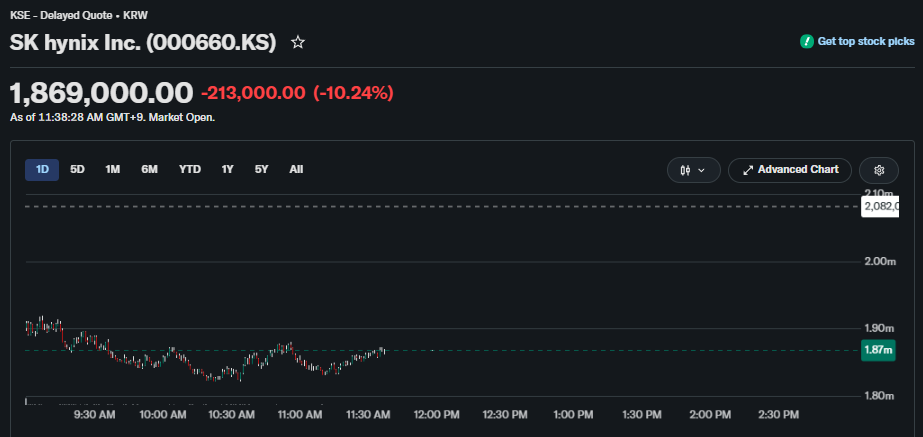
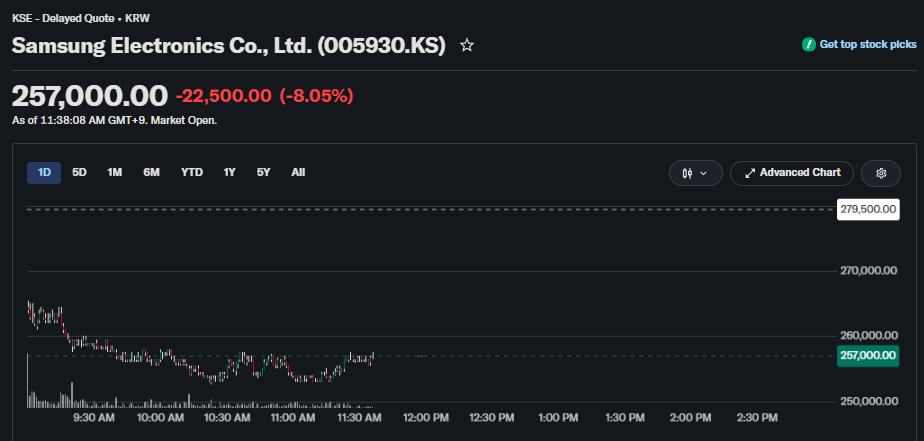
Asian tech stocks continued the overnight decline in US chip stocks! SK Hynix fell more than 10%, Samsung Electronics fell more than 8%
The Zhitong Finance App learned that the impact of the overnight sell-off in US chip stocks spread to the Asian market, causing Asian chip stocks to collectively plummet on Thursday. Among them, SK Hynix shares listed in Seoul once plummeted by more than 11%, completely taking back the 8% increase on the previous trading day, and still falling by more than 10% as of press release. Previously, the stock hit the record for the biggest decline in a single day this Monday, partly because investors chose to make a profit as market concerns about the future of artificial intelligence (AI) spending heated up. Meanwhile, Samsung Electronics' stock price fell more than 8%, Seoul Semiconductor fell more than 5%, LG Innotek fell about 1%, and Samsung SDI fell more than 2%.
The weak trend in chip stocks spread rapidly across Asia. In Japan, AI-related equipment manufacturer AdvanTest's stock price fell more than 6%, SoftBank Group fell nearly 7%, Tokyo Electron (Tokyo Electron) fell more than 5%, and Renesas Electronics fell 4%.
The fall in Asian chip stocks continued the overnight sell-off in the US semiconductor sector. Micron Technology (MU.US) shares fell 8%, Intel (INTC.US) fell more than 4%, and Fanlin Group (LRCX.US) and AMD (AMD.US) both fell about 3%.
Rolf Burke, head of semiconductor and infrastructure stock research at Futurum Group, said: “Today's decline is mainly a continuation of overnight US market trends.” He pointed out that the proposed suspension of data center construction in New York State and reports that CoreWeave is considering hedging measures to cope with a possible fall in memory prices in the future have had a slight negative impact on market sentiment.
New York Governor Kathy Hochul ordered the temporary suspension of new large-scale data center projects until the state establishes stricter regulations on data center energy consumption, water use, and environmental impact. US President Trump publicly criticized Hochul's decision on Wednesday to suspend approval for the construction of new large-scale data centers, calling this policy “a bad decision” and urging New York State to immediately lift the relevant ban. The dispute between the two sides over AI infrastructure construction and energy costs has further escalated.
However, Burke said that the recent weakening of the market was more reflected in the return of profits after the previous sharp rise, rather than a deterioration in the fundamentals of the industry. He added that the structural requirements for AI infrastructure and memory chips are still intact.
It is worth noting that at the time of this round of chip stock sell-off, ASML.US (ASML.US) has just announced strong results. The Dutch chip equipment manufacturer raised its annual sales guidelines for the second time this year. The annual revenue is expected to reach 43 billion euros to 45 billion euros, higher than analysts' expectations, and announced plans to further expand the production capacity of extreme ultraviolet (EUV) lithography machines.
xFunds trader Louis Kondratiev said that the recent pullback reflects that trading in the semiconductor sector has become too crowded as AI continues to drive. He said, “Currently, the semiconductor sector alone accounts for about 20% of the weight of the S&P 500 index. It is extremely difficult to maintain this share for a long time.” He pointed out that during the Internet bubble in 2000, the weight of the semiconductor sector in the S&P 500 index was only slightly above 8%, while the historical average was usually between 2% and 5%.
He also said that although corporate profits are still growing strongly, this upward trend may become more and more difficult to sustain in the future as investors re-evaluate excessive valuation levels. He pointed out, “Profit growth momentum has always been very strong, but it is mainly concentrated in the semiconductor industry, and as valuations gradually return to a reasonable level, this growth momentum may begin to slow down.”
Furthermore, the latest fund manager survey report released by Wall Street financial giant Bank of America shows that global investors who are aggressively buying stocks should actively consider reducing their exposure to risky asset allocation. The core judgment of the Bank of America strategist team is not that the fundamentals of global technology stocks or the AI computing power industry are about to fall into a downward trajectory, but rather that investors' extreme optimism, bullish stock positions and strong profit expectations, and continued valuation expansion have seriously overdrawn fundamental growth prospects for the next 1-2 years or so, causing the marginal risk-return of risk assets to deteriorate significantly. This is reflected in the fact that fund managers' share of cash plummeted from 4.1% to a very low level of 3.6%, and the Bull and Bear Index reached a pessimistic score of 9.4 out of 10.
As a result, the Bank of America strategist team led by Bank of America strategist Michael Hartnett, who has the title of “Wall Street's Most Promising Strategist,” suggests taking a wait-and-see stance to reduce stocks and high beta exposure as much as possible. The essence of the latest forecast is also to remind investors that the long-term trend of AI computing power themes is still there, but extreme semiconductor trading congestion, extreme leveraged positions, low cash buffers, and the risk of medium- to long-term growth in overdraft pricing and capital expenditure cooling risks. The outlook may suppress the summer market and amplify the retracement in valuation caused by any slight weakness.