
- PRICING
- LIVE QUOTES
- LEARN
- HELP


EN
Is Amazon (AMZN.US) undervalued? The “troika” of clouds, self-developed chips, and robots is opening up new space for growth
The Zhitong Finance App notes that as an unquestionably superior company, the current value of Amazon (AMZN.US) seems to be underestimated by the market — over the past year, the company's stock price performance has lagged behind the S&P 500 index. According to analyst Jetstream Research, the current valuation level provides a good opportunity for long-term investors to enter the market.
The analyst believes that Amazon's growth narrative is a combination of strong revenue growth and expanding operating cash flow profit margins. In particular, AWS and the advertising business — Amazon's two strongest growing segments — are driving the company's overall revenue growth rate. More importantly, the profit margins of these two businesses are far higher than their core e-commerce businesses. As these businesses continue to expand, operating cash flow margins have also soared. Furthermore, Amazon's investment in self-developed chips and robotics will boost profit margins over the long term, and is expected to cause the company's operating cash flow to grow faster than revenue growth.
At the same time, Amazon's stock price is at a historically low share price/operating cash flow ratio, which provides long-term investors with a rare opportunity to buy one of the world's largest and best quality companies at a discount. Based on this, the analyst gave Amazon a “Strong Buy” rating.
Amazon's revenue structure and operating profit margin
According to a Jetstream Research article, Amazon divides its huge revenue into three categories: North American, international, and AWS cloud services. Over the past 12 months, the company achieved revenue of $743 billion (up 14% year over year), of which 59% came from North America, 23% from international sources, and 18% from AWS.
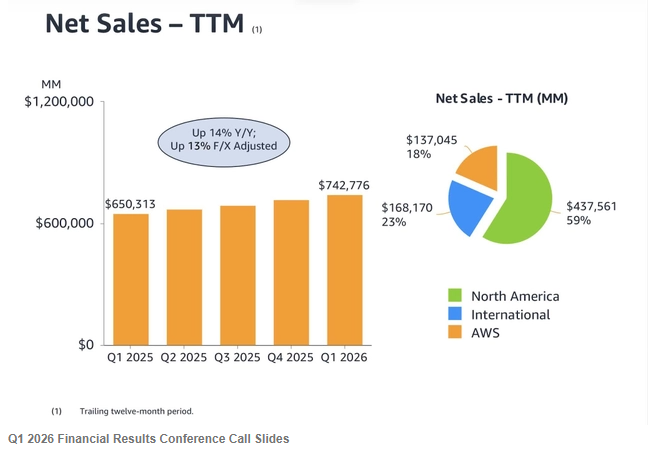
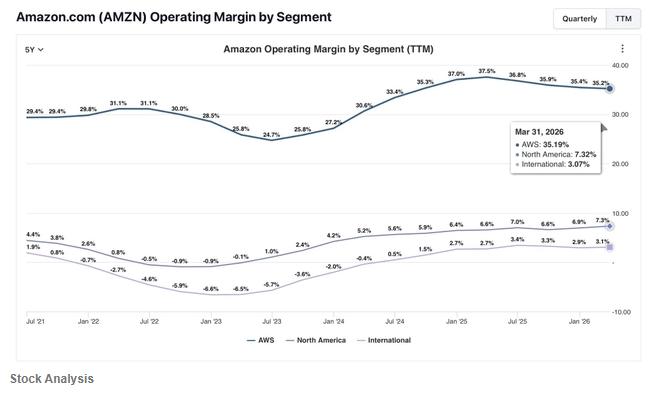
Although AWS accounts for only 18% of revenue, it contributes about 56% of operating profit; this is because AWS's operating margin is much higher than the North American (only 7%) and international (only 3%) sectors.
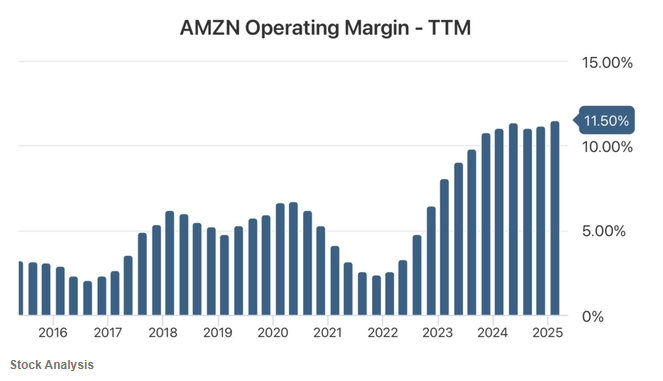
Over time, the growth of AWS has increased Amazon's overall operating margin from less than 5% ten years ago to over 11% today. The analyst expects Amazon's operating margin to expand further in the future as AWS continues to grow.
Amazon also further subdivided sales into seven segments, which more clearly showed the driving role of each business in overall growth. Advertising and AWS are the fastest-growing sectors, and the growth rate far exceeds the 20% year-on-year increase. Even the largest sectors — online stores and third-party seller services — maintained very healthy low double-digit year-over-year growth.
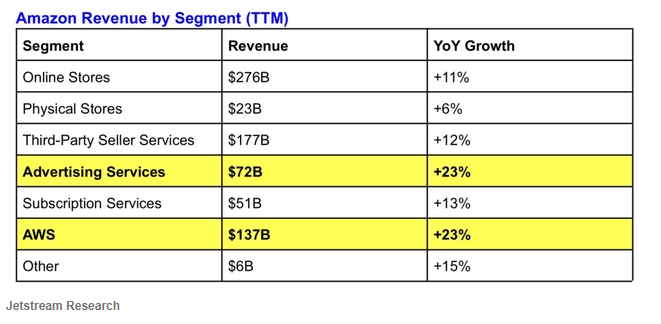
Thankfully, Amazon's fastest growing sector is also the sector with the highest profit margin. As a result, advertising and AWS will gradually increase Amazon's overall operating margin as they continue to outperform other sectors. In light of this, investors should keep a close eye on the growth rate of these two sectors as they contribute the most to Amazon's overall profitability.
Self-developed chips help AWS accelerate growth
Like other hyperscale cloud service providers, Amazon has been developing self-developed chips to reduce reliance on Nvidia (NVDA.US). This provides AWS customers with more economical computing power resources and has boosted the sector's revenue growth rate over the past few quarters.
CEO Andy Jassi described this during the 2026 first quarter earnings call. Regarding the price/performance ratio of his self-developed chips, he said:
“Our Trainium2 chip is about 30% more cost-effective than similar GPUs, and is now almost sold out. Shipments of Trainium 3 chips have just begun in 2026, and their cost performance ratio is 30% to 40% higher than Trainium 2. Currently, almost all of them have been pre-ordered; while Trainium4, which is still about 18 months away from widespread launch, has also been locked in large part ahead of schedule.”
This excellent cost performance ratio is driving the market to extremely high demand for chips developed by Amazon. Jia Xi explained the revenue growth of the chip business as follows:
“We achieved nearly 40% month-on-month growth in the first quarter. Our annualized revenue operating rate has now exceeded $20 billion, and the year-on-year increase has reached a three-digit percentage, but this somewhat masks the true size of the business.”
“If our chip business were an independent company, and like other leading chip companies, we would sell the chips produced this year to AWS and third parties, our annual revenue and operation rate would reach 50 billion US dollars. According to our judgment, our self-developed chip business has now become one of the top three data center chip businesses in the world.”
Overall, the total annualized revenue operating rate of AWS is 150 billion US dollars, so the 20 billion dollar chip revenue operating rate (year-on-year increase over the “three-digit percentage”) accounts for about 13% of the total volume, which is by no means a small amount. Self-developed chips are rapidly growing into an important part of the overall revenue of AWS, and have clearly boosted the sector's revenue growth.
Jia Xi is also considering selling self-developed chips directly to other companies rather than exclusively leasing them through AWS. As he stated on the earnings call, this will enable the company's chip business to reach an annualized revenue operating rate of 50 billion US dollars (and still growing rapidly). Therefore, if Amazon decides to move in this direction, this will be another opportunity for it to increase revenue.
Self-developed chips not only save AWS customers money, but also reduce costs and increase efficiency for Amazon itself. By designing his own chips, Jia Xi anticipates that as more self-developed chips are deployed in its data centers, the company will save a lot of capital expenses and operating expenses:
“After reaching a certain scale, we expect Trainium to save us tens of billions of dollars in capital expenses each year and provide hundreds of basis points of operating margin advantage over relying on other chips in terms of reasoning.”
This is certainly a positive sign for AI infrastructure costs, which the market is generally concerned about. Jetstream Research believes that investors should continue to track AWS's operating profit margins to verify whether self-developed chips have actually brought the operating cost savings described by Jasi. Over the past five years, AWS's operating margin has expanded from 29% in 2021 to 35% today, and the situation continues to improve.
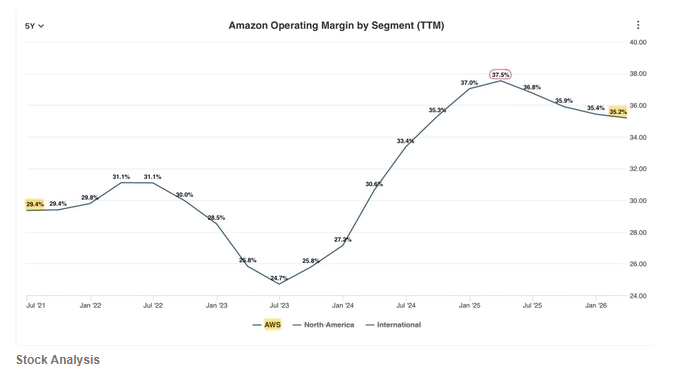
However, this profit margin peaked at 37% in 2025, meaning it fell 2% in the past year. “Some degree of fluctuation is to be expected, but ideally, this indicator should trend upward over the long term. Therefore, investors should keep a close eye on this indicator in the future,” Jetstream Research said.
AI and robotics benefit other business segments of Amazon
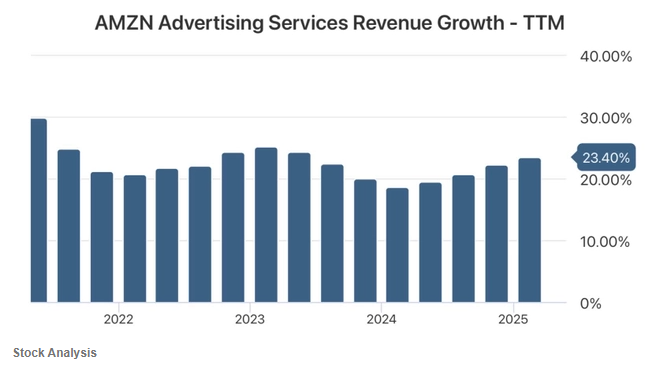
Amazon's investment in AI not only benefited AWS, but also had a positive impact on other businesses. The advertising sector is a clear example — its revenue growth rate has risen from a year-on-year high 10-digit period a year ago to a level in the early 20s.
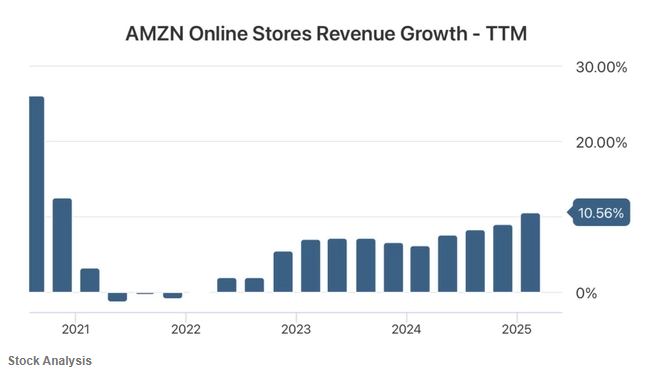
AI also enables Amazon to provide customers with more accurate product recommendations, thereby boosting e-commerce sales growth. According to data released by Amazon, customers using its AI assistant “Rufus” (recently renamed “Alexa for Shopping”) have a purchase conversion rate of more than 60% higher than customers using traditional searches. The ability to make accurate recommendations to specific customers from more than 300 million products on its own platform is a huge competitive advantage for Amazon, and is driving its online store's revenue growth rate from medium to high single digits to the lowest double digits.
Some of Amazon's most valuable AI apps aren't aimed at consumers. The company routinely uses AI to optimize internal operational efficiency, such as predicting consumer demand for different products to proactively optimize inventory or planning more efficient delivery routes to reduce delivery times. These ultimately enabled Amazon to deliver more products at a lower cost and with greater efficiency, which, under its size, constituted a strong competitive barrier.
Amazon has also invested heavily in robotics technology, further improving the company's efficiency. Amazon developed its own robots and deployed more than 1 million robots across its entire operating network. As a reference, Amazon currently has about 1.6 million employees, and the number of robot workers in the future may even surpass that of humans. These robots are responsible for sorting inventory, packaging, and other repetitive tasks at fulfillment centers.
Additionally, Amazon uses its AWS infrastructure to store and process massive amounts of data collected by these robot cameras and sensors. As a result, the company's investment in self-developed chips not only improved the cost efficiency of AWS customers, but also reduced Amazon's own internal operating expenses, which provided room for further expansion of its profit margins in the future.
What is clear is that AI is clearly beneficial to all segments of Amazon's business. Whether it's providing AWS customers with more cost-effective computing power, delivering more accurate advertisements and product recommendations, or optimizing internal operating processes, Amazon's investment in AI infrastructure is driving revenue growth and operating margin expansion.
A healthy balance sheet and manageable long-term debt
Amazon's aggressive investment in AI infrastructure has reduced its free cash flow to almost zero. Although operating cash flow increased 30% year over year in the last quarter (the growth rate exceeded revenue), free cash flow fell by about 95% year on year due to large-scale capital expenditure.
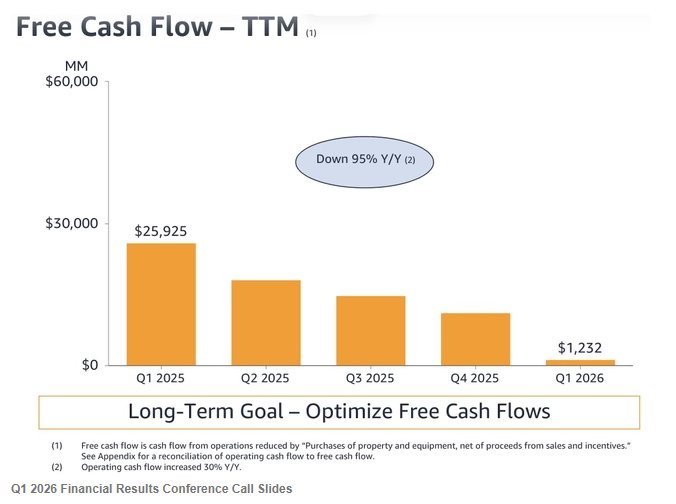
To finance the investment, Amazon provided debt financing: as of the most recent quarter, it had $119 billion in long-term debt on its balance sheet.
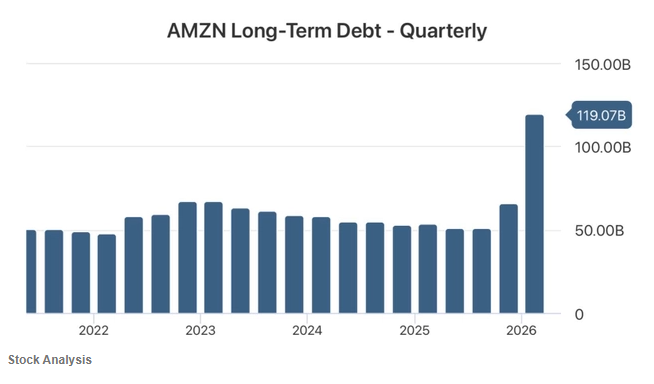
Jetstream Research said that at first glance, this number is huge, but considering the size of Amazon, it is still within a manageable range. Compared to its $442 billion shareholders' equity, Amazon's long-term debt to equity ratio is just 0.27. In terms of short-term solvency, it has current assets of $255 billion, current liabilities of $217 billion, and a current ratio of 1.17 billion. As a result, overall, Amazon is in a good position to pay both short-term and long-term debts.
It's also worth noting that Amazon's profitability is increasing in terms of operating cash flow. As mentioned earlier, Amazon's operating cash flow over the past 12 months increased 30% year over year to 149 billion US dollars, outperforming the 14% revenue growth rate over the same period. Considering its already large base, this growth is quite impressive. As a result, Amazon's future financial position in terms of meeting debt and supporting growth is likely to be more stable.
Revenue and operating cash flow forecast (2026-2031)
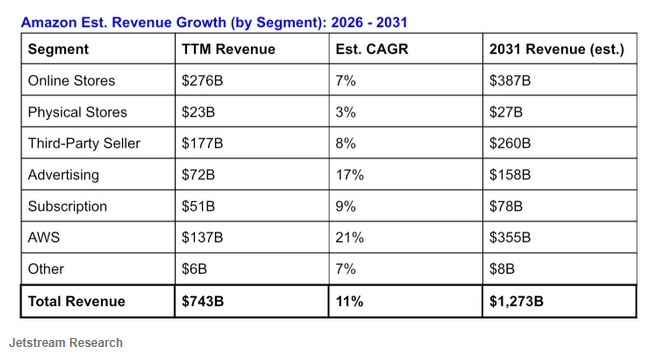
As mentioned earlier, several of Amazon's revenue segments are showing an acceleration in revenue growth; however, for the sake of conservatism, Jetstream Research has modeled a certain deceleration in revenue growth over the next few years. Advertising and AWS should continue to be the fastest-growing sector (with a growth rate of close to 20% to slightly over 20%), while revenue from other sectors will grow in the middle to high single digits (with the exception of the physical store sector, where the historical growth rate is only in the middle single digits). The following results were obtained by forecasting and summing up the various sectors for the next five years:
As for operating cash flow, Amazon has been steadily increasing its operating cash flow profit margin over the past ten years:
FY2016: $17 billion operating cash flow/ $136 billion revenue = 13% profit margin on operating cash flow
2026 (past 12 months): $149 billion operating cash flow/ $743 billion revenue = 20% profit margin on operating cash flow
In other words, Amazon has increased its operating cash flow profit margin by about 7 percentage points in the past ten years. If Amazon continues to expand its profit margin at a similar rate over the next five years, then by 2031, its operating cash flow profit margin is expected to reach a reasonable 24%. Combined with the above revenue estimates, the following results can be obtained:
$1.273 trillion in revenue × 0.24 = $306 billion in operating cash flow
Finally, using a ratio of 20 times the share price/operating cash flow ratio (less than 25 times its 10-year median) and calculating 11.31 billion tradable shares (assuming annual dilution of about 1%), the following valuation for 2031 can be obtained:
Operating cash flow of US$306 billion × 20 times = market value of US$6.12 trillion
$6.12 trillion market capitalization/11.3.1 billion shares = $541 per share
Judging from the current stock price of about $250, the above results will bring investors a compound annual growth rate (CAGR) of about 17% from now until 2031. This is also based on relatively conservative revenue and operating cash flow forecasts.
If Amazon grows slightly faster than the above forecast and can reach $541 per share in 2030 (rather than 2031), investors will get a compound annual growth rate of about 21% during this period. “As a result, Amazon's stock is very likely to achieve an annualized return of nearly 20% to slightly over 20% within the next four to five years,” Jetstream Research said.
Risk Warning: Anthropic and OpenAI's Revenue Concentration
Despite being optimistic about Amazon's future, Jetstream Research cautioned that one key risk investors need to be aware of is that the growth of AWS is increasingly tied to just two companies: Anthropic and OpenAI. The two companies are spending a lot of cash, which means that their ability to actually deliver on their spending promises is far from a foregone conclusion. This raises the question: What would AWS's growth look like with and without Anthropic and OpenAI?
Jetstream Research made the following analysis from backlog orders: As of the first quarter of 2026, AWS's backlog of orders was $364 billion, an increase of 93% over the previous year. In addition to this, AWS also has a $100 billion spending commitment from Anthropic, and CEO Andy Jassi made it clear that this portion is not included in the current $364 billion backlog. This means that when the two are added up, AWS has locked in a spending commitment of approximately $464 billion.
However, Jassie did not specify how much of the $364 billion backlog order came from OpenAI. According to information, OpenAI's total spending commitment to AWS is 138 billion US dollars; assuming that this part is already included in AWS's 364 billion US dollar backlog order, then about 38% of the current backlog order comes from OpenAI alone.
If Anthropic is also taken into account (bringing the total backlog of AWS orders to 464 billion US dollars), then it can be concluded that slightly more than half of the total AWS backlog orders may come from the two companies Anthropic and OpenAI.
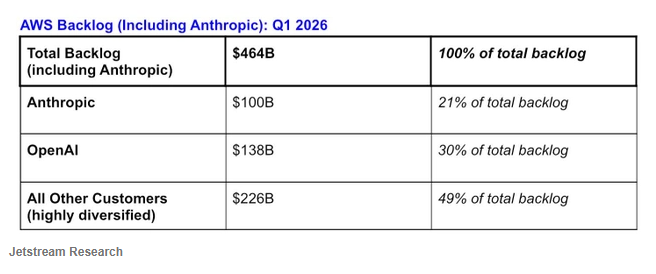
At this point last year, AWS's backlog of orders was $189 billion; if Anthropic and OpenAI are excluded, Jetstream Research estimates that AWS's current backlog of orders may be US$226 billion, an increase of 20% over the previous year. Although this is far from the explosive growth of up to 93% when OpenAI was included, it is still a healthy growth rate for a business of this size. This shows that AWS's highly diverse customer base is continuing to expand spending.
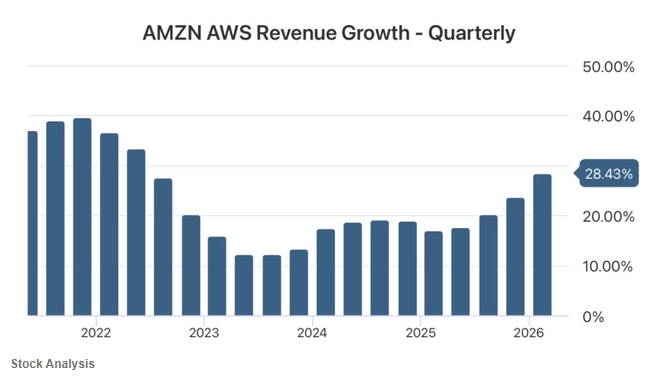
The analyst also assessed this risk by examining AWS's revenue growth over the past year and the previous year (that is, before spending commitments from Anthropic and OpenAI surged). As shown in the chart below, the revenue growth rate of AWS in 2024 and 2025 was close to 20%, while the growth rate accelerated to more than 20% in the past three quarters:
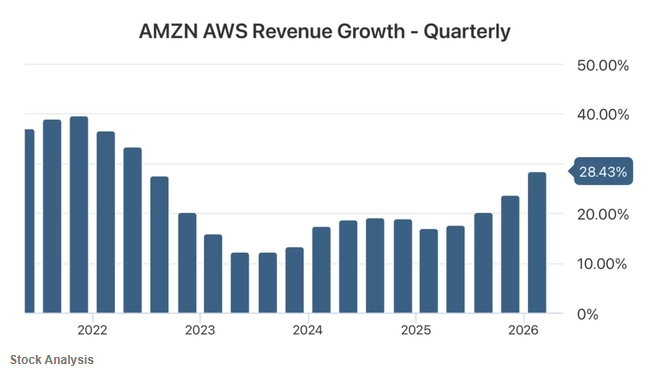
“Although Amazon does not split in detail how much of AWS's current revenue comes from Anthropic and OpenAI and how much of it comes from other customers; however, Jassie has stated that “AWS's AI revenue and operation rate has exceeded $15 billion” — this is roughly equivalent to 10% of AWS's total revenue of 150 billion US dollars, and this 15 billion dollars is probably dominated by Anthropic and OpenAI, so it is reasonable to assume that the two companies together account for about 10% of AWS's total current revenue. As these two companies outpace AWS's diverse customer base in terms of spending growth, this share is expected to gradually rise in the future,” Jetstream Research said.
In the most recent quarter, AWS achieved revenue of $38 billion, an increase of 28% over the previous year. If 10% of the quarter's revenue came from Anthropic and OpenAI, then about $4 billion came from these two companies. From this, it is possible to estimate the growth of AWS after excluding these two companies, as shown below:
First quarter of 2025: $29 billion (up 17% year over year)
Q1 2026 (excluding Anthropic and OpenAI): $34 billion (up 17% year over year)
Q1 2026 (including Anthropic and OpenAI): $38 billion (up 28% year over year)
“As can be seen from this, AWS' revenue growth rate from a highly diversified customer base remained at nearly 20% year over year, while additional revenue from Anthropic and OpenAI further boosted this growth rate to slightly less than 30%. As a result, even as a business of this size, AWS's highly diverse customer base has led to very healthy revenue growth.”
Jetstream Research points out that the key point to consider in the future is that as Anthropic and OpenAI increase their spending, they will account for an increasingly higher share of AWS revenue in the future. These two companies already account for half of AWS's total backlog of orders, so their share of total AWS revenue could easily expand to 30% to 40% or more within the next three to five years.
This has had a profound impact on Amazon's overall business, as nearly 60% of the company's operating profit comes from AWS. If 30% to 40% of this 60% comes from Anthropic and OpenAI alone, these two companies could end up contributing around 20% to 25% of Amazon's total operating profit—which would be a very serious customer concentration risk.
“Of course, there is no guarantee that either of these two companies will actually meet these spending commitments. Both companies currently have negative cash flow: Anthropic expects to be profitable in 2028, while OpenAI doesn't expect to turn a loss into a profit until 2030. If any of them decide to cut spending targets, AWS's revenue growth rate will slow down accordingly,” Jetstream Research said.
Therefore, investors should continue to pay attention to this situation, particularly the size of AWS's backlog orders, the reference to “AWS's AI revenue operation rate” (which can be used as a proxy indicator to observe Anthropic's and OpenAI's contributions), and news about Anthropic and OpenAI's profit status (or loss). If Anthropic and OpenAI account for more than 40% of AWS's total revenue but are still unprofitable, this will be a dangerous sign. At that time, any company's problems will pose a headwind to AWS's revenue growth, which in turn will drag down Amazon's overall operating cash flow growth.