
- PRICING
- LIVE QUOTES
- LEARN
- HELP


EN
As everyone gets involved in the AI theme, smart capital seeks “reverse trading” to hedge against the sell-off storm: the UK stock market is both undervalued and defensive
Global investors have become so optimistic about the outlook for the global economy and the tech stock boom, that they are increasingly avoiding the UK stock market, which is considered too defensive and safe-haven this year. This also makes share buybacks and mergers and acquisitions one of the few favorable factors in the London stock market.
At the same time, although the British stock market, which has been labeled as “reverse trading,” has significantly outperformed the global tech bull market, some fund managers seem expected to bounce back in the next round of market sell-off storms.
The Zhitong Finance App learned that the British stock market has seriously lagged behind similar markets in Europe and the US since this year, and has failed to participate in investors' fervent pursuit of cyclical stocks and technology stocks related to AI computing power. Meanwhile, stocks focusing on the UK domestic market are generally hampered by inadequate reform measures, weak economic growth, and high interest rates. The political turmoil surrounding Prime Minister Kiel Stammer's upcoming departure in the UK has further deterred international buyers.
According to Bank of America's latest global fund manager survey, global investors have reduced the UK stock allocation to a net low of 37%. This is the lowest allocation level since August 2020, when market sentiment was still being severely impacted by the COVID-19 pandemic. As stock bullish prospects in other developed markets and emerging markets such as South Korea and China become increasingly optimistic, the UK has now been included in the “major reverse transactions” mentioned in the Bank of America fund manager survey, and is seen as a potential tool to hedge against the risk of the “AI investment boom peaking.”
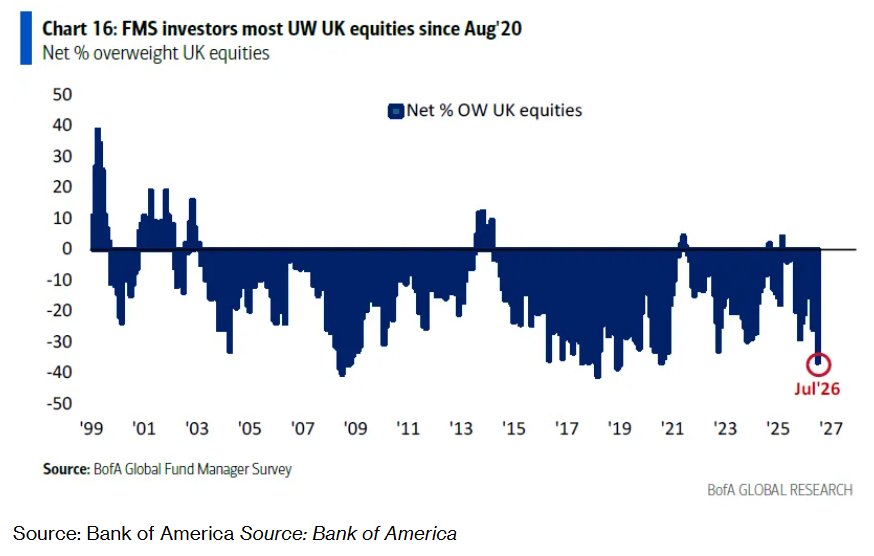
A Bank of America fund manager survey revealed that going long on UK stocks has become a typical reverse trade. Global capital is focusing on assets sensitive to artificial intelligence, technology, and economic growth, while the UK market weighs only about 1.2% of technology, defense sectors such as essential consumer goods and healthcare account for about 34%, and oil and gas stocks account for about 10%. As a result, it continues to lag behind in the optimistic phase of the global economy and leading cyclical stocks.
At the same time, extremely low positions, cheap valuations, corporate repurchases, and cross-border mergers and acquisitions have combined to make British stocks have a reverse value where “the downside has been fully priced and can be revalued with a few catalytic factors.” This is why some fund managers think they must short the UK when the global stock market rises, and buy the UK as a reverse hedging transaction as soon as technology stocks fall.
As global growth accelerates, interest rates stabilize, and technology profits continue to improve, the UK market may continue to outperform the high-beta technology market; when the economic boom peaks, technology valuations shrink, geographical risks drive up oil prices, or investors reprefer dividends, cash flow, and defensive assets, UK large-cap stocks are expected to achieve relatively excess returns through energy, healthcare, essential consumer goods, and undervaluation. Therefore, going long in the UK is more like hedging an insurance position against “overcrowded global technology and cyclical transactions” rather than an unconditionally effective reverse trading formula.
As everyone chases technological prosperity, Britain's defensive assets become an unpopular market
The key problem with the London stock market is that it cannot provide the assets most desired by the current market: AI computing power infrastructure winners, and cyclical stocks that are highly sensitive to economic growth. Technology stocks have the lowest weight in the FTSE 350 index, at only 1.2%, while defensive sectors such as essential consumer goods and healthcare weigh up to 34%. Oil and gas stocks account for 10%, making the benchmark index more susceptible to fluctuations in crude oil prices than similar indices. As market concerns about the war with Iran subsided after the temporary cease-fire between the US and Iran in April, the British stock market's performance lagged behind, but the problems it faced were not only short-term drivers, but also involved structural challenges.
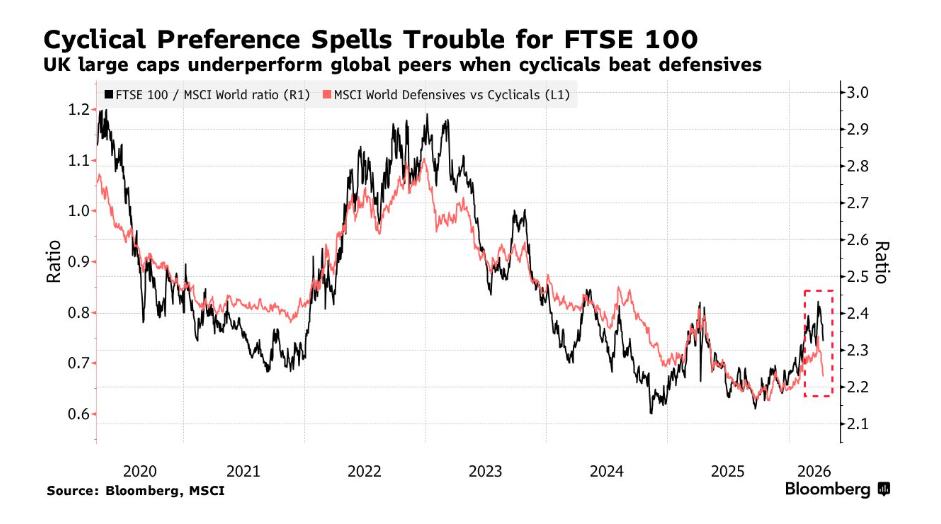
As shown in the chart above, cyclical stocks and technology stock preferences cause trouble for the UK's benchmark stock index, the FTSE 100 Index. When cyclical stocks and technology stocks outperform defensive stocks, UK large-cap stocks outperform similar global markets.
“UK stocks continue to experience net capital outflows from domestic mutual funds,” said Sharon Bell, a senior European market strategist at Goldman Sachs Group, and her team. She pointed out that the domestic mutual fund outflow in the first quarter was close to 20 billion pounds (26.8 billion US dollars). “On an annualized basis, this scale would be much higher than in recent years.”
Bell and his team said retail investors are also showing a similar pattern, adding that unless economic expectations improve, capital inflows to this group are unlikely to increase. Pension funds and insurance companies are still net sellers, selling at roughly the same rate as in recent years, while foreign investors have always been moderate buyers.
This allows companies to only support the market through share buybacks and mergers and acquisitions. According to Goldman Sachs data, the scale of strategic mergers and acquisitions in the UK is higher than in the rest of Europe. The UK is indeed a fertile ground for mergers and acquisitions, and is particularly attractive to private equity bidders and buyers seeking industrial assets. The takeover battle for easyJet, Xavier Neal's offer for Vodafone Group shares held by Emirates Telecom Group, and Prologis' takeover offer for real estate company Segro are all recent examples of attractive valuations of British stocks for foreign buyers.
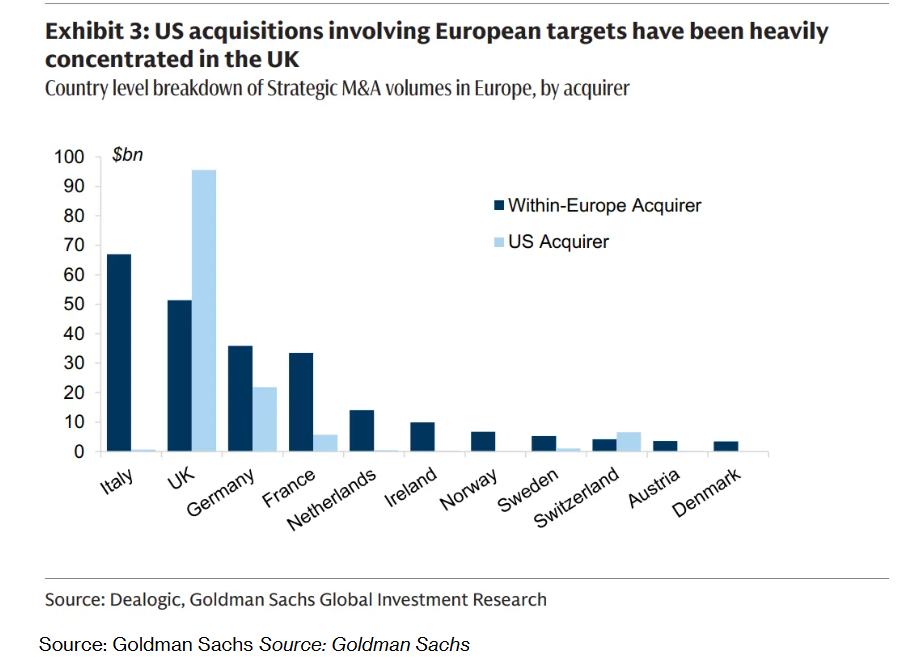
“I think this just reflects a very significant valuation discount effect.” Laura Faure, UK stock market portfolio manager at Junley Henderson Investments, said. She pointed out that the valuation of every industry in the UK is lower than that of its American counterpart. She said that the increase in mergers and acquisitions activity is an important catalyst for the UK stock market, and pointed out that there are currently “a large number of takeover deals.”
After experiencing severe valuation cuts over the past decade, UK stocks are now among the cheapest in developed markets. The FTSE 350 has a valuation discount of nearly 35% compared to the MSCI World Index. Although the UK lacks high-valued growth stocks, and the overall bias is more towards value markets, and its industry structure can explain some of the discounts, even when comparing the same industries horizontally, this valuation gap is still huge.
The real value of the UK stock market may be providing an undervaluation safe haven when global risk appetite reverses
The British stock market continues to lose as global capital is chasing artificial intelligence and cyclical growth due to the low weight of technology and defensive industry structures; however, extreme low prices, deep valuation discounts, and defensive attributes such as energy, medical care, and essential consumer goods make it possible to obtain relatively excessive returns when economic prosperity peaks, technology stock valuations shrink, or geographical risks heat up. Currently, global investor sentiment has risen to an extremely optimistic range, so in the opinion of some fund managers, the British stock market is more suitable for being described as a “reverse safe” to hedge against overcrowded technology trading themes.
In addition to the unexpectedly strong scale of mergers and acquisitions this year, fund manager Faure also emphasized the supporting role of stock repurchases in the market. “The boards of UK companies are increasingly buying back their shares because they are aware of the continued outflow of capital from the market and are therefore creating demand on their own,” she said. “As a result, we are seeing more and more British companies announcing share buybacks, including even relatively small listed companies.”
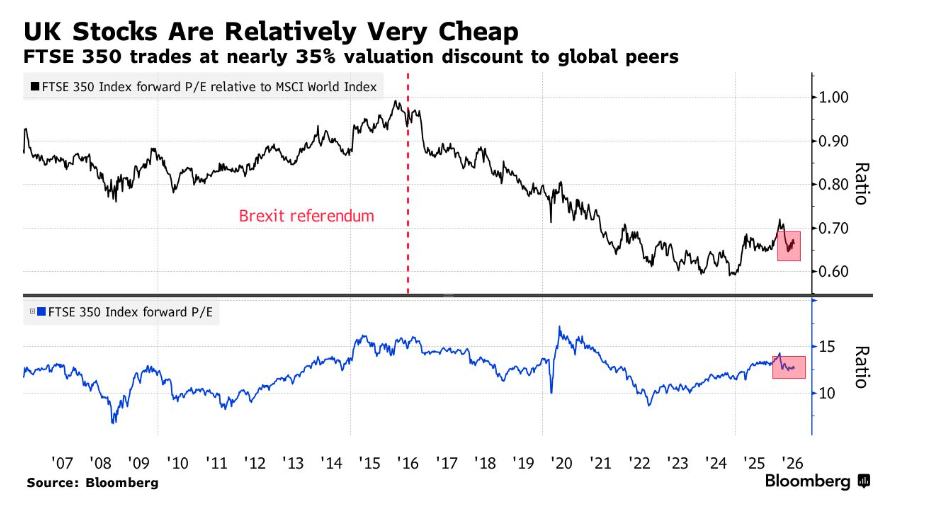
As shown in the chart above, UK stock valuations are relatively much cheaper — the FTSE 350 has a valuation discount of nearly 35% compared to similar global stock markets.
The resurgence of tension in the Middle East may also provide a resuscitating opportunity for British stocks. Oil prices have risen sharply again, and investors and central banks around the world, including the Federal Reserve, may re-evaluate the impact of energy costs on inflation and interest rates. Normally, UK stocks perform better during uncertain times of global economic uncertainty.
Even so, senior Wall Street strategists are increasingly reluctant to recommend UK stocks. The Barclays strategist team favors Eurozone stocks, while J.P. Morgan's peers maintain a neutral stance on the UK, citing a lack of catalysts. Citigroup's Beata Muncie downgraded the UK stock rating by two consecutive levels to “low value” this week.
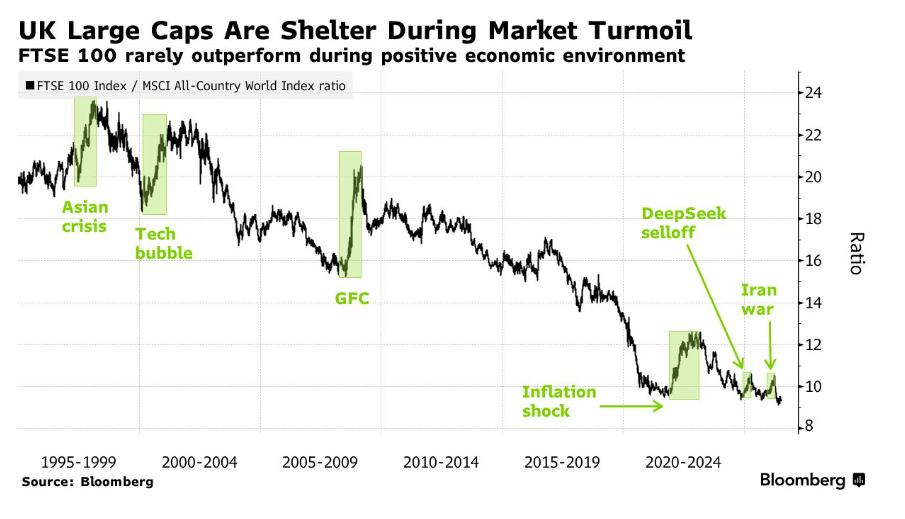
Historical data also shows that large cap stocks in the UK stock market seem to be one of the important safe havens during times of market turbulence. In particular, the FTSE 100 index rarely outperforms the global stock market when the economic environment improves.
“Although valuations are still attractive, in an environment where profit growth and market leadership continues to expand, the UK market's defensive and commodity sector is less attractive,” the senior Citibank strategist said. “We are still more optimistic about cyclical investment opportunities in other markets and the boom in AI infrastructure-related technology investments.”