
- PRICING
- LIVE QUOTES
- LEARN
- HELP


EN
Prediction: This Is What Rivian Stock Will Do if the R2 Is a Smashing Success
Key Points
The recent launch of Rivian Automotive's R2 line of vehicles could represent a turning point for the EV maker.
Forecasts call for a growth resurgence in 2027 and beyond.
while Rivian may finally be having its big moment, factors like share dilution could affect how quickly this translates into higher stock prices.
Currently trading for around $18 per share, Rivian Automotive (NASDAQ: RIVN) has fallen by 82.5% since its 2021 initial public offering (IPO).
Most longtime Rivian investors remain underwater, but new investors could profit following the recent launch of the EV maker's lower-priced R2 line. That said, while the R2 may revive growth, it may not move the needle for the stock.
Missed Nvidia in 2009? This Rare Signal Is Flashing Again. In 2009, a "Double Down" signal flashed for a little-known chipmaker called Nvidia. For the first time in years, that same "Total Conviction" signal is flashing for a company 1/100th the size of Nvidia. Continue »
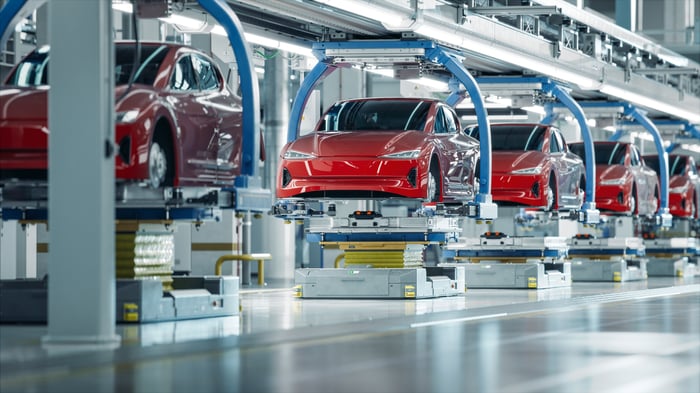
Image source: Getty Images.
How the R2 could get Rivian out of its slump
When Rivian first went public, investors were willing to pay high premiums for would-be "Tesla killers" that could challenge the EV market leader. However, as results clashed with expectations, the prices of Rivian and other electric car stocks cratered.
More recently, however, Rivian has held fairly steady amid the hype surrounding the launch of the R2 vehicle. Priced much lower than Rivian's initial R1S and R1T models, this new line could represent an inflection point. Recent results and outlook updates support this view.
Big potential, but there's a caveat
Last quarter, Rivian reported 12,194 vehicle deliveries, well ahead of prior guidance. A big reason for this was June's launch of the R2 SUV, with a sticker price of $57,990.
In addition, management increased its full-year production guidance, raising the ceiling from 67,000 to 70,000 vehicles. In the years ahead, high growth could persist. Yet while forecasts call for growth to accelerate from 34.2% this year to 61.6% in 2027, they also call for annual losses of $2.61 and $2.28 per share, respectively.
Also, Rivian plans to fund expansion through dilutive share sales, aiming to raise up to $8 billion through 2028. Compared to Rivian's current $25 billion market cap, this level of dilution could really water down gains, even if profitability arrives sooner than expected. Hence, it may be a while before a surge in production growth leads to big gains for Rivian shares.
Thomas Niel has no position in any of the stocks mentioned. The Motley Fool has positions in and recommends Tesla. The Motley Fool has a disclosure policy.