
- PRICING
- LIVE QUOTES
- LEARN
- HELP


EN
It's time to turn cautious! Bank of America's “Bull and Bear Index” soared to 9.4: the most dangerous thing was not the AI bubble, but overcrowded positions
The Zhitong Finance App learned that the latest fund manager survey report released by Wall Street financial giant Bank of America (BofA) shows that global investors who are aggressively buying stocks should actively consider reducing their exposure to risk asset allocation. The core judgment of the Bank of America strategist team is not that the fundamentals of global technology stocks or the AI computing power industry are about to fall into a downward trajectory, but rather that investors' extreme optimism, bullish stock positions and strong profit expectations, and continued valuation expansion have seriously overdrawn fundamental growth prospects for the next 1-2 years or so, causing the marginal risk-return of risk assets to deteriorate significantly. This is reflected in the fact that fund managers' share of cash plummeted from 4.1% to a very low level of 3.6%, and that the Bull and Bear Index reached a pessimistic score of 9.4 out of 10.
The team led by Bank of America strategist Michael Hartnett (Michael Hartnett), who has the title of “Wall Street's Most Promising Strategist,” quoted fund manager surveys and published research reports saying that asset allocators around the world have become extremely bullish, and this is usually a serious sell-off and warning signal from the market; the Bank of America Research Report shows that fund managers' cash allocation level fell to a historically “very low” level of 3.6% last month. At the same time, the survey report also showed that at present, fund managers' stock positions in the US market have risen to the highest level since December 2024, with a net overallocation ratio of 24%.
“Bank of America's bullish indicators have reached an extreme bullish level of 9.4, which means investors should now reduce their exposure to stocks and high-beta risk asset allocations.” A team of strategists led by Michael Hartnett wrote in the report. The Bank of America index ranges from 1 to 10. “Overcrowded and highly leveraged long positions will continue to hinder risk assets such as the stock market from rising further in the summer.”
According to Wall Street giants such as Bank of America and Nomura, and top market research institutes such as SemiAnalysis, this round of global memory chip and even AI computing power infrastructure investment-themed stocks generally plummeted closer to extreme expectations, extremely leveraged positions, and centralized liquidation of overcrowded bullish positions, rather than a sudden collapse in industrial demand. Profit returns after the listing of SK Hynix's American Depositary Receipts, misalignment in valuation between local Korean stocks and American Depositary Receipts, and centralized liquidation of leveraged funds have all amplified price fluctuations.
Although most institutions still don't think that AI is bursting into the bubble, and they don't expect cloud computing vendors to cut capital expenses during the year, in an environment where US stocks are approaching historic highs, profit expectations are extremely high, bullish positions and leverage extremes, and geographical conflicts drive up the risk of oil prices and inflation, the market has moved from “whether fundamentals continue to improve” to “whether the extent of improvement can once again exceed extreme expectations.”
Therefore, the Bank of America strategist team led by Hartnett suggested temporarily adopting a wait-and-see stance to reduce stock and high beta exposure as much as possible. The essence of the latest forecast is also to remind investors that the long-term trend on the topic of AI computing power is still there, but extreme semiconductor congestion, extreme leveraged positions, low cash buffers, medium- to long-term growth prospects of overdraft pricing, and the risk of capital expenditure cooling may suppress the summer market and amplify the valuation pullback caused by any slight shortfall.
Global stock market fervor is approaching the warning line for position reduction. Bank of America suggests cutting stocks and high beta exposure
Fund managers' share of cash plummeted from 4.1% to a very low level of 3.6%. The net overallocation of global stocks rose to 42%, and the net overallocation of US stocks reached 9.4 out of 10, while 82% of respondents regarded going long on semiconductors as the most crowded transaction in the market; at the same time, 48% of investors were concerned that huge AI capital expenses of hyperscale cloud vendors could become the source of the next round of credit incidents.
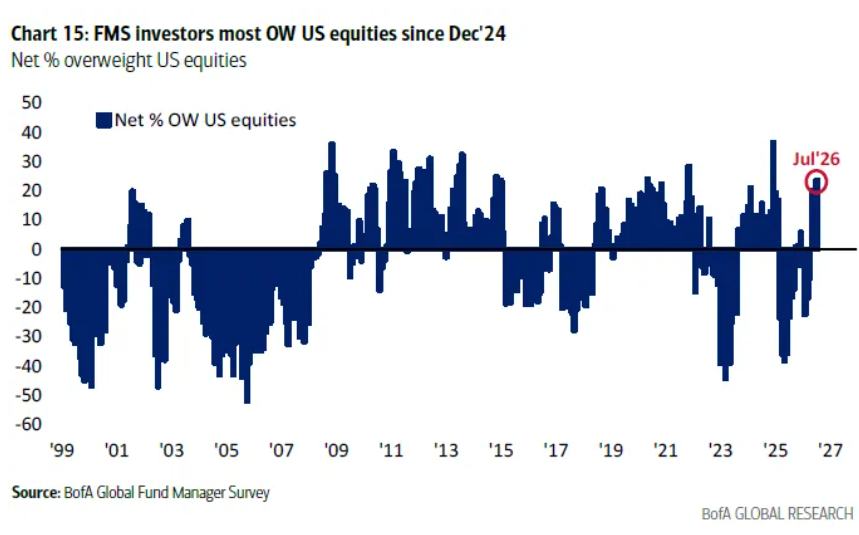
This is why the strategists led by Hartnett suggest investors reduce their exposure to risk asset allocation in this research report, mainly due to extreme optimism, bullish stock positions and strong profit expectations, and the continued pace of valuation expansion, which has seriously overshadowed fundamental growth prospects for the next 1-2 years or so, causing the marginal risk-return of risky assets to deteriorate significantly.
After a sharp rebound from the sharp decline triggered by the Iran war, the US stock market and even most of the world's benchmark stock indexes are currently hovering near their all-time highs, mainly because investors are collectively betting on stocks benefiting from the AI computing power infrastructure frenzy. In particular, AI semiconductor stocks, which are driven by endless demand for AI computing power, will continue to rise strongly.
Meanwhile, the fragile cease-fire situation between the US and Iran and Israel and Lebanon has caused oil prices to continue to fluctuate, while extreme optimism about corporate profits and market concerns about excessive capital spending by large technology companies in the field of artificial intelligence have limited room for growth in the US blue-chip benchmark index, the S&P 500 index, since the beginning of June.
According to the Bank of America survey, up to 82% of institutional investors believe that going long on semiconductor stocks is currently the most crowded transaction in the market. 48% of respondents believe that the risk factor for the huge AI capital expenditure of so-called hyperscale cloud computing vendors is the most likely source of a major credit crash.
However, although investors have cut their long positions in technology stocks since this month, 48% of the fund managers surveyed said that AI stocks are not in the process of the AI bubble or AAAI bubble gradually bursting; 61% of the fund managers surveyed expect that no AI hyperscale cloud computing vendor will announce a reduction in capital expenditure at the AI computing infrastructure level this year.
Bank of America strategists say investors' optimism about the global economy is driving it to further increase its exposure to stocks. 41% of respondents expect the global economy to continue to expand “prosper”, driven by AI, that is, both economic growth and inflation are higher than the long-term trend curve. This ratio is still the highest level in the survey since February 2022.
Overall, the Bank of America survey report shows that global fund managers' share asset allocation increased slightly from 38% of net overallocation last month to net overallocation of 42%. Some institutional investors have begun to increase their exposure through blue-chip stocks such as healthcare, industry, and non-essential consumer goods, which have outperformed technology stocks since this year, with long-term low fluctuations and high quality, and long-term stable cash flow, while reducing their holdings in energy, communications, and essential consumer goods, and technology stocks.
From a regional perspective, institutional investors have clearly increased their allocation to US and Eurozone stock assets, while reducing UK stock assets to the worst low allotment level since August 2020, and reducing their positions in emerging market stock assets. The bond allocation ratio is still low. The net underallocation ratio is about 34%, a slight improvement from last month's net underallocation of 42%.
The survey was conducted from July 2 to July 9, covering 181 senior fund managers interviewed worldwide, with total assets under management of US$484 billion.
From the Bank of America's extreme bullish value of 9.4 to Korea's KOSPI Index being blown up several times, South Korea's leverage has stepped on to unravel the cracks in crowded semiconductor transactions
Michael Burry, who has the title of “Big Short”, has been posting pessimistic remarks about “the end is coming” on his Substack subscription platform, and is shorting popular AI technology stocks at a time when global capital continues to flood into the topic of AI computing power infrastructure.
The latest series of AI-themed high-frequency shorting operations by the world's top investor, famous for successfully and accurately predicting the 2008 US real estate crash and the full outbreak of the subprime mortgage crisis, was interpreted by the market as his bearish stance on extremely crowded storage chip themes driven by the AI infrastructure frenzy, semiconductor manufacturing equipment, and popular AI chip-related stocks such as AI GPU/AI ASIC, as well as systemic doubts about the return on investment expectations of increasingly huge AI computing power infrastructure capital expenses and the basic situation in high-valuation technology stocks. He also previously disclosed his put options positions on Nvidia and Palantir through 13F. As the Korean stock market plummeted again to collapse on Monday and popular technology stocks related to AI computing power in the global stock market fell into sharp fluctuations, some investors began to agree with the argument that the AI bubble was about to burst and joined Burry's shorting camp on the AI theme.
Bank of America strategists led by Hartnett are not as pessimistic as “big bears” on the topic of AI computing power and the bullish trajectory of global stock markets, but they are also advising investors to consider curbing the pace of aggressive buying.
What is most alarming right now is not the sudden collapse of AI demand, but the stock market's near-perfect pricing for growth, and the bond market's increasingly cautious pricing of financing scales and payback cycles has begun to split. According to the Bank of America survey, fund managers' cash positions have dropped from 4.1% to 3.6%, and the bullbear indicator has risen to an extremely bullish range of 9.4; 82% of respondents believe that going long on global semiconductors is the most crowded transaction, and 48% believe that huge AI capital expenses from hyperscale cloud computing vendors are most likely to trigger the next round of credit events, but 61% still don't expect cloud vendors to cut capital expenses during the year. This combination means that the market is not bearish on the AI computing power industry chain, but rather that stock positions, profit expectations, and risk appetite are close to the limit. Any “good performance but not impressive enough” results may trigger valuation compression.
The bond market warning has substantial macro implications. Credit spreads on the hyperscale technology corporate bond basket tracked by Goldman Sachs Trading Desk are said to have widened by 22 basis points in a week, while the stock index and volatility market remained unusually calm; at the same time, the capital expenditure of hyperscale cloud vendors in 2026 is estimated to be close to US$725 billion, and the expenditure growth rate is faster than operating cash flow. Morgan Stanley expects that global AI-related debt issuance may increase to about US$570 billion.
The construction of AI training clusters and sky-level reasoning infrastructure, data centers, power systems, and high-performance network clusters is evolving from technology giants' internal cash flow projects to macro-variables affecting global investment-grade bond supply and capital costs; if credit spreads continue to expand, it is not necessarily AI application demand that is being suppressed first, but rather project discount rates, external financing capabilities, and capital expenditure payback periods, which in turn forces the market from “who invests the most” to “who can turn computing power into revenue and free cash flow the fastest”.
The Korean stock market, on the other hand, has become a high-velocity stress test for this set of risk transmission mechanisms. Together, Samsung Electronics and SK Hynix account for more than half of KOSPI's weight. The index retracted by about 25% from its June high, but it still rose about 60% during the year; SK Hynix fell more than 15% in a single day, and related double leveraged ETFs fell by more than 30%, and pushed KOSPI down about 9% in a single day. These all highlight extreme single-share leveraged products, guaranteed financing, programmatic rebalancing, and high index concentration, which have indeed amplified the correction of normal profit expectations into a violation of liquidity.
However, it is also too optimistic to attribute the total decline to a “pure technical sell-off,” as the market is also re-evaluating the decline in HBM4 shipments, the flexibility of price increases limited by long-term contracts, and whether historical profits can continue to exceed expectations. The silence of long funds is not automatically equivalent to confirmation at the bottom; it may also mean that institutions are still waiting for leverage to be cleared and valuations to re-establish a margin of safety. Therefore, Bank of America strategist Hartnett's latest investment strategy opinion should not be understood as abandoning the main line of AI computing power infrastructure, but should temporarily shift from AI-themed betting driven by high beta, congestion, and leverage to non-tech stock asset allocation driven by stable cash flow, long-term high-quality order support, and strong balance sheets.
Wall Street financial giant Jefferies (Jefferies) advises investors to hold high-quality, high-cash flow stocks with low profit settlement pressure and low congestion in order to survive the likely summer tech stock pullback, mainly because of the AI semiconductor congestion transaction clearance and deleveraging crisis associated with the AI investment boom and growing concerns about AI revenue generation paths. As the AI semiconductor theme fell back due to position congestion and high leverage, capital began to shift from overcrowded AI computing power beta to cash flow defense, and the main line of Wall Street strategy also spread from AI computing power infrastructure to a wider range of high-quality fundamental assets that significantly outperformed technology.