
- PRICING
- LIVE QUOTES
- LEARN
- HELP


EN
The chief economist of the Federal Reserve of New Zealand warns that inflation is more stubborn, and there is still a risk of further interest rate hikes in the future
The Zhitong Finance App learned that New Zealand Federal Reserve Chief Economist Paul Conway said on Tuesday that inflation in New Zealand may not fall as fast as predicted by the central bank, which means that interest rates may rise further in the future.
The New Zealand Federal Reserve lowered its third-quarter inflation forecast from 4.3% to 3.3% last week, mainly reflecting the impact of falling fuel prices after the US and Iran reached an interim agreement. However, with the recent outbreak of another conflict in the Middle East region, oil prices have rebounded again.
Speaking in Wellington, Conway said, “I think the development of the situation in the Middle East over the past week means that our inflation forecast for the third quarter is at an upward risk. If inflationary pressure from the Middle East conflict lasts longer than expected, we will respond.”
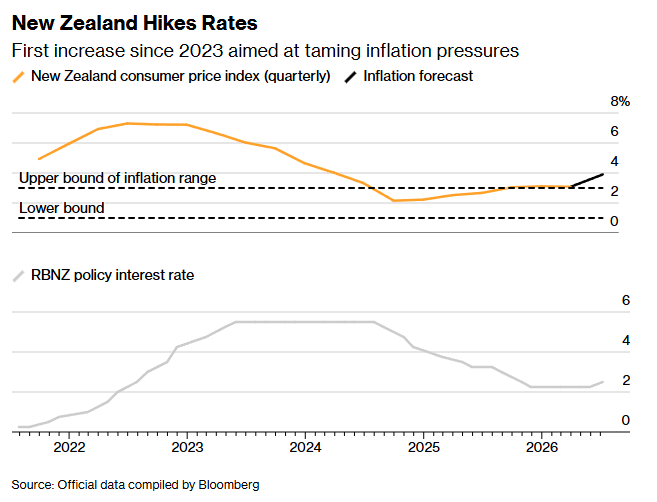
The New Zealand Federal Reserve raised the official cash rate (OCR) by 25 basis points to 2.5% last week. This is the first rate hike in three years. The central bank said the move was aimed at gradually withdrawing stimulus to the economy and ensuring that inflation returns to near the midpoint of the 1% to 3% target range next year.
Policymakers are concerned that medium term inflation may solidify, so they hope to gradually adjust the OCR to a neutral level. They also expect the New Zealand economy to recover in the second half of 2026, which may further increase price pressure.
Due to hawkish signals from the New Zealand Federal Reserve and a series of positive economic data, traders are betting that interest rates will be raised twice this year and push the New Zealand dollar higher. Currently, investors expect OCR to rise to 3% in December this year. At the same time, the market also anticipates that interest rates may be raised again in the first quarter of 2027.
Conway said, “Short-term inflationary pressure appears to have abated, at least for now. This is certainly a welcome development.” “But the Middle East conflict still has another major inflationary impact on the global economy and the New Zealand economy.”
The New Zealand Federal Reserve believes that the current economy still has sufficient idle production capacity, which will make it more difficult for companies to fully pass on the cost increase to consumers. Conway added, “Idle production capacity is also expected to inhibit companies' pricing decisions, making price setting behavior more in line with a low and stable inflation environment over time. At the same time, less stimulating monetary policies will also reduce medium-term inflationary pressure.”
However, according to a survey released by the New Zealand Institute of Economic Research (NZIER) on Tuesday, companies still seem interested in continuing to raise prices. According to the “Quarterly Business Opinion Survey”, in the three months ending June, 54% of companies indicated that costs had risen, and 54% of companies expected costs to continue to increase in the third quarter. The survey also showed that 41% of companies raised product prices in the second quarter, while 54% of companies expect to continue to increase prices in the current quarter. The survey covered more than 800 businesses.
Christina Leung, Deputy CEO of NZIER, said: “We are really seeing rising costs and pricing metrics. This shows that inflationary pressure in the New Zealand economy is increasing.”
Conway said that although oil prices have declined somewhat, the impact of the current oil price shock will continue to spread to the entire economy for some time to come. “When companies can more easily pass on rising costs, inflation will become more sustainable,” he said. “And the longer inflation lasts, the more effort must be made by monetary policy to bring inflation back to the target level.”