
- PRICING
- LIVE QUOTES
- LEARN
- HELP


EN
The Vanguard ETF Warren Buffett Endorsed in 2014 Would Have Turned $5,000 Into $20,465 Today
Key Points
Patience has paid off for investors who don't feel compelled to take constant action every time the market ebbs and flows.
Too much timing-minded trading activity, in fact, can be detrimental to a portfolio's performance.
Temperament and humility are far more important to an investor than information or experience.
You may know him as Berkshire Hathaway's (NYSE: BRKA) (NYSE: BRKB) long-tenured, brilliant stock picker, as evidenced by Berkshire's market-beating returns.
Warren Buffett isn't necessarily a big fan of picking individual stocks, though, discouraging most ordinary investors not to whenever they have the option. His advice? Buy index funds meant to mirror the performance of the S&P 500 (SNPINDEX: ^GSPC); he prefers the Vanguard S&P 500 ETF (NYSEMKT: VOO).
Missed Nvidia in 2009? This Rare Signal Is Flashing Again. In 2009, a "Double Down" signal flashed for a little-known chipmaker called Nvidia. For the first time in years, that same "Total Conviction" signal is flashing for a company 1/100th the size of Nvidia. Continue »
The thing is, his simple solution has proven to be brilliant since he first made his feelings on the matter clear.
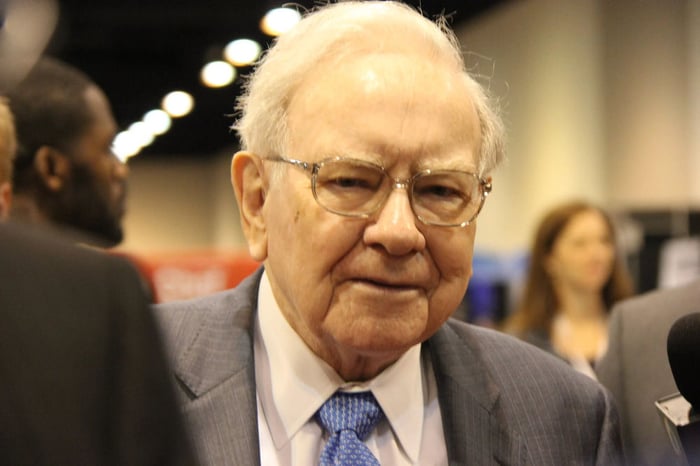
Image source: Getty Images.
Simpler is better
Buffett's always leaned in this general direction. He put his commitment to the premise in writing back on March 1, 2014, however, penning in Berkshire's 2013 shareholder letter:
My advice to [my estate's] trustee could not be more simple: Put 10% of the cash in short-term government bonds and 90% in a very low-cost S&P 500 index fund. (I suggest Vanguard's.) I believe the trust's long-term results from this policy will be superior to those attained by most investors -- whether pension funds, institutions or individuals -- who employ high-fee managers.
And he was right. Over the past 10 years, data from Standard & Poor's suggests that over 85% of large-cap mutual funds available to U.S. investors have underperformed the S&P 500. For the last 15 years, nearly 90% of these funds have lagged the benchmark index. The numbers don't get any better with other timeframes either. Beating the market is just hard to do, which is why even most professionals don't do it.
Perhaps more important to investors, you would have done very well by simply taking Buffett's advice, regardless of how the fund fared against others. A $5,000 investment made in the Vanguard S&P 500 ETF on the first trading day after Buffett's letter was released would be worth a whopping $20,465 today. And that's without factoring in dividends. Adding reinvested dividends to the mix pumps this number up to $25,270.
You could have certainly done worse. And most people did.
Avoiding ego traps is the strategy
Sure, it's boring. Picking individual stocks, conversely, is exciting, specifically because it gives you a chance of beating the market.
If you want to play the statistical odds, though -- minimizing your risk while realistically maximizing your reward -- something else Warren Buffett explains in the very same shareholder letter hits home. That is, "the unsophisticated investor who is realistic about his shortcomings is likely to obtain better long-term results than the knowledgeable professional who is blind to even a single weakness." That's what Standard & Poor's surprising fund performance numbers are actually showing us.
The trick? You just need to be strong enough to admit to yourself that you may be unable to navigate the market's ebbs and flows as easily as it seems it should be. In Buffett's own words, the average investor is far too likely to "enter the market at a time of extreme exuberance and then become disillusioned when paper losses occur," ultimately leading to decisions that make matters worse rather than better. Holding a long-term stake in Vanguard's simple index fund sidesteps this risk altogether.
Of course, the SPDR S&P 500 ETF Trust (NYSEMKT: SPY) is a perfectly fine alternative to Vanguard's S&P 500 ETF.
James Brumley has no position in any of the stocks mentioned. The Motley Fool has positions in and recommends Berkshire Hathaway and Vanguard S&P 500 ETF. The Motley Fool has a disclosure policy.