
- PRICING
- LIVE QUOTES
- LEARN
- HELP


EN
Microsoft (MSFT) Stock May Be A Bargain On Cash Flow And Earnings
Microsoft stock has fallen 22.9% over the past year but is still up 42.9% over five years, and current valuation checks suggest the market price may be lagging the company’s intrinsic value estimate based on a Discounted Cash Flow (DCF) approach and traditional earnings multiples.
- A 42.9% gain over five years points to solid long term shareholder returns, even after the more recent pullback.
- Heavy AI investment, from new offerings like Microsoft Frontier Company to in house AI chips, can support long term cash flow. However, rising capital needs and regulatory scrutiny on cloud and AI remain key risks for how that cash flow is ultimately valued.
- With a high valuation score indicating Microsoft screens as undervalued in 6 of 6 checks, both the Discounted Cash Flow (DCF) intrinsic value estimate and earnings multiples currently point to an undervalued stock.
The issue now is whether Microsoft’s current share price properly reflects that intrinsic value signal, or if the discount is a sign that the market is pricing in lasting pressure on AI returns and capital intensity.
Find out why Microsoft's -22.9% return over the last year is lagging behind its peers.
Is Microsoft a Bargain on Cash Flow?
The Discounted Cash Flow (DCF) approach here values Microsoft by projecting its future free cash flows and discounting them back to today. On this model, Microsoft generated about $93.7b in free cash flow over the latest twelve months, and the forecast assumes cash flow continues growing rather than shrinking from that base.
Those projections, run through a 2 Stage Free Cash Flow to Equity framework, produce an estimated intrinsic value of about $562 per share. That implies the current share price sits roughly 31.5% below this DCF estimate, which is a sizable gap for a company with Microsoft’s scale and established cash generation. Heavy AI and data center investment, including the new Microsoft Frontier Company, helps explain why the market is cautious on near term cash returns, even while the model supports a higher long term valuation.
On balance, the DCF work suggests Microsoft stock currently screens as undervalued relative to the cash flows being modeled.
Our Discounted Cash Flow (DCF) analysis suggests Microsoft is undervalued by 31.5%. Track this in your watchlist or portfolio, or discover 44 more high quality undervalued stocks.
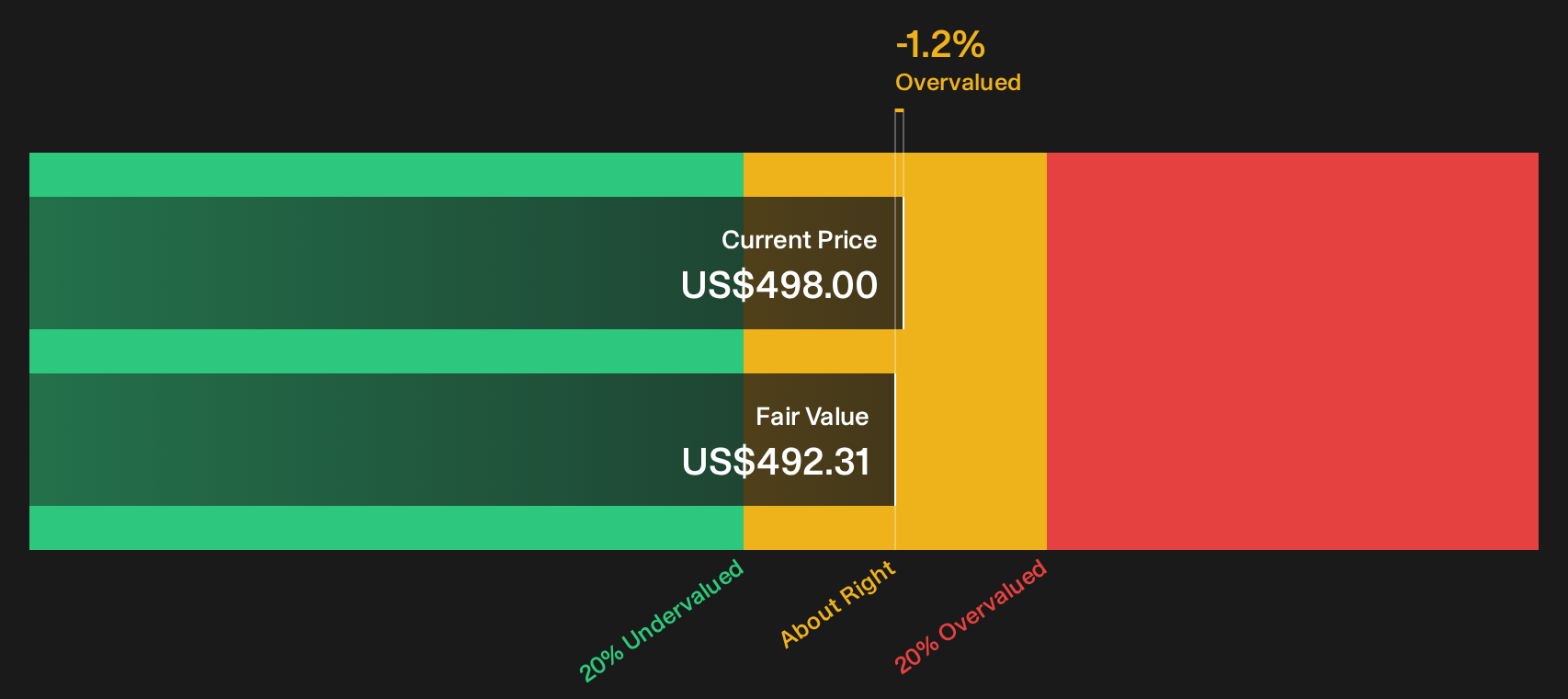
Does Microsoft Look Undervalued on Earnings?
The P/E ratio fits Microsoft well because earnings remain a core anchor for how investors value its mix of software, cloud and AI businesses. On current figures, Microsoft trades on a P/E of about 22.8x, below both the software industry average of roughly 29.1x and the peer group average of about 28.2x.
A fair P/E for Microsoft, based on its margins, scale, risk profile and sector, is estimated at 42.5x, which is well above where the stock currently trades. That gap suggests the market is assigning a discount despite Microsoft’s broad earnings base across Office, Azure, security and newer AI services, and despite the heavy AI and data center spending that is already visible in current results.
Taken together, the P/E analysis indicates Microsoft stock appears undervalued relative to the earnings multiple it might command given its profile.

See what the numbers say about this price — find out in our valuation breakdown.
The Microsoft Narrative: What Would Justify Today's Price?
Simply Wall St Narratives take the valuation puzzle around Microsoft and turn it into specific, testable stories about what would need to happen with the company’s growth, margins and earnings for the stock to be worth materially more or less than today’s price, and they sit on the Community page. Instead of leaving you with a single output from a ratio or model, they unpack the future it relies on so you can see, over time, whether that path is actually playing out.
The community is split on Microsoft, with one camp arguing the stock is on clearance and the other saying the price already reflects most of the value.
Bull case: 17% undervalued
"A business that generates $71.6 billion in free cash flow, maintains a 45.6% operating margin, earns roughly 28 cents of profit on every dollar of invested capital, and holds a net cash position of $49 billion is not a business in crisis…"
Read the full Bull Case to see why Microsoft could be undervalued
Bear case: 7% overvalued
"Calendar 2026 capex is projected at ~$190B (+61% YoY), with ~$25B driven by component cost inflation and roughly two thirds allocated to short lived compute assets…"
Read the full Bear Case to see why Microsoft could be overvalued
Do you think there's more to the story for Microsoft? Head over to our Community to see what others are saying!
The Bottom Line
For Microsoft, both the Discounted Cash Flow (DCF) intrinsic value estimate and the current P/E comparison point to an undervalued stock, rather than a mixed signal that is easy to dismiss. The central question is whether heavy AI and data center spending ultimately supports the cash flows that the intrinsic value model is already assuming, and whether the market is willing to re-rate the earnings multiple if that happens. From here, the key debate is whether current AI-driven capital intensity becomes a springboard for future returns on capital or a drag that keeps the valuation discount in place.
This article by Simply Wall St is general in nature. We provide commentary based on historical data and analyst forecasts only using an unbiased methodology and our articles are not intended to be financial advice. It does not constitute a recommendation to buy or sell any stock, and does not take account of your objectives, or your financial situation. We aim to bring you long-term focused analysis driven by fundamental data. Note that our analysis may not factor in the latest price-sensitive company announcements or qualitative material. Simply Wall St has no position in any stocks mentioned.
Have feedback on this article? Concerned about the content? Get in touch with us directly. Alternatively, email editorial-team@simplywallst.com