
- PRICING
- LIVE QUOTES
- LEARN
- HELP


EN
Coca Cola (KO) Stock May Be Fully Priced On Its 72% Run
Coca-Cola stock has delivered a 71.9% return over the past 5 years, yet investors now face mixed valuation signals as an intrinsic value estimate suggests some upside while earnings multiples point to a richer price tag.
- A 71.9% 5 year return puts Coca-Cola firmly in the camp of stocks where you need to ask whether the current price already reflects much of the story.
- Planned moves like the proposed Hindustan Coca-Cola Beverages IPO in India may support long term cash flow expectations, while questions about margin durability and pricing power could weigh on how much investors are willing to pay for those earnings.
- Coca-Cola screens as undervalued by about 11.2% on a Discounted Cash Flow (DCF) intrinsic value estimate, but trades on a richer P/E multiple and scores just 2 out of 6 checks. Taken together, the broader picture leans expensive rather than like a clear bargain.
For investors, the debate is whether Coca-Cola's premium market multiple or its intrinsic value estimate is giving the more reliable signal at today's price.
Is Coca-Cola Still Cheap on Cash Flow?
The Discounted Cash Flow (DCF) model values Coca-Cola by projecting the cash the company could return to shareholders and discounting it back to today. On this view, Coca-Cola is treated as a mature business with growing but steady free cash flow rather than a high growth story.
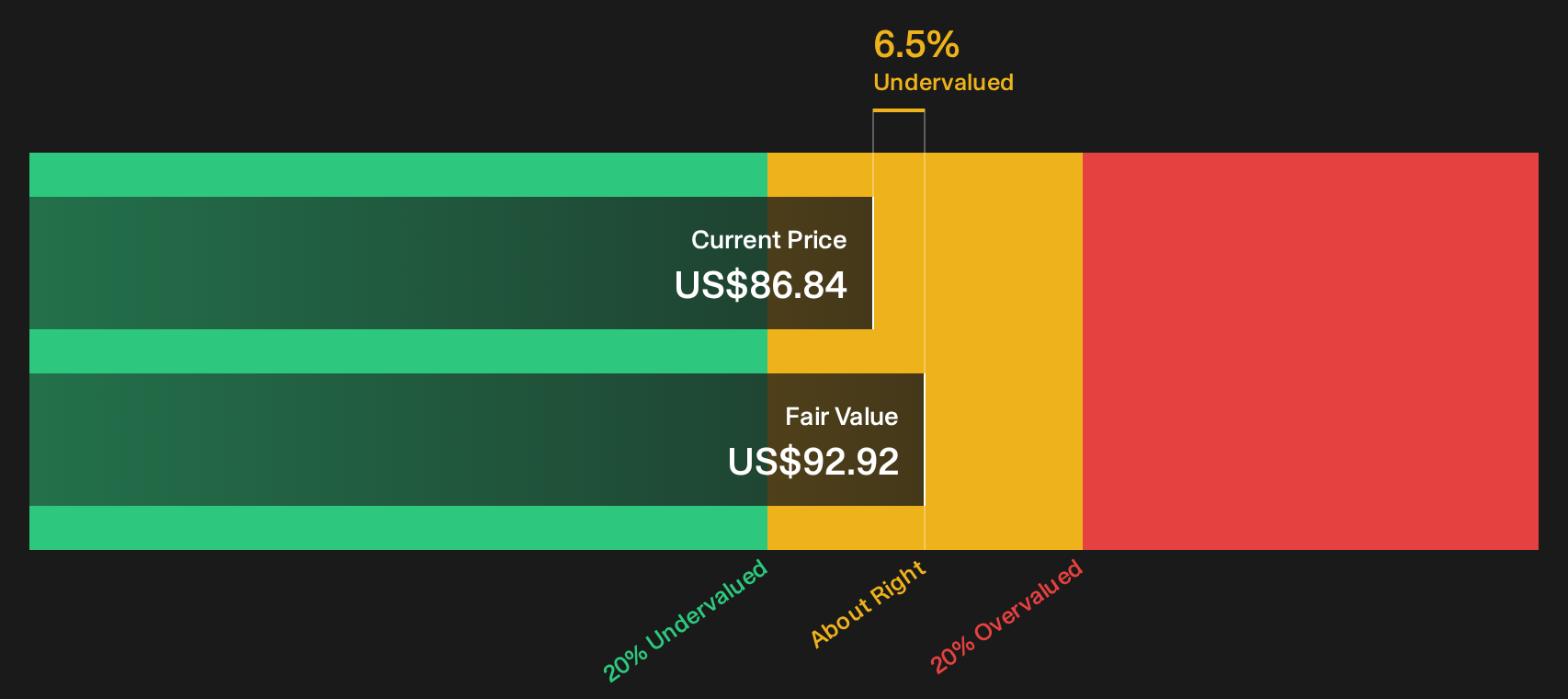
The model uses latest twelve month free cash flow of about $12.5b and assumes that cash generation continues to grow, settling into a slower second stage over time. That stream of cash flows translates into an estimated intrinsic value of about $93.94 per share. On this basis, the stock screens as roughly 11.2% undervalued versus the current market price. The planned Hindustan Coca-Cola Beverages IPO in India fits this picture, because it is another example of the company using an asset light structure to support that cash flow profile without changing the underlying DCF outcome.
On this cash flow view, Coca-Cola stock currently appears undervalued relative to what its projected future cash generation supports.
Our Discounted Cash Flow (DCF) analysis suggests Coca-Cola is undervalued by 11.2%. Track this in your watchlist or portfolio, or discover 44 more high quality undervalued stocks.
Does Coca-Cola Look Pricey on Earnings?
P/E is a useful way to look at Coca-Cola because earnings are the core driver of how most investors value this kind of mature consumer brand. At around 26.2x earnings, Coca-Cola trades very close to a peer group average of about 27.0x, but well above the broader beverage industry average of 16.9x.
The fair P/E ratio estimate for Coca-Cola, which adjusts for its size, margins and risk profile, sits lower at about 22.5x. That is a clear gap to the current multiple, suggesting the stock carries a premium to what this model implies is justified by its fundamentals, even after considering the steady profile that many investors like. Put simply, the P/E view is less generous than the DCF output and indicates that Coca-Cola stock is priced on the high side relative to its current earnings power.
On the P/E approach, Coca-Cola appears overvalued, with the market asking investors to pay more for each dollar of earnings than this framework suggests is reasonable.

See what the numbers say about this price — find out in our valuation breakdown.
The Coca-Cola Narrative: What Would Justify Today's Price?
Simply Wall St Narratives build on Coca-Cola's mixed DCF and P/E signals by outlining which combinations of future growth, margins and earnings would need to occur for the stock to be worth materially more or less than its current market price. Each Narrative presents Coca-Cola's fair value as a specific, testable view of the business that you can monitor over time on Simply Wall St's Community page.
Community views on Coca-Cola sit far apart, with some investors seeing steady cash flows as support for the current price while others lean toward caution.
Bull case: roughly fairly valued
"Coca-Cola's ongoing investments in sustainable packaging, water stewardship, and digital innovation (e.g., connected packaging, refillables, AI-powered pricing tools) are anticipated to enhance brand equity, consumer loyalty, and regulatory resilience..."
Read the full Bull Case to see why Coca-Cola could be undervalued
Bear case: 24% overvalued
"KO currently trades at a 23.47x P/E vs. a forward P/E of 21.84x and an industry average of 17.63x..."
Read the full Bear Case to see why Coca-Cola could be overvalued
Do you think there's more to the story for Coca-Cola? Head over to our Community to see what others are saying!
The Bottom Line
Coca-Cola sits in a tension between an intrinsic value estimate that points to undervalued cash flows and a market-multiple view that flags an overvalued P/E. The Discounted Cash Flow (DCF) framework leans on the durability and timing of future cash generation, while the richer multiple reflects what investors are currently willing to pay for Coca-Cola's earnings versus peers. Broader valuation checks are weak, so that DCF signal needs to be treated with caution rather than as a simple green light. The crux from here is whether Coca-Cola can sustain margins and pricing power strongly enough to keep justifying that premium earnings multiple.
This article by Simply Wall St is general in nature. We provide commentary based on historical data and analyst forecasts only using an unbiased methodology and our articles are not intended to be financial advice. It does not constitute a recommendation to buy or sell any stock, and does not take account of your objectives, or your financial situation. We aim to bring you long-term focused analysis driven by fundamental data. Note that our analysis may not factor in the latest price-sensitive company announcements or qualitative material. Simply Wall St has no position in any stocks mentioned.
Have feedback on this article? Concerned about the content? Get in touch with us directly. Alternatively, email editorial-team@simplywallst.com