
- PRICING
- LIVE QUOTES
- LEARN
- HELP


EN
Warby Parker Stock And 2 Consumer Discretionary Names Investors Are Reassessing
U.S. consumer discretionary stocks are sitting at an interesting crossroads, with oil prices easing after improved shipping conditions in the Middle East, while core inflation and the possibility of a future Fed rate hike keep pressure in the background. For investors trying to make sense of retail, leisure, and dining stocks tied to U.S. consumer spending, this mix of cheaper energy, steady but elevated inflation, and more confident households presents both potential openings and clear risks. This article reviews three stocks from our U.S. Domestic Consumer Discretionary Stocks screener that appear most exposed to these current news-driven shifts.
Warby Parker (WRBY)
Overview: Warby Parker is a U.S. and Canada based eyewear company that sells prescription glasses, sunglasses, contact lenses, and related accessories through a mix of physical stores, its website, and mobile apps. It also offers eye exams and vision tests. It targets everyday vision needs as well as premium options such as progressives, light responsive lenses, and blue light filtering products.
Operations: Warby Parker generates about US$890.6 million in revenue from its Holistic Vision Care segment, all of which currently comes from customers in the United States.
Market Cap: US$3.6b
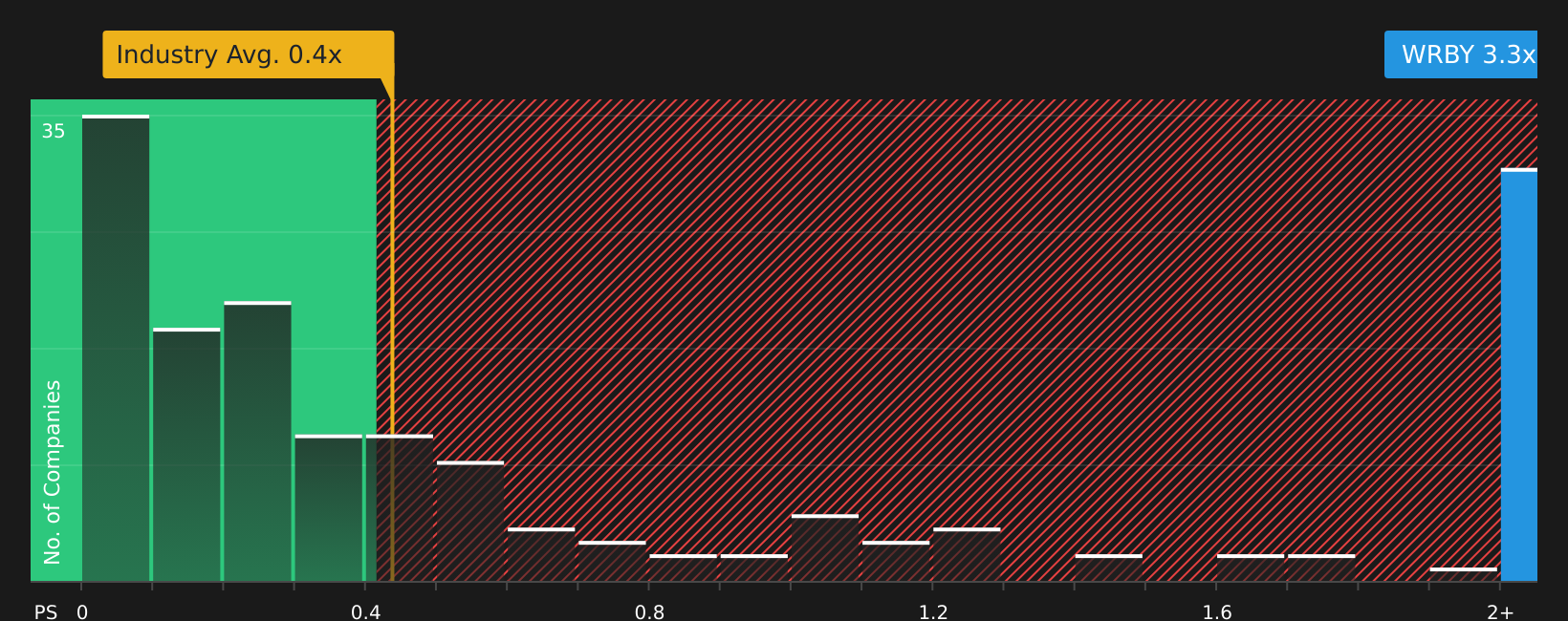
Warby Parker stands out in U.S. consumer discretionary stocks because it blends a recognizable retail brand with a recurring health linked need and is now pushing into higher value areas such as eye care services and AI powered eyewear through its Google partnership. The company is already profitable, and recent index additions have raised its profile, but the stock trades on a rich P/S multiple and carries a low ROE, with critics pointing to capital intensity and efficiency concerns. With plans for more store openings, new product lines such as Warby Parker Sport, and meaningful investment in AI eyewear, investors watching U.S. consumer spending trends may want to look more closely at the balance between that growth story and the execution and valuation risks.
Warby Parker’s push into AI powered eyewear and higher value eye care services could be masking a far more interesting tension between its rich P/S ratio and low ROE, and the 2 key rewards and 1 important warning sign might be where that trade off really comes into focus
Brunswick (BC)
Overview: Brunswick is a recreation company focused on boating, producing outboard and inboard engines, marine electronics, and a wide range of fiberglass and aluminum boats, while also running services like Freedom Boat Club that let customers access boats without owning them. Its brands, including Mercury, Boston Whaler, Sea Ray, and Navico Group electronics, position Brunswick across both high end and more accessible leisure segments in the U.S. and overseas.
Operations: Brunswick generates most of its roughly US$5.5b in revenue from Propulsion (US$2.3b), Boat (US$1.5b), and Engine Parts & Accessories (US$1.3b), with additional sales from Navico Group (US$815.7m) and consolidating segment eliminations.
Market Cap: US$5.2b
Brunswick sits at the intersection of U.S. leisure spending and boating technology, which is why factors such as fuel costs and consumer confidence could matter so much here. The company combines a large U.S. revenue base with higher margin, recurring services such as digital boating tools and Freedom Boat Club. At the same time, it carries meaningful debt and is currently reporting losses and a negative ROE. Some analysts note that earnings are forecast to improve and that the stock trades below certain estimates of fair value, and recent cost reduction moves in Navico Group and facility optimization are aimed at supporting margins. For investors weighing those potential tailwinds against pressure in value boat segments and dividend coverage concerns, a key consideration is how durable Brunswick’s earnings recovery could be if consumer demand for leisure remains resilient.
Brunswick’s earnings story looks like it could be quietly turning a corner. However, the real tension between services, debt, and margin repair is still underappreciated, and the 3 key rewards and 3 important warning signs may reveal what the headline numbers are not saying.

MasterCraft Boat Holdings (MCFT)
Overview: MasterCraft Boat Holdings designs and builds premium recreational powerboats, from high end ski and wake boats to pontoon models, selling them under the MasterCraft, Crest, and Balise brands through independent dealers in the U.S. and overseas.
Operations: MasterCraft Boat Holdings generates about US$252.6 million in revenue from its Mastercraft segment and US$45.9 million from its Pontoon segment.
Market Cap: US$588.8 million
MasterCraft Boat Holdings provides direct exposure to U.S. leisure spending through premium tow boats and pontoons at a time when lower fuel costs and steadier consumer confidence could coax buyers back into big ticket discretionary purchases. The company combines a long operating history with a dealer network that management says is healthier after inventory cleanup. Analysts are currently expecting both earnings and revenue to grow faster than the broader U.S. market. However, the stock also carries a rich P/E multiple, has relied on external borrowing, and recently swung from quarterly profit to a small loss, so the margin story and governance changes matter. The key consideration for investors is whether that mix of growth expectations and balance sheet strength justifies the current valuation.
MasterCraft Boat Holdings looks like a growth story that hinges on whether expectations and the balance sheet truly line up, and the analyst forecasts for MasterCraft Boat Holdings could highlight the one risk that changes the whole picture.

The three stocks covered here are only a starting point, and the full U.S. Domestic Consumer Discretionary Stocks screener has 16 more companies with equally compelling narratives that you have not seen yet in this article, all captured in the U.S. Domestic Consumer Discretionary Stocks screener.
Take Control of Your Investment Journey
If Warby Parker or any of these companies sound like a great opportunity, register for FREE with Simply Wall St and add your companies to a Watchlist to monitor the share price against the fair value the ideal entry point. Once you've made your move, manage your holdings with our Portfolio Command Center that filters out the noise to deliver only the most critical, actionable updates. Throughout your journey, our Community allows you to filter the best ideas from thousands of investor perspectives. By uncovering hidden catalysts and risks early, you'll accelerate your decision-making and stay one step ahead of the market.
Seeking Fresh Alternatives Beyond Today?
Some of the sharpest breakouts and quietest drops start before the crowd even looks. Track fresh ideas while they are still under the radar for now, act now.
- Spot companies quietly building momentum before headlines catch up by scanning the 18 high quality undiscovered gems, which filters for strong fundamentals and healthier balance sheets.
- Target resilience when markets turn choppy by checking the 74 resilient stocks with low risk scores, designed to surface businesses with lower risk scores and sturdier financial profiles.
- Focus on structural themes instead of short term noise by reviewing the 36 power grid technology and infrastructure stocks, which highlights companies tied to critical grid technology and infrastructure upgrades.
This article by Simply Wall St is general in nature. We provide commentary based on historical data and analyst forecasts only using an unbiased methodology and our articles are not intended to be financial advice. It does not constitute a recommendation to buy or sell any stock, and does not take account of your objectives, or your financial situation. We aim to bring you long-term focused analysis driven by fundamental data. Note that our analysis may not factor in the latest price-sensitive company announcements or qualitative material. Simply Wall St has no position in any stocks mentioned.
Have feedback on this article? Concerned about the content? Get in touch with us directly. Alternatively, email editorial-team@simplywallst.com