' fill='white'%3e %3cg id='%e7%bc%96%e7%bb%84-7' transform='translate(0.000000%2c 86.000000)'%3e %3cg id='%e7%bc%96%e7%bb%84-2' transform='translate(80.533981%2c 22.000000)'%3e %3cpath d='M41.7832962%2c0 C41.9459106%2c0 42.0882746%2c0.0866854658 42.1666825%2c0.216359069 C43.8289923%2c2.66540836 44.7676281%2c5.46271319 44.7676281%2c8.43208061 C44.7676281%2c18.1345746 34.7460532%2c26 22.383814%2c26 C10.0215749%2c26 0%2c18.1345746 0%2c8.43208061 C0%2c5.46716016 0.935826425%2c2.67378733 2.58829888%2c0.223985685 C2.67109477%2c0.0916264068 2.81687473%2c0 2.9840593%2c0 C3.23130408%2c0 3.43173558%2c0.200393004 3.43173558%2c0.447590303 C3.43173558%2c0.475056669 3.42926112%2c0.501945205 3.42452292%2c0.528045226 L3.41810883%2c0.550292077 C3.37800671%2c0.861741908 3.3575721%2c1.17661276 3.3575721%2c1.49443092 C3.3575721%2c7.98336 11.2132389%2c12.5742305 22.383814%2c12.5742305 C33.5543891%2c12.5742305 41.410056%2c7.98336 41.410056%2c1.49443092 C41.410056%2c1.17865223 41.3898828%2c0.865783153 41.3502888%2c0.556288325 C41.3402868%2c0.521941442 41.3356199%2c0.48531078 41.3356199%2c0.447590303 C41.3356199%2c0.200393004 41.5360514%2c0 41.7832962%2c0 Z' id='logo%e5%a4%87%e4%bb%bd-6'%3e%3c/path%3e %3cpath d='M75.1559425%2c3.74404927 C75.7071421%2c3.74404927 76.2394493%2c3.66184338 76.7416414%2c3.50883715 L74.281987%2c20.8666902 C74.0430787%2c22.5662954 73.2732628%2c23.0518969 71.8929033%2c23.0518969 L70.459453%2c23.0518969 C69.2649111%2c23.0518969 68.6278221%2c22.458384 68.2561868%2c20.893668 L66.1591022%2c11.9909739 C66.1060114%2c11.7481731 66.1060114%2c11.6942174 65.9998299%2c11.6942174 C65.8936484%2c11.6942174 65.867103%2c11.7481731 65.8140123%2c11.9909739 L63.7169276%2c20.893668 C63.3452924%2c22.458384 62.7082033%2c23.0518969 61.5136614%2c23.0518969 L60.0802112%2c23.0518969 C58.6998516%2c23.0518969 57.9300358%2c22.5662954 57.6911274%2c20.8666902 L55.2123917%2c3.37406084 C55.8253692%2c3.61307396 56.491017%2c3.74404927 57.1867652%2c3.74404927 C57.7974457%2c3.74404927 58.3849364%2c3.64314414 58.9339751%2c3.4568446 L60.8234817%2c19.3829078 C60.8500271%2c19.6257086 60.8500271%2c19.7875757 60.9562086%2c19.7875757 C61.0623901%2c19.7875757 61.0623901%2c19.6257086 61.1154808%2c19.3829078 L63.3983831%2c9.91367858 C63.5576554%2c9.26620991 63.9292906%2c8.69967483 65.0707418%2c8.69967483 L66.9023727%2c8.69967483 C68.0438238%2c8.69967483 68.4154591%2c9.26620991 68.5747313%2c9.91367858 L70.8576336%2c19.3829078 C70.9107244%2c19.6257086 70.9107244%2c19.7875757 71.0169059%2c19.7875757 C71.1230874%2c19.7875757 71.1230874%2c19.6257086 71.1496327%2c19.3829078 L73.0551401%2c3.32292288 C73.7026096%2c3.59432921 74.4120718%2c3.74404927 75.1559425%2c3.74404927 Z' id='Combined-Shape'%3e%3c/path%3e %3cpath d='M85.0594095%2c7.43171536 C89.1473973%2c7.43171536 91.3772089%2c10.2643908 91.3772089%2c14.2840921 L91.3772089%2c15.7948523 C91.3772089%2c16.2264981 91.2179366%2c16.4692988 90.8463013%2c16.4692988 L82.1925089%2c16.4692988 L82.1925089%2c16.5502324 C82.1925089%2c18.1149484 82.829598%2c19.9764208 85.377954%2c19.9764208 C87.3157664%2c19.9764208 89.1473973%2c19.8145536 90.2623031%2c19.7066422 L90.3419392%2c19.7066422 C90.607393%2c19.7066422 90.819756%2c19.8415315 90.819756%2c20.1113101 L90.819756%2c21.8918489 C90.819756%2c22.3234947 90.7401198%2c22.5123397 90.2623031%2c22.5932733 C88.5368537%2c22.9170076 87.501584%2c23.0518969 85.1125002%2c23.0518969 C82.4579627%2c23.0518969 78.6885194%2c21.5950924 78.6885194%2c16.2804538 L78.6885194%2c14.2840921 C78.6885194%2c10.0755457 80.997967%2c7.43171536 85.0594095%2c7.43171536 Z M85.0594095%2c10.5071915 C83.4135962%2c10.5071915 82.2190543%2c11.6942174 82.2190543%2c13.8254684 L82.2190543%2c13.9333799 L87.8466739%2c13.9333799 L87.8466739%2c13.8254684 C87.8466739%2c11.7211953 86.7052228%2c10.5071915 85.0594095%2c10.5071915 Z' id='Combined-Shape'%3e%3c/path%3e %3cpath d='M97.88151%2c2.98826245 L97.8808258%2c7.62056039 C98.8630047%2c7.48567108 99.7920929%2c7.43171536 100.429182%2c7.43171536 C104.702987%2c7.43171536 106.773527%2c9.99461216 106.773527%2c14.2031585 L106.773527%2c16.2804538 C106.773527%2c20.4890001 104.702987%2c23.0518969 100.429182%2c23.0518969 C98.7302779%2c23.0518969 96.7393747%2c22.7821183 95.0935614%2c22.3504725 C94.4830178%2c22.1886054 94.3768363%2c22.0267382 94.3768363%2c21.6220703 L94.3758373%2c3.08694115 C94.884566%2c3.24434375 95.4244809%2c3.32900525 95.9838525%2c3.32900525 C96.6506785%2c3.32900525 97.2898545%2c3.20869291 97.88151%2c2.98826245 Z M100.429182%2c10.3453244 C99.7920929%2c10.3453244 98.6240964%2c10.4262579 97.8808258%2c10.5341694 L97.8808258%2c19.9494429 C98.385188%2c20.0573544 99.4735484%2c20.1382879 100.429182%2c20.1382879 C102.712084%2c20.1382879 103.269537%2c18.4926384 103.269537%2c16.2804538 L103.269537%2c14.2031585 C103.269537%2c11.9909739 102.712084%2c10.3453244 100.429182%2c10.3453244 Z' id='Combined-Shape'%3e%3c/path%3e %3cpath d='M111.502687%2c8.72457747 C112.045508%2c8.72457747 112.570006%2c8.64485191 113.065463%2c8.49629404 L113.064781%2c16.5232546 C113.064781%2c19.3289521 114.073505%2c19.9764208 115.613137%2c19.9764208 L115.772409%2c19.9764208 C117.312041%2c19.9764208 118.320765%2c19.3289521 118.320765%2c16.5232546 L118.320226%2c8.4334735 C118.872544%2c8.62226395 119.463958%2c8.72457747 120.078886%2c8.72457747 C120.689352%2c8.72457747 121.276644%2c8.62374317 121.825517%2c8.43756894 L121.824755%2c16.5232546 C121.824755%2c22.4044283 117.338586%2c23.0518969 115.772409%2c23.0518969 L115.526483%2c23.0512514 C113.88817%2c23.0271041 109.560791%2c22.2994073 109.560791%2c16.5232546 L109.560465%2c8.36700801 C110.164542%2c8.59813531 110.819085%2c8.72457747 111.502687%2c8.72457747 Z' id='Combined-Shape'%3e%3c/path%3e %3cpath d='M128.780182%2c3.03790128 L128.779643%2c22.269539 C128.779643%2c22.5662954 128.56728%2c22.836074 128.275281%2c22.836074 L125.806561%2c22.836074 C125.514562%2c22.836074 125.275653%2c22.5662954 125.275653%2c22.269539 L125.275475%2c3.04219481 C125.82418%2c3.22824247 126.411273%2c3.32900525 127.021522%2c3.32900525 C127.63645%2c3.32900525 128.227864%2c3.22669173 128.780182%2c3.03790128 Z' id='Combined-Shape'%3e%3c/path%3e %3cpath d='M134.372549%2c3.32900525 C134.939348%2c3.32900525 135.48617%2c3.24208064 136.000812%2c3.08063296 L135.999985%2c22.269539 C135.999985%2c22.5662954 135.787622%2c22.836074 135.495623%2c22.836074 L133.026903%2c22.836074 C132.734904%2c22.836074 132.495995%2c22.5662954 132.495995%2c22.269539 L132.495929%2c2.99605058 C133.081688%2c3.21152525 133.713619%2c3.32900525 134.372549%2c3.32900525 Z' id='Combined-Shape'%3e%3c/path%3e %3c/g%3e %3c/g%3e %3c/g%3e %3c/g%3e%3c/svg%3e)




Commission-free trading in Canada has reshaped how DIY investors approach the market. Whether you're building a long-term portfolio or exploring active strategies, understanding zero-commission stock trading platforms can help you keep more of your returns. This guide examines how commission-free investing works in Canada, what hidden costs to watch for, and how platforms like Webull compare across key features.
Key Takeaways
Commission-free trading eliminates per-trade fees on stocks and ETFs, but other costs — such as currency conversion spreads and regulatory fees — still apply.
Webull Canada offers commission-free trading on Canadian- and US-listed stocks, ETFs, with no minimum balance requirement.
All investors should review a platform's full fee schedule before opening an account.
Webull Securities (Canada) Limited is a CIRO member; eligible client accounts may be covered by CIPF within applicable limits and conditions.
Part 1. What Is Commission-Free Trading in Canada?
Commission-free trading — also called zero-commission trading — means you pay no per-trade fee when buying or selling eligible stocks or ETFs through a participating online broker. Historically, Canadian investors paid up to C$9.99 per trade through major bank-owned brokerages. The rise of digital-first platforms has driven those fees to zero for many asset classes.
However, "commission-free" does not mean "cost-free." Brokers generate revenue through other means, including foreign exchange conversion spreads, margin interest, optional premium features. Understanding these costs is essential before selecting a platform.
GetSmarterAboutMoney.ca — https://www.getsmarteraboutmoney.ca/learning-path/diy-investing/commission-free-trading/
1.1 How Commission-Free Brokers Make Money in Canada
Common revenue sources include:
Currency conversion spreads — Rates vary in Canada on CAD-to-USD conversions
Margin interest — charged on borrowed funds in margin accounts
Premium subscriptions — advanced data, features, or account tiers
GetSmarterAboutMoney.ca — https://www.getsmarteraboutmoney.ca/learning-path/diy-investing/commission-free-trading/
1.2 Key Terms Every Canadian Investor Should Know
Commission: A per-trade fee charged by a broker when you buy or sell a security.
Spread: The difference between the bid and ask price of a security.
CIPF: The Canadian Investor Protection Fund, which protects eligible client assets if a CIRO member firm becomes insolvent, subject to coverage limits and conditions.
Part 2. Webull Canada: Commission-Free Trading Platform Review
Webull Canada stands out for offering commission-free trading on U.S. and Canadian stocks and ETFs, paired with a feature-rich platform designed for both newer and more experienced self-directed investors. Webull Securities (Canada) Limited is a CIRO investment dealer member and an Order Execution Only (OEO) brokerage built to service traders of all levels.
2.1 Available Securities and Account Features
Webull Canada currently supports trading in:
Canadian-listed and US-listed stocks
Canadian-listed and US-listed ETFs
US-listed options
450 OTC securities
Webull Canada does not currently support futures, short selling, fractional share trading. Charting and quoting for unsupported instruments are also unavailable.
Webull Canada — https://www.webull.ca/
2.2 Fees and Costs at Webull Canada
Webull Canada charges no commission on Canadian and US stock and ETF trades. We also charge no commission on options trading — there is only a contract fee of $0.99 per contract. This applies to all accounts. There is no minimum balance requirement to begin trading, including options trading.
Currency conversion: A 1.5% markup applies to both CAD-to-USD and USD-to-CAD conversions. Clients manage cash balances between USD and CAD independently; Webull Canada will not automatically convert currency to cover a negative cash balance resulting from a security purchase.
Broker-to-broker transfer (outgoing): $50 for partial account transfer out and $150 for full account transfer out
US options: Regulatory and exchange fees apply per contract. Additional clearing fees are applicable to options purchases and sales.
For complete details on all applicable fees, please refer to Webull Canada's full fee schedule.
Rates vary by service provider; please refer to the latest pricing.
Webull Canada — https://www.webull.ca/
2.3 Options Trading at Webull Canada
All Webull Canada accounts support options trading. There is no minimum balance requirement to apply. Clients apply for options access through the Webull app under Menu → Settings → Account Management → Options Trading.
Level 1 access includes:
Covered Calls
Cash Secured Puts
Buy-Writes
Level 2 access includes:
Long Calls & Puts
Long Straddles
Long Strangles
Collars
Protective Puts
Level 3 access includes (Only for Margin accounts):
Credit Spreads
Debit Spreads
Butterflys
Condors
Iron Butterflys
Iron Condors
Advanced strategies available in margin accounts may carry additional maintenance requirements, displayed on the order screen within the app. Not all account types provide access to the same options strategies.
Webull Canada — https://www.webull.ca/
2.4 Platform Tools and Research Features
Webull Canada provides a mobile-first trading experience with access to real-time market data, advanced charting tools, and multi-leg options order capabilities. The platform is designed to support self-directed investors who want analytical depth alongside commission-free execution.
Key platform features include:
Real-time quotes and streaming data
Advanced charting with technical indicators
Options chain analysis tools
Paper trading (practice mode) for new investors
Multi-device access (iOS, Android, desktop)
Part 3. Costs of Commission-Free Trading in Canada
Understanding where costs arise — even on "free" platforms — is a core part of informed investing.
3.1 Currency Conversion: The Largest Variable Cost
When you buy a US-listed stock or ETF, currency conversion does not occur automatically at the time of the trade. If your account holds USD, you can use your USD funds to trade US-listed securities without any conversion. If you hold CAD and need USD, currency conversion is handled as a separate process, and the applicable FX rate may include a spread. Most Canadian brokers, including Webull Canada, apply a spread of approximately 1.5% on currency conversions.
On a C$10,000 currency conversion, a 1.5% spread would cost approximately C$150. Investors who regularly trade US-listed securities should factor this cost into their total cost of ownership.
Strategies to manage FX costs:
Purchase Canadian-listed ETFs that hold US assets internally (the ETF provider handles currency conversion)
Maintain separate CAD and USD balances where supported
BrokerGuide.ca — https://www.brokerguide.ca/blog/hidden-brokerage-fees-canada
3.2 Regulatory and Exchange Fees
Even on commission-free platforms, certain regulatory and exchange fees may apply. In Canada, these include:
SEC fees (on US equity sales)
FINRA Trading Activity Fees(TAF) (on US equity and options trades)
CAT fees
Exchange fees on options contracts
Other applicable regulatory and transaction fees
These fees are typically small on a per-trade basis but should be reviewed in a broker's full fee schedule before trading.
3.3 Margin Interest Rates
A margin account allows investors to borrow funds from their broker to purchase securities. Borrowing is not automatic, and margin interest is generally charged only when an investor borrows funds. Interest rates vary by broker and the amount borrowed. Webull Canada publishes its margin interest rate schedule on its website.
Rates vary by service provider; please refer to the latest pricing.
Part 4. How to Choose a Commission-Free Trading Platform in Canada
Selecting the right zero-commission broker involves more than comparing headline trading fees. The following framework can help Canadian investors evaluate platforms systematically.
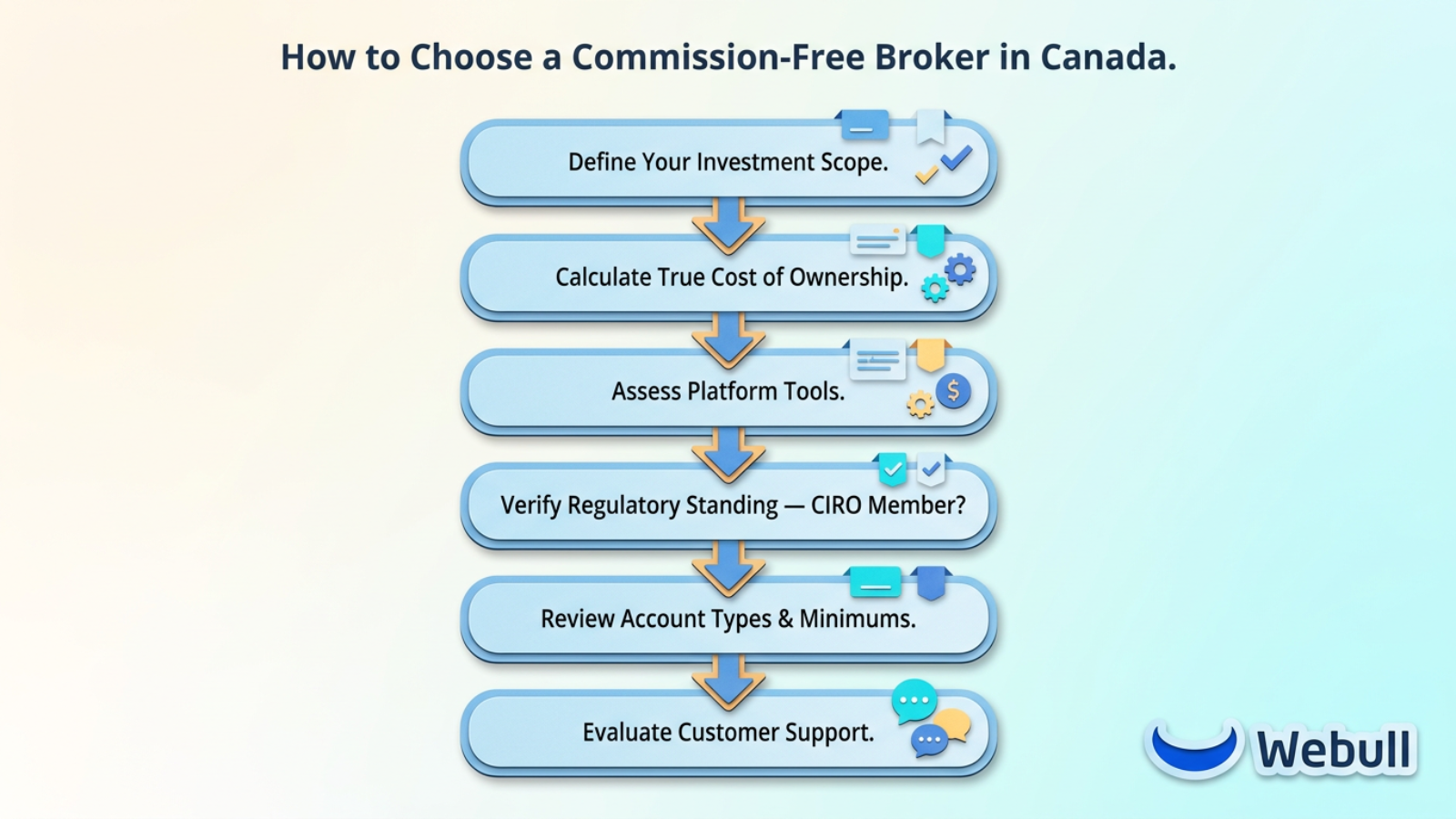
4.1 Step-by-Step Evaluation Framework
Step 1 — Define your investment scope.
Identify which securities you plan to trade: Canadian stocks, US stocks, ETFs, or options. Confirm that your chosen platform supports those instruments.
Step 2 — Calculate your true cost of ownership.
Beyond commissions, estimate your likely FX conversion costs, any account fees, and applicable regulatory fees. Use a broker's published fee schedule, not just the headline rate.
Step 3 — Assess platform tools.
Consider whether the platform's charting, research, and order management tools match your investing style. Active traders may require more analytical depth than passive ETF investors.
Step 4 — Verify regulatory standing.
Confirm the broker is a CIRO member. Check whether client accounts are eligible for CIPF coverage and understand the applicable limits and conditions.
Step 5 — Evaluate customer support.
Review the availability and quality of customer service, particularly for resolving account or trade issues.
4.2 Pros and Cons of Commission-Free Trading
Pros:
Eliminates per-trade friction, making it easier to invest smaller amounts regularly
Reduces the cost drag on long-term portfolio building
Encourages broader market participation among newer investors
Supports disciplined, systematic investing strategies
Cons:
Absence of commissions may encourage overtrading, which carries its own costs
Platform quality and research tools vary significantly across zero-commission brokers
The Bottom Line
Commission-free trading in Canada has made self-directed investing more accessible, but "zero commission" rarely means zero cost. Currency conversion spreads, regulatory fees, and margin interest all contribute to the true cost of trading. Webull Canada offers commission-free stocks, ETFs, and options with no minimum balance, backed by CIRO membership and potential CIPF coverage. Review the full fee schedule and assess your own investment needs before opening any account.
Past performance is not indicative of future results. Actual results may vary by individual.
Disclosure:
Webull Securities (Canada) Limited (regulated by CIRO and a member of CIPF) offers Order Execution Only securities trading. All investments involve risk. Regulatory Fees, Exchange Fees and other Fees may apply.
Options trading entails significant risk and is not appropriate for all investors. Option investors can rapidly lose the value of their investment in a short period of time and incur permanent loss by expiration date. Losses can potentially exceed the initial required deposit. You need to complete an options trading application and get approval on eligible accounts. Please read the Derivatives Disclosure Document before trading options, available at www.webull.ca.
