
- PRICING
- LIVE QUOTES
- LEARN
- HELP


EN
Is Terex (TEX) Still Attractive After Recent Pullback And Mixed Valuation Signals?
- Investors may be wondering if Terex at around US$57.30 is offering good value right now, or if the easy gains are already behind it.
- The stock is up 26.7% over the last year and 4.1% year to date, even though it has fallen 10.3% in the last week and 5.9% over the past month.
- Recent coverage has focused on Terex as a cyclical industrial stock, with investors weighing its exposure to heavy equipment demand and broader capital spending trends. This has kept attention on how resilient its order pipeline and profitability could be if conditions change.
- Simply Wall St currently gives Terex a valuation score of 3/6. The rest of this article will unpack what that means across different valuation methods, then finish with a framework that can help you interpret those valuations more effectively.
Find out why Terex's 26.7% return over the last year is lagging behind its peers.
Approach 1: Terex Discounted Cash Flow (DCF) Analysis
A Discounted Cash Flow, or DCF, model estimates what a stock could be worth by projecting the company’s future cash flows and discounting them back to today’s value using a required rate of return.
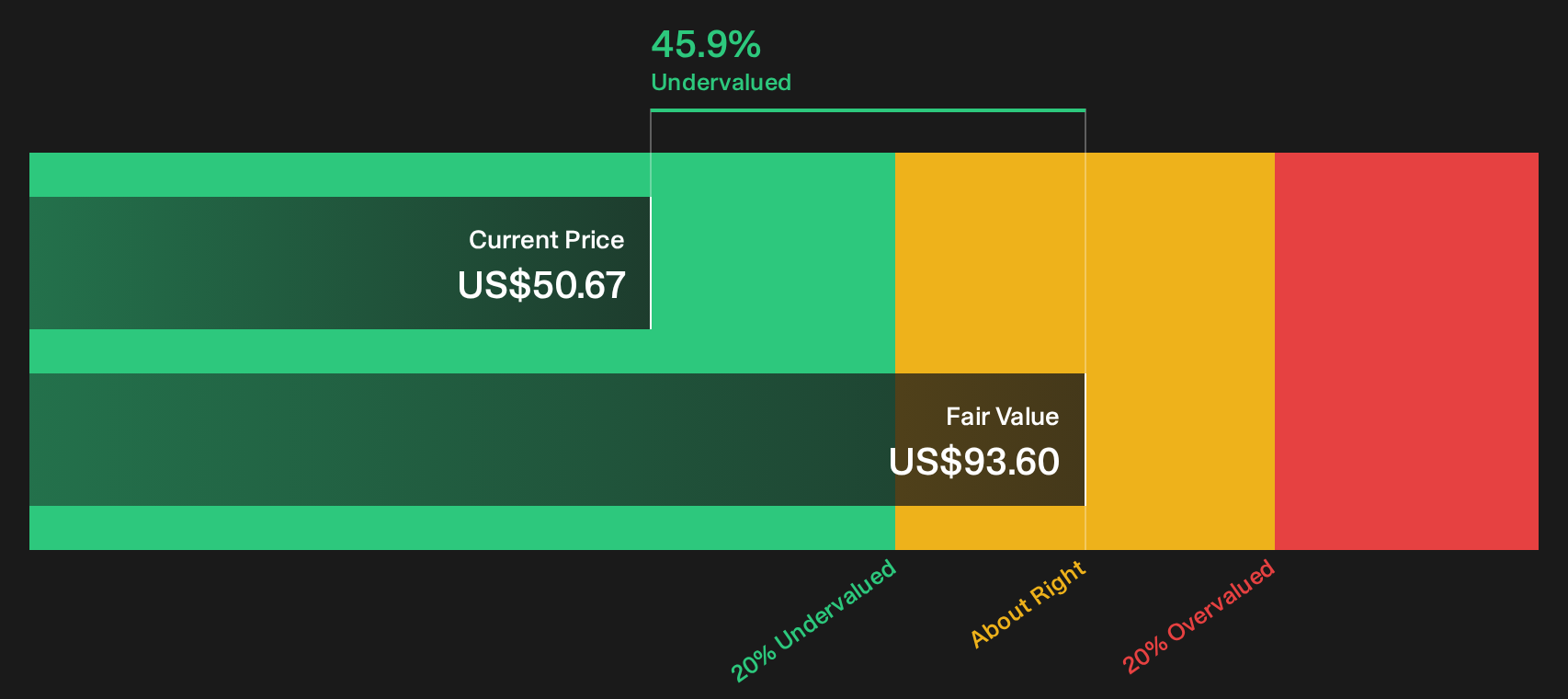
For Terex, the model used is a 2 Stage Free Cash Flow to Equity approach. The company’s latest twelve month free cash flow is about $288.2 million. Analyst based projections and Simply Wall St extrapolations point to free cash flow of $499.6 million in 2026 and $562.1 million in 2027, with further estimates extending out to 2035, all in $. These ten year cash flow projections are then discounted and combined with a terminal value to arrive at an estimated intrinsic value of $89.09 per share.
Compared with the recent share price around $57.30, this implies Terex is trading at about a 35.7% discount to the DCF estimate. On this cash flow based measure, the stock screens as undervalued.
Result: UNDERVALUED
Our Discounted Cash Flow (DCF) analysis suggests Terex is undervalued by 35.7%. Track this in your watchlist or portfolio, or discover 53 more high quality undervalued stocks.
Approach 2: Terex Price vs Earnings
For profitable companies like Terex, the P/E ratio is a useful way to gauge how much you are paying for each dollar of current earnings. It links the stock price directly to the company’s bottom line, which many investors focus on when comparing opportunities.
What counts as a “normal” P/E depends on how fast earnings are expected to grow and how risky those earnings are. Higher growth or lower perceived risk can justify a higher P/E, while slower growth or higher risk usually lines up with a lower P/E.
Terex currently trades on a P/E of 61.16x. That is above the Machinery industry average P/E of 26.45x and above the peer group average of 18.57x. Simply Wall St’s Fair Ratio for Terex is 45.28x, which is its proprietary estimate of an appropriate P/E once factors such as earnings growth, profit margin, industry, market cap and risk profile are taken into account.
The Fair Ratio aims to be more tailored than a simple comparison with peers or the industry because it adjusts for company specific characteristics instead of assuming they all deserve the same multiple. Since Terex’s actual P/E of 61.16x is higher than the Fair Ratio of 45.28x, the stock screens as overvalued on this metric.
Result: OVERVALUED

P/E ratios tell one story, but what if the real opportunity lies elsewhere? Start investing in legacies, not executives. Discover our 20 top founder-led companies.
Upgrade Your Decision Making: Choose your Terex Narrative
Earlier it was mentioned that there is an even better way to understand valuation, so Narratives are introduced as a simple way for you to write the story you believe about Terex and connect it directly to your own estimates for future revenue, earnings, margins and a fair value.
A Narrative on Simply Wall St links three pieces together: your view of the company’s story, the financial forecasts that follow from that view, and the resulting fair value, all presented side by side with the current share price so you can quickly see whether your story suggests Terex is priced above or below what you consider reasonable.
Narratives live inside the Community page on Simply Wall St’s platform, where millions of investors can create or review different Terex stories. Each Narrative automatically refreshes when new information comes in, such as company news or earnings, so your fair value stays aligned with the latest data instead of a static snapshot.
For Terex, one investor might build a more optimistic Narrative that lines up with a fair value around US$95.00. Another might lean toward a cautious Narrative closer to US$38.00, and comparing those to the current price helps you decide whether the stock looks closer to fully priced or offering a margin of safety under your own assumptions.
For Terex however we'll make it really easy for you with previews of two leading Terex Narratives:
First is a higher fair value view that lines up with the analyst consensus target.
Fair value in this narrative: US$76.79 per share
Implied discount to this fair value versus the last close around US$57.30: about 25.4% below that fair value estimate
Assumed revenue growth used in this narrative: 15.47% a year
- Analysts in this camp tie Terex to long running themes in infrastructure, urbanization and sustainability, which they see as supporting demand for equipment across multiple end markets.
- They also lean on expected benefits from electrified and digital offerings, plus REV Group synergies, as reasons for higher margins and stronger free cash flow over time.
- Their fair value clusters around the US$76.79 target, using earnings, margin and discount rate assumptions that you can compare directly with your own view of Terex.
The second narrative reflects the lowest analyst target and sketches out what a more cautious fair value could look like.
Fair value in this narrative: US$38.00 per share
Implied premium to this fair value versus the last close around US$57.30: about 50.8% above that fair value estimate
Assumed revenue growth used in this narrative: 5.07% a year
- This view leans on concerns that automation, tighter environmental rules and larger competitors could weigh on Terex equipment demand and pricing power over time.
- It frames tariffs, supply chain costs and potential price competition as risks to margins, even if earnings still grow from today’s levels.
- The bearish fair value of US$38.00 assumes a lower revenue growth path and a much lower future P/E, which readers can use as a stress test against the current share price.
Do you think there's more to the story for Terex? Head over to our Community to see what others are saying!

This article by Simply Wall St is general in nature. We provide commentary based on historical data and analyst forecasts only using an unbiased methodology and our articles are not intended to be financial advice. It does not constitute a recommendation to buy or sell any stock, and does not take account of your objectives, or your financial situation. We aim to bring you long-term focused analysis driven by fundamental data. Note that our analysis may not factor in the latest price-sensitive company announcements or qualitative material. Simply Wall St has no position in any stocks mentioned.
Have feedback on this article? Concerned about the content? Get in touch with us directly. Alternatively, email editorial-team@simplywallst.com