
- PRICING
- LIVE QUOTES
- LEARN
- HELP


EN
Is It Too Late To Consider ON Semiconductor (ON) After Its Recent Share Price Surge?
- Wondering whether ON Semiconductor at around US$109.61 is still offering value, or if most of the opportunity is already reflected in the price.
- The stock has been volatile lately, with the price falling 7.4% over the past week but still up 26.1% over the past month, 93.3% year to date and 159.2% over the last year.
- Recent headlines around ON Semiconductor have focused on its role within the broader semiconductor sector and how investor sentiment has shifted as chip related themes stay in focus. These stories help explain why the stock can move sharply in short periods even without company specific announcements driving every swing.
- Despite these moves, ON Semiconductor currently scores just 1 out of 6 on Simply Wall St's valuation checks. The rest of this article will compare different valuation methods and then look at an even more complete way to think about what the stock might be worth.
ON Semiconductor scores just 1/6 on our valuation checks. See what other red flags we found in the full valuation breakdown.
Approach 1: ON Semiconductor Discounted Cash Flow (DCF) Analysis
A Discounted Cash Flow, or DCF, model estimates what a stock could be worth by projecting the cash the company may generate in the future and then discounting those amounts back to today in $ terms.
For ON Semiconductor, the model used here is a 2 Stage Free Cash Flow to Equity approach. The latest twelve month free cash flow is reported at about $744.7m. Analyst based and extrapolated forecasts used by Simply Wall St project free cash flow rising to $2,581.2m by 2030, with ten year projections sourced from a mix of analyst estimates and gradual growth assumptions after those analyst horizons.
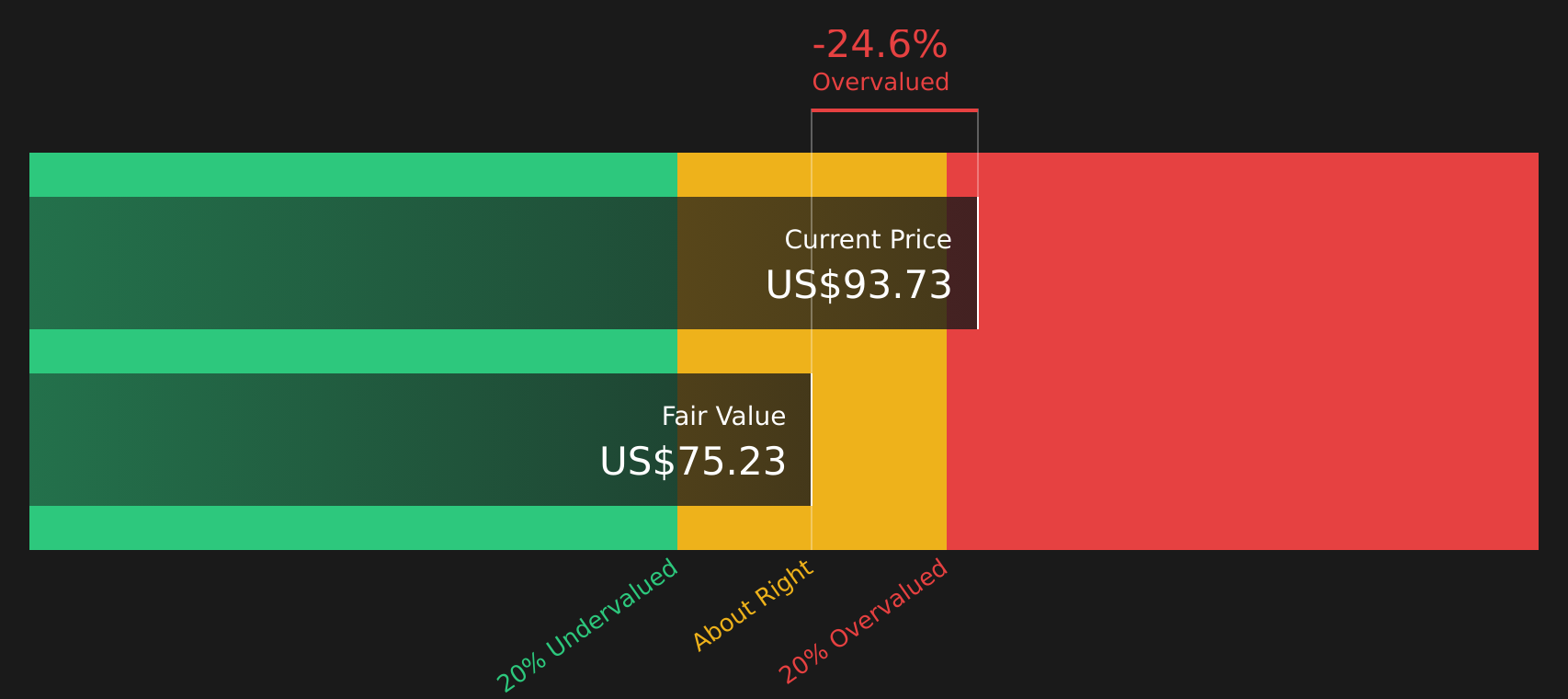
Discounting those projected cash flows back to today gives an estimated intrinsic value of about $73.16 per share. Compared with the current share price of around $109.61, the DCF output suggests the stock is trading at a premium, with the model indicating ON Semiconductor is about 49.8% overvalued on this basis.
Result: OVERVALUED
Our Discounted Cash Flow (DCF) analysis suggests ON Semiconductor may be overvalued by 49.8%. Discover 53 high quality undervalued stocks or create your own screener to find better value opportunities.
Approach 2: ON Semiconductor Price vs Earnings
For profitable companies, the P/E ratio is a useful shorthand because it links what you are paying directly to the earnings the business is currently generating. It lets you compare how the market prices one dollar of earnings across different stocks.
What counts as a “normal” P/E depends a lot on growth expectations and risk. Higher expected growth or lower perceived risk can justify a higher P/E, while lower growth or higher risk usually points to a lower one.
ON Semiconductor currently trades on a P/E of 74.88x. This sits above the Semiconductor industry average of 63.57x and below the peer group average of 101.20x. Simply Wall St also calculates a proprietary “Fair Ratio” for ON Semiconductor of 49.41x.
The Fair Ratio is designed to go further than a simple peer or industry comparison. It adjusts the preferred multiple for factors specific to the company such as its earnings growth profile, profit margins, industry, market capitalization and key risks, which can make it a more tailored benchmark.
Comparing ON Semiconductor’s current P/E of 74.88x with the Fair Ratio of 49.41x suggests the stock is trading above this company specific benchmark.
Result: OVERVALUED

P/E ratios tell one story, but what if the real opportunity lies elsewhere? Start investing in legacies, not executives. Discover our 20 top founder-led companies.
Upgrade Your Decision Making: Choose your ON Semiconductor Narrative
Earlier it was mentioned that there is an even better way to understand valuation, so Narratives are introduced here as simple stories you choose about ON Semiconductor that connect your own view of its future revenue, earnings and margins to a specific fair value. You can then compare that fair value with the current price to help you decide what action, if any, makes sense.
On Simply Wall St's Community page, Narratives are presented as easy to use setups where you pick or adjust a forecast and instantly see how that storyline flows through to valuation. This valuation is then refreshed when new information such as earnings, guidance, partnerships or buyback updates is added to the platform.
For example, one ON Semiconductor Narrative on the more cautious side might lean toward a fair value around US$68.28 or US$73.15 based on moderate revenue growth and margins. A more optimistic Narrative could lean toward a higher fair value such as US$78.63. By seeing these side by side you can decide which story aligns more closely with your own expectations for the stock before comparing any of them with the latest share price.
Do you think there's more to the story for ON Semiconductor? Head over to our Community to see what others are saying!

This article by Simply Wall St is general in nature. We provide commentary based on historical data and analyst forecasts only using an unbiased methodology and our articles are not intended to be financial advice. It does not constitute a recommendation to buy or sell any stock, and does not take account of your objectives, or your financial situation. We aim to bring you long-term focused analysis driven by fundamental data. Note that our analysis may not factor in the latest price-sensitive company announcements or qualitative material. Simply Wall St has no position in any stocks mentioned.
Have feedback on this article? Concerned about the content? Get in touch with us directly. Alternatively, email editorial-team@simplywallst.com