
- PRICING
- LIVE QUOTES
- LEARN
- HELP


EN
The global market is too optimistic! IMF and World Bank Reminder: Don't Underestimate the Economic Impact of War
The Zhitong Finance App learned that the International Monetary Fund (IMF) and the World Bank have always been symbols of free trade, capitalism, and financial market wisdom, but at their spring meeting, an anti-mainstream view emerged: investors underestimated the economic losses caused by the Iran war. At various public forums, private dinners, and side events held in Washington this week, participants gradually came to a consensus — even if the US and Iran reach a lasting peace agreement soon, the impact of the conflict on the global economy may worsen significantly before improving.
Government officials and others attending the conference said during the opening of the conference that the world is currently experiencing far from being an ordinary shock. They warned that what could really take root are structural changes involving rising costs, lengthening trade routes, and increasing geopolitical uncertainty, which will slow global growth potential.
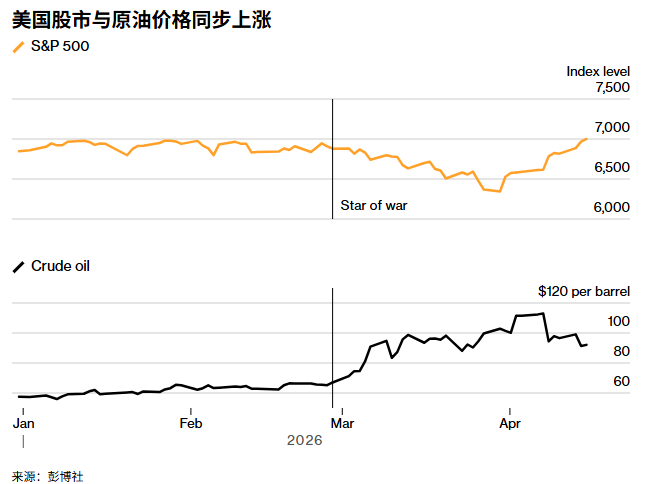
Qatar's Finance Minister Ali bin Ahmed Al-Kuwari said bluntly at the International Monetary Fund meeting on Wednesday: “What we have seen is only the tip of the iceberg.” At the time, the US stock market was approaching an all-time high, yet oil prices were below $100 per barrel.
Kuwari's economy has been severely affected by liquefied natural gas exports. He predicts that within the next one to two months, the current energy price shock will evolve into energy shortages in some countries, and “it will not even be able to light up the country.” He warned that the food crisis caused by the shortage of chemical fertilizers would follow, and emphasized that Qatar supplies nearly one-third of the world's helium (essential for semiconductor manufacturing): “This war will have a huge economic impact, and the crisis is imminent.”
Trump administration officials called on all parties to remain calm and restrained. In particular, major central banks should adopt a wait-and-see attitude and suspend interest rate hikes to deal with inflationary pressure. The US side believes that the short-term pain is worth bearing, because in the long run, this will put an end to Iran's nuclear threat.
Temporary impact
US Treasury Secretary Scott Bessent tried to describe the conflict and the resulting sharp rise in prices as a temporary phenomenon, and energy costs are expected to fall rapidly after the end of the hostilities. “This war will eventually end, or in three days, three weeks, or March, but it will definitely end.” He said, adding that “the market is future-focused.” However, this optimism was difficult to be widely accepted at meetings between the International Monetary Fund and the World Bank just a few blocks from the White House.
Bloomberg Economic Research notes, “The US is seeking to break away from Iran's influence. The market is betting that it will succeed, but it needs to overcome obstacles such as control of the Strait of Hormuz, Iran's nuclear program, and the conflict with Hezbollah in Lebanon.”
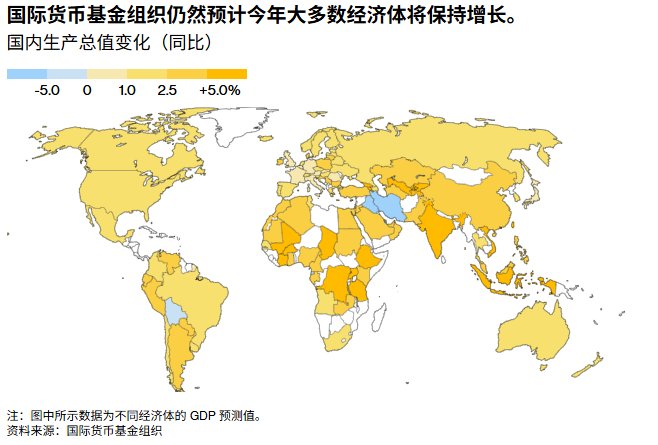
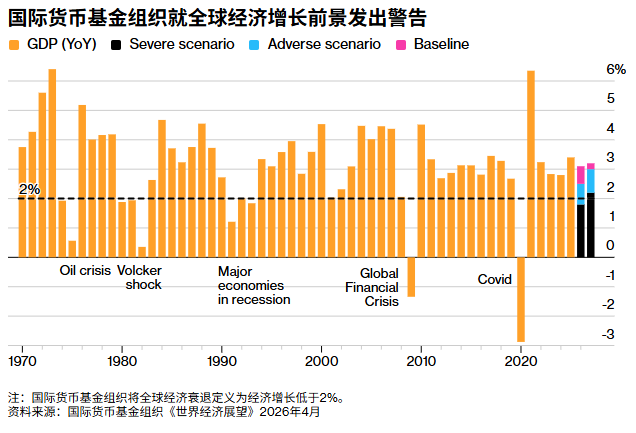
IMF chief economist Pierre Olivier Gourinchas lowered growth expectations on Tuesday and predicted that the world would experience the slowest growth since the outbreak of the pandemic. He then predicted further cuts in the future. He said that the new US blockade of the Strait of Hormuz and other developments mean that the “unfavorable” scenario set by the agency (that is, global economic growth falls to 2.5% from the pre-war forecast of 3.3%) now seems increasingly likely to occur.
“With each passing day and every additional day of interruption in energy supply, we are one step closer to an unfavorable scenario,” Gulinshas said. ECB President Christine Lagarde issued a similar warning about Europe's growth path.
The growing concern stems from a perception that even if the US and Iran soon end the war through negotiations, the six-week conflict will leave an even longer shadow over the global economy.
World Bank President Ajay Banga said on Tuesday: “Don't think of this as just another month of pain. Think of it as a test over a longer period of time, because even assuming the fighting stops and energy facilities are no longer structurally damaged, it will take time for the supply system to stabilize.”
Although oil prices have soared, the full pain of what the International Energy Agency says is the biggest energy shock in the world's history is yet to be fully felt. Although the Strait of Hormuz has actually been closed for six weeks, the last shipment from the Persian Gulf before the war has just arrived at its destination.
“March was a very difficult month for the world, both from an energy and economic point of view, and April is likely to be worse than March,” International Energy Agency Director Fatih Birol said at the spring conference.
Stock market rebounds
In such a sluggish atmosphere, participants were puzzled as to why the US stock market (S&P 500 in particular) was able to recover so quickly from its initial wartime losses? ——The index reached a record high as the International Monetary Fund lowered its global growth forecast on Tuesday. On Wednesday, the US stock market remained close to high due to mixed signals that the cease-fire may be extended and that the Strait of Hormuz continues to be slow.
For some attendees, the answer was simple. “The market is underestimating the seriousness of the situation,” said Alexis Crow, the US chief economist at PwC, who advises corporate clients around the world. Crow and others believe this is because the market is unaware of the disruptions the war has caused to the supply chain.
Many market participants don't want to fall victim to Trump's “TACO” — “TACO” refers to the “Trump always backs down” model, that is, when the market doesn't respond well, he abandons aggressive initiatives.
Furthermore, investors were also driven by “FOMO” (fear of missing out) this week. Signs of easing tension in the Middle East, optimism about artificial intelligence technology, and profit expectations for US companies prompted skeptics to abandon caution. “It's hard for investors to avoid fear of missing out.” Matt Marley, chief market strategist at Miller Tabak + Co., said.
IMF Managing Director Kristalina Georgieva said that another reason for market optimism is that the US economy is relatively healthy, and as an oil exporter, it is less affected by energy shocks. “But let me say this is not the case in other parts of the world; other regions have already suffered immensely.” When directly asked if the market should be more careful, she responded: “It should be more careful, as supply chain disruptions are already quite significant.”
Washington also has questions: How resilient can the global economy remain after experiencing tariff shocks, the pandemic, and the escalation of the Russian-Ukrainian conflict? These shocks have led to rising debt levels and weakened the ability of many governments to cope with another crisis in an increasingly divided world. Pierre Cayeto, head of Lazard Investment Bank's sovereign advisory team, said in an interview: “No one knows how far it is from the point of collapse, but economic, financial, and social resilience is not limitless.”
Although both the IMF and the World Bank have emphasized that they are prepared to deal with the crisis, there are calls for them to do more. Within the IMF, concerns about the magnitude of the crisis are spreading, and some have warned the market and some policy makers to underestimate its impact. A person familiar with the matter said that the biggest concern is that the ripple effect caused by the energy shock will spread to global financial markets. The source added that the problem was how to deliver the right message without triggering panic.
Nigeria's Minister of Finance and Economy Olawale Edun spoke on Tuesday on behalf of the Group of 24 and called on the IMF and World Bank to mobilize more resources. He pointed out that the crisis is hitting developing countries at a time when the US and other wealthy countries have suddenly cut foreign aid, and many poor countries have already spent more on debt repayment than they have received in aid or foreign direct investment.
Rebecca Paterson, a former senior researcher at the J.P. Morgan Chase and Bridgewater Foundation and currently a senior researcher at the Foreign Relations Committee, said that one point that many investors have overlooked is that the impact of the current energy shock may be similar to the COVID-19 pandemic. Just like the health crisis that swept the world in 2020, “this is a rolling epidemic.”
Referring to the subsequent effects of the Iran war, Paterson said, “Asia first felt the impact of the interruption in energy supply, and now Europe is beginning to feel it. America will be next as the last ships sailing to America from the Gulf region are about to arrive.”