
- LIVE QUOTES
- LEARN
- HELP


EN
Is It Time To Reassess Diamondback Energy (FANG) After Strong 1 Year Share Price Gain?
- If you are wondering whether Diamondback Energy's current share price reflects its true worth, you are not alone. This article is designed to help you weigh up what you are really paying for.
- The stock recently closed at US$186.31, with returns of 4.5% over 30 days, 22.3% year to date, and 55.4% over 1 year, giving plenty for valuation focused investors to think about.
- Recent news coverage has centered on Diamondback Energy's position within the US oil and gas sector and how its scale, asset base, and capital return policies compare with peers. Commentary has also focused on how investors are reacting to sector wide themes such as commodity price expectations, capital discipline, and consolidation trends.
- Simply Wall St currently assigns Diamondback Energy a valuation score of 2/6. Next up is a closer look at the usual valuation tools such as P/E, cash flow based models, and peer comparisons, followed by a broader way of thinking about value that goes beyond any single metric.
Diamondback Energy scores just 2/6 on our valuation checks. See what other red flags we found in the full valuation breakdown.
Approach 1: Diamondback Energy Discounted Cash Flow (DCF) Analysis
A Discounted Cash Flow, or DCF, model estimates what a company could be worth by projecting its future cash flows and then discounting those back to today’s value using a required rate of return.
For Diamondback Energy, the model used is a 2 Stage Free Cash Flow to Equity approach, based on cash flow projections in $. The latest twelve month free cash flow is about $1.21b. Analyst estimates and subsequent extrapolations feed into a series of annual free cash flow projections, with one example being a projected $6.04b in 2030. Simply Wall St uses analyst inputs for the earlier years, and then extends those trends to build a 10 year outlook.
Pulling these cash flows together, the DCF model produces an estimated intrinsic value of about $499.24 per share. Compared with the recent share price of $186.31, this implies a 62.7% discount, which points to Diamondback Energy stock trading well below this cash flow based estimate of value.
Result: UNDERVALUED
Our Discounted Cash Flow (DCF) analysis suggests Diamondback Energy is undervalued by 62.7%. Track this in your watchlist or portfolio, or discover 62 more high quality undervalued stocks.

Approach 2: Diamondback Energy Price vs Earnings
For profitable companies, the P/E ratio is a widely used yardstick because it connects what you pay today with the earnings the business is currently generating. It also tends to reflect what the market is willing to pay for each dollar of earnings, given expectations and perceived risk.
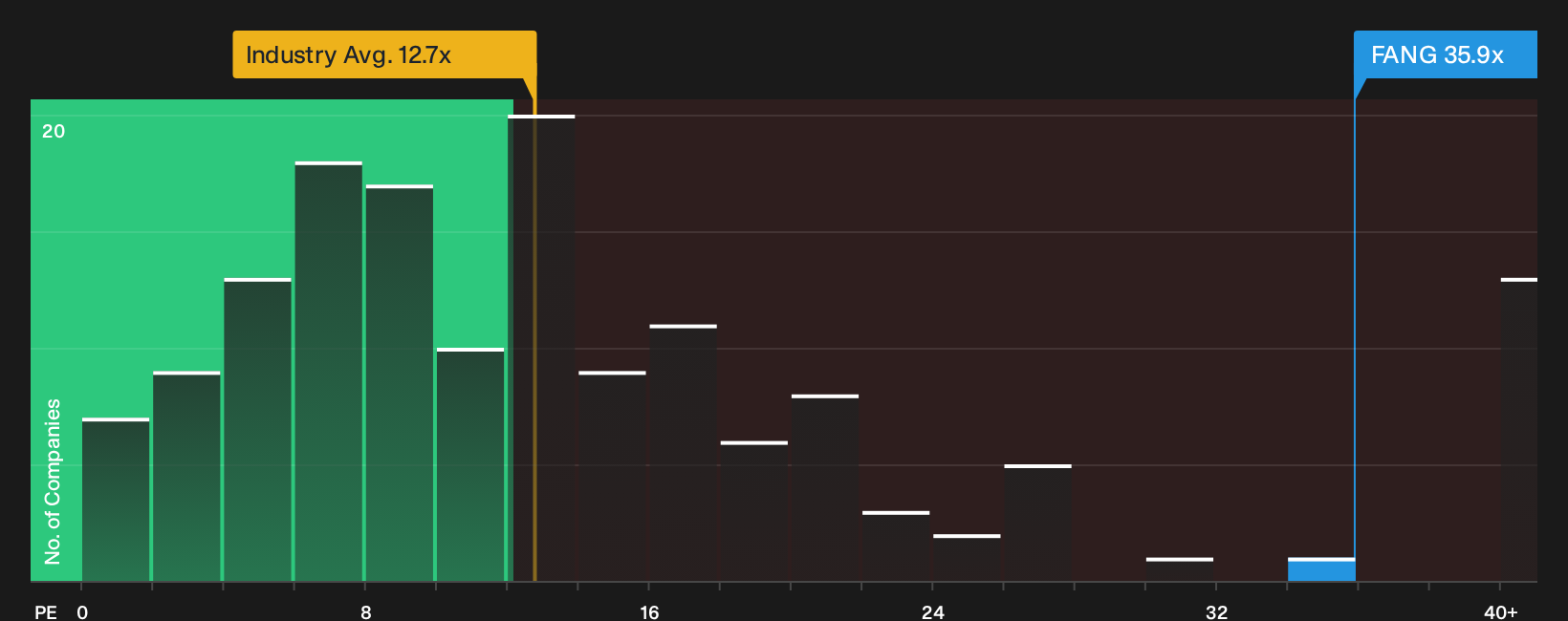
Higher expected earnings growth and lower perceived risk usually support a higher, or more generous, P/E ratio, while lower growth or higher risk usually line up with a lower, more cautious, P/E. Diamondback Energy currently trades on a P/E of 31.65x. That compares with an Oil and Gas industry average P/E of about 15.09x and a peer group average of 23.55x, so the stock is priced above both of those benchmarks.
Simply Wall St also calculates a proprietary "Fair Ratio" to estimate what P/E might be reasonable given factors such as earnings growth, industry, profit margins, market cap and company specific risks. This Fair Ratio for Diamondback Energy is 26.52x, which aims to provide a more tailored anchor than simple peer or industry comparisons. With the current P/E at 31.65x versus a Fair Ratio of 26.52x, the shares screen as trading above this customised benchmark.
Result: OVERVALUED
P/E ratios tell one story, but what if the real opportunity lies elsewhere? Start investing in legacies, not executives. Discover our 19 top founder-led companies.
Upgrade Your Decision Making: Choose your Diamondback Energy Narrative
Earlier it was mentioned that there is an even better way to understand valuation. Narratives on Simply Wall St let you turn your view of Diamondback Energy into a clear story that links the business drivers you care about to a set of revenue, earnings and margin forecasts, and then to a Fair Value that you can compare with the current share price. Because these Narratives sit on the Community page and update automatically when fresh news or earnings land, you can quickly see how a more optimistic storyline with a Fair Value of about US$257.44 and a more cautious one at about US$164.00 sit alongside a consensus view around US$179.03. You can then decide what to do when your chosen Fair Value sits above or below the latest market price.
For Diamondback Energy, here are previews of two leading Diamondback Energy narratives to make comparison easier:
🐂 Diamondback Energy Bull Case
Fair Value: US$257.44
Undervalued vs last close: about 27.6%
Revenue growth assumption: 5.14%
- Focuses on efficiency, acquisitions and infrastructure investments that are expected to support cash generation and shareholder distributions over time.
- Builds in bullish analyst assumptions on revenue growth, rising profit margins and lower future P/E, alongside ongoing share count reduction.
- Flags key risks around the energy transition, ESG pressures, Permian concentration, high capital needs and reserve depletion that could challenge this upbeat view.
🐻 Diamondback Energy Bear Case
Fair Value: US$179.03
Overvalued vs last close: about 4.1%
Revenue growth assumption: 1.19%
- Centers on consolidation, cost control and balance sheet clean up supporting production, margins and cash flow, while keeping expectations closer to consensus.
- Uses more moderate assumptions for revenue growth, steady margins and a future P/E that is only slightly above the industry, with modest share reduction.
- Highlights risks from rising costs, lower quality drilling inventory, commodity price swings, fading efficiency gains and tougher M&A economics that could limit long term upside.
If you want the full context behind these numbers, the community has explored earnings paths, risks and valuation ranges for Diamondback Energy in more detail, so you can decide which storyline feels closer to your own view of the stock.
Do you think there's more to the story for Diamondback Energy? Head over to our Community to see what others are saying!

This article by Simply Wall St is general in nature. We provide commentary based on historical data and analyst forecasts only using an unbiased methodology and our articles are not intended to be financial advice. It does not constitute a recommendation to buy or sell any stock, and does not take account of your objectives, or your financial situation. We aim to bring you long-term focused analysis driven by fundamental data. Note that our analysis may not factor in the latest price-sensitive company announcements or qualitative material. Simply Wall St has no position in any stocks mentioned.
Have feedback on this article? Concerned about the content? Get in touch with us directly. Alternatively, email editorial-team@simplywallst.com