
- LIVE QUOTES
- LEARN
- HELP


EN
What's the Outlook for Gold- and Silver-Mining Stocks in 2026?
Key Points
Gold and silver have declined despite their safe-haven reputation.
Long-term fundamentals for the precious metals remain positive, with demand from central banks and industry supporting a bullish outlook.
Many investors have been left surprised by the sharp sell-off in gold and silver following the commencement of the war in the Persian Gulf. They are often held up as safe-haven assets providing security in times of stress.
But gold and silver have both declined sharply, as equities, industrial metals, and bonds have all sold off in response to the conflict. That said, the long-term outlook remains positive for the precious metals.
Will AI create the world's first trillionaire? Our team just released a report on the one little-known company, called an "Indispensable Monopoly" providing the critical technology Nvidia and Intel both need. Continue »
If you are worried about the near-term outlook and are looking for stocks to protect against the risk to the global economy created by the closure of the Strait of Hormuz (which 20% of the world's energy typically flows through), you can find some in the hyperlinks in this article, including energy stocks to buy if oil tops $100 a barrel.
Returning to the question of gold and silver, which directly affect leading miners such as SSR Mining (NASDAQ: SSRM) and Hecla Mining (NYSE: HL), the thesis here is that investors should be inclined to buy on a sustained dip. And the outlook for both metals is lower and then higher.

Image source: Getty Images.
Near-term weakness
According to JPMorgan, investors held 2.8% of their assets in gold in late 2025, which might not sound like much, but it's about double the figure of a decade ago. Moreover, data from the Silver Institute and the World Gold Council indicate that investment demand for gold increased by almost 990 tonnes in 2025 over 2024, and silver by 13.5 million ounces, compared to declines of 620 tonnes for gold and 29.4 million ounces of silver from all other demand sources.
Those declining sources of demand include jewelry and silverware. All of which is clear evidence of marginal destruction in demand in response to high prices. Meanwhile, the investor positions in gold and silver that grew in 2025 may be unwinding now.
Why gold and silver can go higher
If the near-term outlook is questionable, the long-term drivers for both -- at least on the demand side -- remain positive. For example, industrial demand for silver makes up around 59% of total demand, and it was stable in 2025 compared to 2024. Silver has upside potential due to the likelihood of its increased use in a new generation of data centers coming next year.
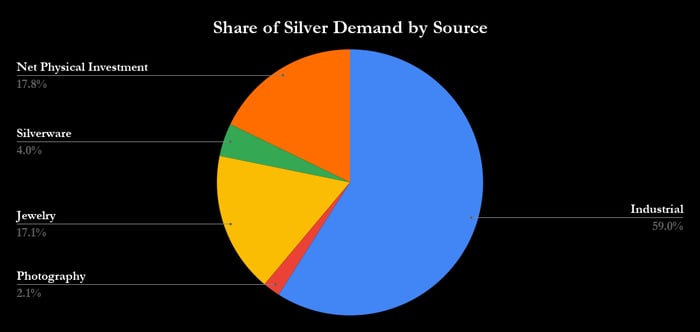
Data source: World Silver Institute. Chart by author.
There's been a clear trend upward in the share of gold in global official reserves since the financial crisis of 2008-2010. According to the International Monetary Fund, it had risen from 6% in 2008 to nearly 13% by the end of 2024.
It's a trend likely driven by growing concern about the counterparty risk inherent in holding U.S. Treasuries, due to rising U.S. debt and worries that the debt held by foreign countries might be frozen as a result of political actions.
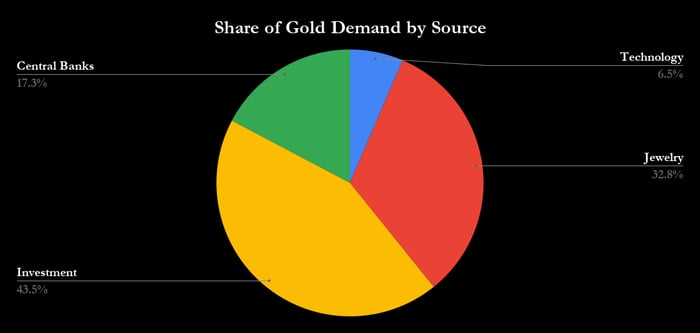
Data source: World Gold Council. Chart by the author.
While marginal demand from central banks did decline in 2025, this may be in line with banks hitting their target gold holdings due to the price rise. As such, any major drop in gold prices could lead to increased central bank buying, not least as concerns over U.S. debt levels and geopolitical tensions aren't going away anytime soon.
All told, while there's a strong case for near-term weakness due to investor selling, the long-term bullish case for gold and silver looks good, and any major dip could be an excellent buying opportunity.
JPMorgan Chase is an advertising partner of Motley Fool Money. Lee Samaha has no position in any of the stocks mentioned. The Motley Fool has positions in and recommends JPMorgan Chase. The Motley Fool has a disclosure policy.