
- LIVE QUOTES
- LEARN
- HELP


EN
Warren Buffett's Berkshire Faces The Dreaded Death Cross—Is Too Much Apple The Problem?
For decades, Warren Buffett’s Berkshire Hathaway Inc. (NYSE:BRK) (NYSE:BRK) was built to avoid exactly this kind of risk: concentration, momentum swings, and market timing. Now, the stock is flashing one of the market's most closely watched technical warning signs — a Death Cross — just as questions begin to surface about what's really driving its performance.
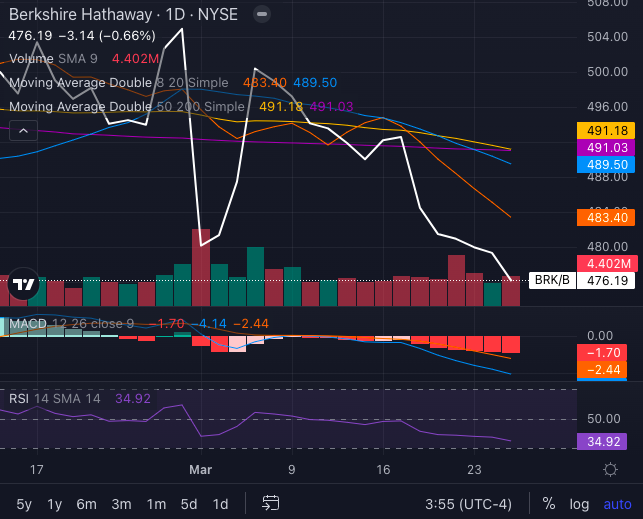
Chart created using Benzinga Pro
And one name sits at the center of that conversation: Apple Inc. (NASDAQ:AAPL).
A Portfolio Built On One Giant
Apple accounts for roughly 23% of Berkshire's equity portfolio — by far its largest position.
That concentration has worked for years. Apple delivered consistent cash flows, buybacks, and steady appreciation — fitting neatly into Buffett's playbook of owning high-quality businesses for the long term.
But in today's market, that exposure cuts both ways.
Because while Apple remains a dominant franchise, it's not the part of the market driving outsized returns right now.
The Bigger Issue Isn't Just Apple
Look beyond Apple, and a pattern emerges.
Berkshire's portfolio is still heavily tilted toward:
- financials like American Express Co (NYSE:AXP) and Bank of America Corp(NYSE:BAC)
- consumer staples like Coca-Cola Co (NYSE:KO)
- energy and industrial exposure
What's missing? Meaningful exposure to:
- AI infrastructure
- high-growth tech
- defense and space — the current momentum trades
Even Berkshire's stakes in Amazon.com, Inc. (NASDAQ:AMZN) and Alphabet Inc. (NASDAQ:GOOG) (NASDAQ:GOOGL) are relatively small.
In a market where leadership has narrowed sharply around AI, that positioning matters.
When Diversification Becomes A Drag
The irony is hard to miss.
Berkshire was designed to be diversified — a portfolio that could perform across cycles. But in a market dominated by a handful of themes, diversification can start to look like underexposure.
That's where the Death Cross becomes more than just a technical signal. It reflects a deeper reality:
Berkshire isn't broken — it's just out of sync with where returns are coming from right now.
The Apple Question
So is Apple the problem? Not exactly.
If anything, Apple is the lens. Its outsized weight makes Berkshire more sensitive to a single stock, but it also highlights a broader issue — the rest of the portfolio isn't positioned to offset shifts in market leadership.
And that's the real tension.
Because as long as the market continues to reward AI-driven growth, Berkshire's more traditional mix may continue to lag — regardless of how strong its underlying businesses remain.
Photo: Shutterstock