
- LIVE QUOTES
- LEARN
- HELP


EN
Is It Time To Reconsider Autodesk (ADSK) After Recent Price Softness?
- If you are wondering whether Autodesk at around US$248 a share still offers value or if the easier gains have already been realized, this article breaks down what the current price may be implying.
- The stock has been relatively soft over the last week with a 1.2% decline. It is up 8.0% over 30 days and still shows a 7.2% decline over the past year, which can influence how the market views both its growth potential and its risk profile.
- Recent attention on Autodesk has focused on its role as a major software name in design and engineering tools, along with ongoing interest in how recurring subscription revenue shapes its profile compared with other software peers. These themes help explain why sentiment can swing between caution over past returns and optimism about how the business model is perceived.
- Autodesk currently registers a value score of 3 out of 6, which means it screens as undervalued on half of the six checks used here. The next sections will walk through those valuation approaches and then point to a more complete way to think about value at the end of the article.
Find out why Autodesk's -7.2% return over the last year is lagging behind its peers.
Approach 1: Autodesk Discounted Cash Flow (DCF) Analysis
A Discounted Cash Flow, or DCF, model projects a company’s future cash flows and then discounts them back to today’s value to estimate what the whole business might be worth right now.
For Autodesk, the model used is a 2 Stage Free Cash Flow to Equity approach based on cash flow projections. The latest twelve month free cash flow is about $2.36b. Analyst estimates and extrapolated figures point to projected free cash flow of around $3.45b in the year to January 2029, with ten year projections ranging from $2.28b in 2026 to about $4.85b in 2035, all in $ terms. Simply Wall St uses analyst inputs for the nearer years and then extends the trend further out.
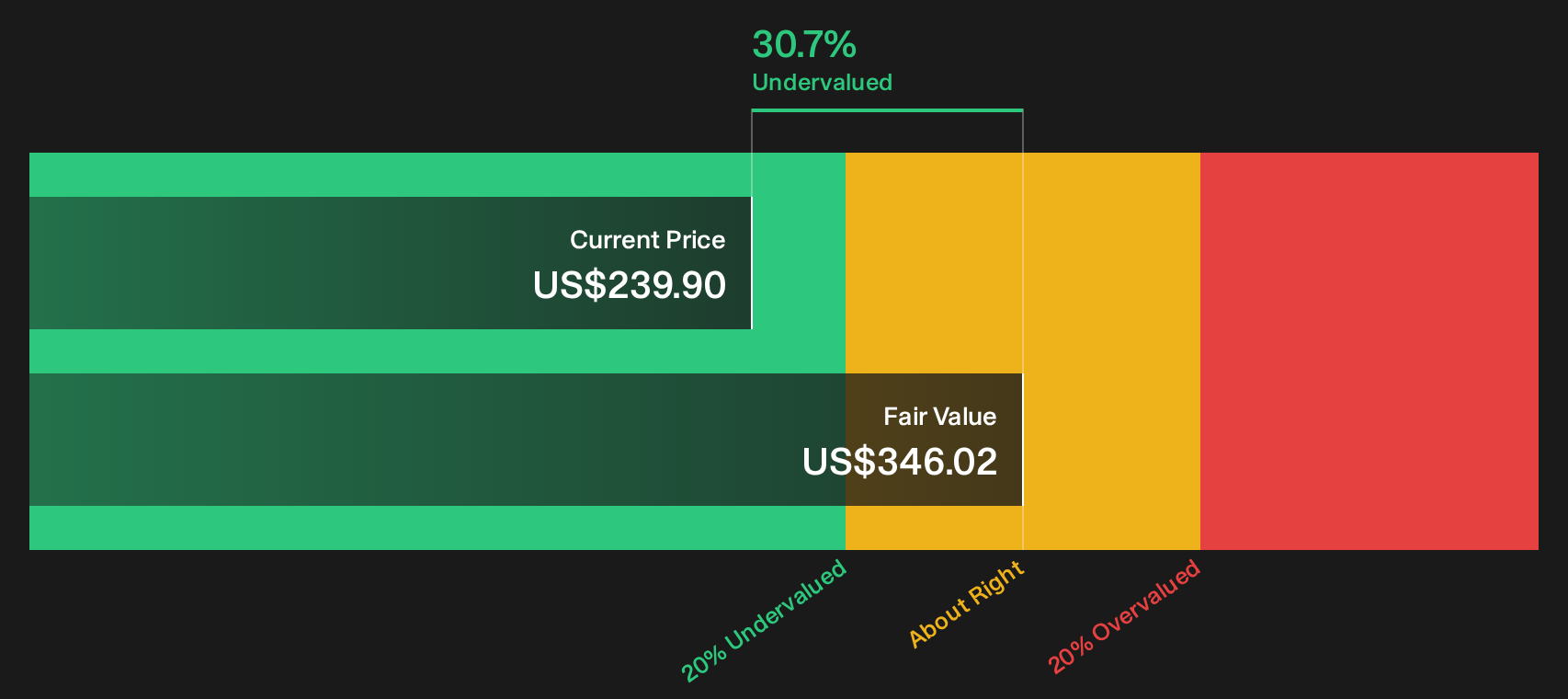
Discounting these projected cash flows back to today produces an estimated intrinsic value of about $309.32 per share. When this estimate is compared with a current share price around $248, the DCF output implies Autodesk trades at roughly a 19.8% discount. On this model alone, Autodesk appears to be undervalued.
Result: UNDERVALUED
Our Discounted Cash Flow (DCF) analysis suggests Autodesk is undervalued by 19.8%. Track this in your watchlist or portfolio, or discover 51 more high quality undervalued stocks.
Approach 2: Autodesk Price vs Earnings
For profitable companies, the P/E ratio is a straightforward way to relate what you pay per share to the earnings that each share generates. This makes it a practical yardstick for many investors.
What counts as a “normal” or “fair” P/E depends on how the market views a company’s growth prospects and risk. Higher expected growth or lower perceived risk can support a higher P/E, while slower growth or higher risk usually points to a lower one.
Autodesk currently trades on a P/E of 46.57x. That sits above the broader Software industry average of 29.01x, but below the peer group average of 54.41x. To go a step further, Simply Wall St calculates a proprietary “Fair Ratio” of 33.84x for Autodesk, which reflects factors such as earnings growth, industry, profit margins, market cap and specific risks.
This Fair Ratio approach can be more tailored than a simple comparison with peers or the industry, because it accounts for Autodesk’s own characteristics rather than assuming it should trade like an average Software name. Comparing the Fair Ratio of 33.84x with the actual P/E of 46.57x suggests the shares are pricing in more than what this framework would indicate.
Result: OVERVALUED

P/E ratios tell one story, but what if the real opportunity lies elsewhere? Start investing in legacies, not executives. Discover our 20 top founder-led companies.
Upgrade Your Decision Making: Choose your Autodesk Narrative
Earlier it was mentioned that there is an even better way to understand valuation. Narratives bring this to life by letting you set a story for Autodesk, link that story to assumptions about future revenue, earnings and margins, and then see the fair value that falls out of those numbers.
On Simply Wall St, Narratives sit in the Community page and turn this into an accessible tool. Instead of only relying on a single DCF or P/E view, you can see how a particular thesis translates into a forecast and a fair value that can be compared directly with the current share price.
Because Narratives on the platform refresh when new information such as earnings, guidance or news becomes available, you get a living view of how updated assumptions flow through to fair value. This can help you judge whether the gap between price and value looks wide or narrow for your own comfort level.
For Autodesk, one investor might lean toward a more optimistic story that lines up with a Fair Value around US$413.07, while another might prefer the more cautious view that anchors closer to US$262.20. Narratives let you see both side by side and decide which feels closer to your own expectations.
Do you think there's more to the story for Autodesk? Head over to our Community to see what others are saying!

This article by Simply Wall St is general in nature. We provide commentary based on historical data and analyst forecasts only using an unbiased methodology and our articles are not intended to be financial advice. It does not constitute a recommendation to buy or sell any stock, and does not take account of your objectives, or your financial situation. We aim to bring you long-term focused analysis driven by fundamental data. Note that our analysis may not factor in the latest price-sensitive company announcements or qualitative material. Simply Wall St has no position in any stocks mentioned.
Have feedback on this article? Concerned about the content? Get in touch with us directly. Alternatively, email editorial-team@simplywallst.com