
- LIVE QUOTES
- LEARN
- HELP


EN
A Look At St. Joe (JOE) Valuation After Strong 1 Year Returns And DCF Implied Upside
St. Joe (JOE) has drawn investor attention after recent share price moves, with the stock showing mixed short term performance alongside relatively stronger results over the past year and the past three months.
See our latest analysis for St. Joe.
At a share price of US$70.59, St. Joe has seen short term share price weakness over the past week, alongside stronger momentum over the past three months and solid 1 year total shareholder returns of 61.27%.
If St. Joe’s move has you thinking about other areas of the market, it could be a good moment to look through 20 top founder-led companies as a fresh set of ideas.
With a 1 year total return above 60% and an estimated 33% intrinsic discount, the key question now is whether St. Joe still offers value or if the market is already pricing in future growth.
Preferred P/E of 35.1x: Is it justified?
St. Joe is trading on a P/E of 35.1x, which sits above the broader US Real Estate industry average of 32.2x, but below its direct peer group at 46.8x. At a last close of $70.59 and with our SWS DCF model indicating an intrinsic value of $104.76, the market is pricing the company at a premium earnings multiple while the cash flow model suggests a sizeable valuation gap.
The P/E multiple shows how much investors are currently paying for each dollar of earnings, which is often a key reference point for real estate and asset heavy businesses. For St. Joe, that 35.1x multiple is sitting alongside 1 year earnings growth of 55.9% and a 5 year earnings growth rate of 10.1% per year, as well as net profit margins of 22.5% compared with 18.4% last year.
Against the US Real Estate industry, St. Joe screens as expensive on P/E, with its 35.1x multiple above the 32.2x industry average. However, when the lens is narrowed to its peer set, the same 35.1x P/E comes in below the 46.8x peer average. This suggests the market is assigning a lower earnings multiple to St. Joe than many similar companies even after strong 1 year and 3 year total returns and faster earnings growth than the sector.
See what the numbers say about this price — find out in our valuation breakdown.
Result: Price-to-Earnings of 35.1x (ABOUT RIGHT)
However, that valuation gap can narrow if real estate demand in its core markets cools, or if the company struggles to convert its development pipeline into earnings.
Find out about the key risks to this St. Joe narrative.
Another View: DCF Points to a Different Story
While the 35.1x P/E suggests St. Joe is priced at a premium to the wider US real estate group, our SWS DCF model tells a different story. With an intrinsic value estimate of $104.76 versus a $70.59 share price, the model implies the stock is trading at a discount.
This kind of gap can reflect genuine mispricing, or it can signal that the market is more cautious about future cash flows than the model assumes. The key question for you is which side of that gap you trust more, and why.
Look into how the SWS DCF model arrives at its fair value.
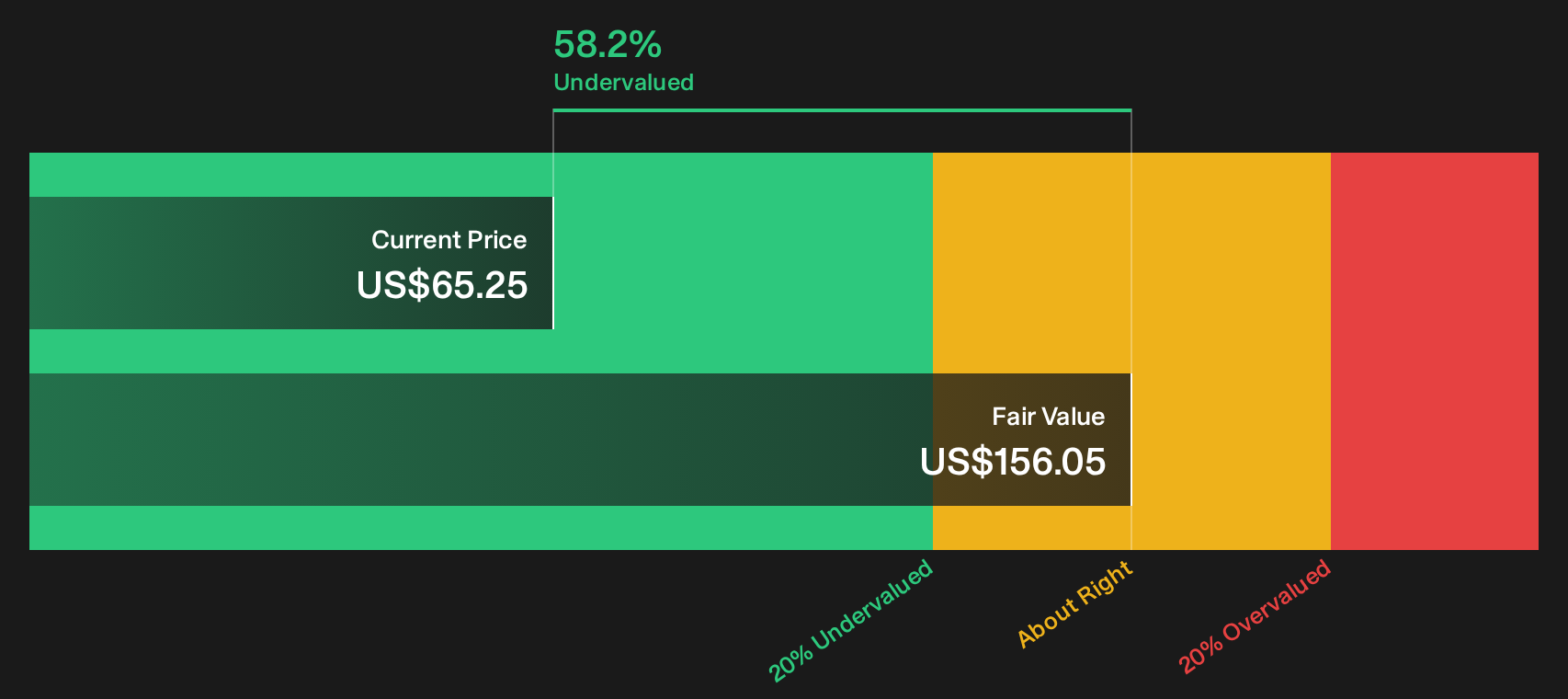
Simply Wall St performs a discounted cash flow (DCF) on every stock in the world every day (check out St. Joe for example). We show the entire calculation in full. You can track the result in your watchlist or portfolio and be alerted when this changes, or use our stock screener to discover 48 high quality undervalued stocks. If you save a screener we even alert you when new companies match - so you never miss a potential opportunity.
Next Steps
Curious whether the recent share price and valuation story lines up with your own expectations? Take a moment to review the full picture on risks and potential upsides so you can decide where you stand, starting with 2 key rewards and 1 important warning sign.
Looking for more investment ideas?
If St. Joe has sharpened your focus, do not stop there. Broaden your watchlist with a few targeted screens that can surface opportunities you might otherwise miss.
- Zero in on potential value opportunities by scanning our list of 48 high quality undervalued stocks that pair solid fundamentals with appealing price tags.
- Prioritize resilience and support steadier risk management by checking out 68 resilient stocks with low risk scores, built around companies with more stable risk profiles.
- Spot earlier stage opportunities before everyone else by reviewing a screener containing 23 high quality undiscovered gems that the market may not be fully paying attention to yet.
This article by Simply Wall St is general in nature. We provide commentary based on historical data and analyst forecasts only using an unbiased methodology and our articles are not intended to be financial advice. It does not constitute a recommendation to buy or sell any stock, and does not take account of your objectives, or your financial situation. We aim to bring you long-term focused analysis driven by fundamental data. Note that our analysis may not factor in the latest price-sensitive company announcements or qualitative material. Simply Wall St has no position in any stocks mentioned.
Have feedback on this article? Concerned about the content? Get in touch with us directly. Alternatively, email editorial-team@simplywallst.com