- LIVE QUOTES
- LEARN
- HELP
 Nasdaq
 Wall Street Journal
EN
Interest rate futures inversion warning: Traders are betting on “continuous interest rate cuts” to replace “next year's interest rate hikes”. Why did the market's expectations for the Fed suddenly change overnight?
The Zhitong Finance App learned that traders in the US futures and options market are betting heavily that the Federal Reserve will continue to cut interest rates until next year rather than restart interest rate hikes.
Futures spreads linked to the guaranteed overnight financing rate (which closely tracks market expectations of the Federal Reserve's policies) are becoming deeply inverted — marking the beginning of a more protracted period of central bank easing for traders.
Until recently, traders have been betting that interest rate hikes will resume in 2027 after the Federal Reserve has cut interest rates twice by 25 basis points each by the end of this year. However, increasingly intense discussions surrounding the impact of artificial intelligence on the labor market are prompting them to reevaluate this prospect. On Tuesday, Federal Reserve Governor Lisa Cook warned that in the face of rising unemployment caused by the spread of AI applications, the central bank might not be able to cope.
Since late last week, the flattening trend of the SOFR spread has accelerated, coinciding with concerns about the disruptive impact of AI dragging down stocks and triggering a rise in long-term US bonds.
“The question is how AI will trigger inflation, and maybe the long end of the yield curve is sensing all of this,” said Jack McIntyre, portfolio manager at Brandywine Global Investment Management. The only area where AI can cause inflation is the construction of data centers and the associated energy demand, and this is known.”
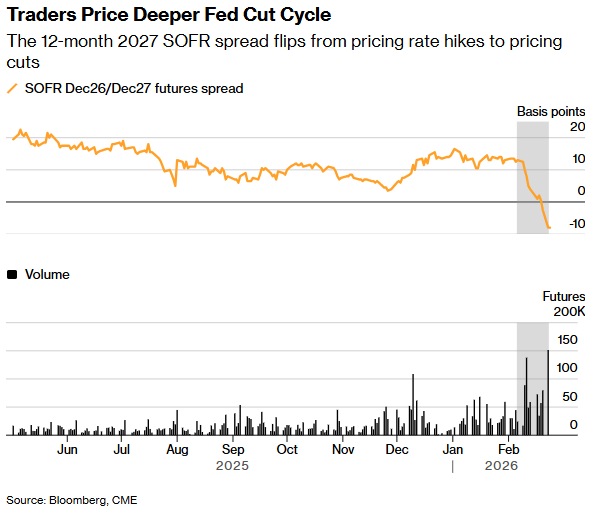
The 12-month SOFR spread from December 2026 to December 2027 fell into a negative area last Friday. The inversion further deepened to negative 8 basis points on Tuesday, indicating that investors' expectations have completely shifted from raising interest rates in 2027 to cutting interest rates at that time. During Monday's trading session, the 12-month spread recorded a record volume of over 150,000 copies.
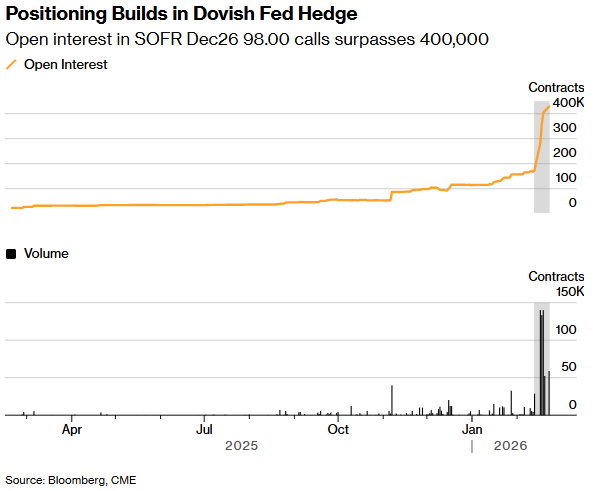
In the SOFR options market, a similar dovish theme is emerging, and trading tends to hedge against the prospect of multiple interest rate cuts this year. These deals were active again on Tuesday, and one of the positions continued to expand in size to hedge against the possibility that the policy interest rate would drop to as low as 2% by the end of the year. The number of open positions for 98.00 call options due in December surged to more than 400,000 this week. The swap market currently prices the Fed's year-end interest rate at about 3.1% — that is, just over two 25 basis point interest rate cuts — about 110 basis points higher than the option's exercise price.
“After the Federal Reserve hit terminal interest rates, the market definitely showed some signs of repricing to lower yields,” said Gennady Goldberg, head of US interest rate strategy at TD Securities. The market “expects the yield to gradually rise more slowly.”
“This may be due to the uncertainty about AI's impact on the labor market, but the Fed's longer-term expectations tend to fluctuate quite a bit, so it's difficult to make a clear interpretation based on this,” he added.
Various indicators of the US Treasury yield curve also reflect the market's pricing for continued interest rate cuts. Interest spreads on 2-year to 5-year treasury bonds reached their flattest level since the beginning of December. At the same time, due to outstanding performance in the middle of the curve, the 2s5s30s butterfly spread steepened to the largest single day in six months.
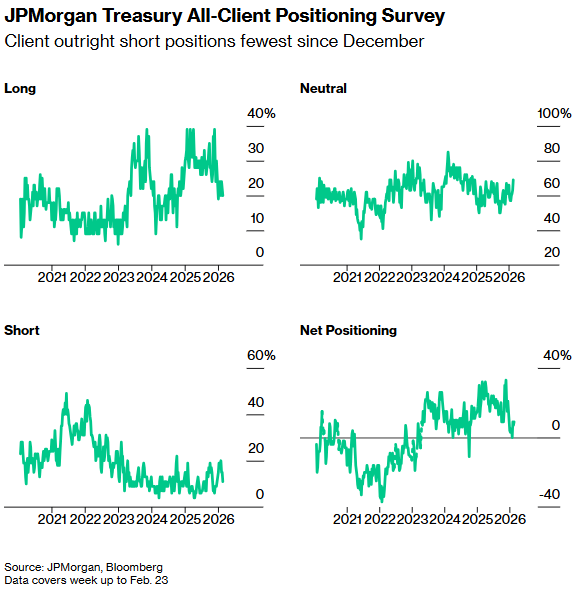
At the same time, in the spot market, traders seem to lack confidence in how to lay out US bonds. According to J.P. Morgan's latest customer survey for the week ending February 23, the proportion of investors with a neutral stance reached its highest level since the end of 2024.
The following is a list of the latest position indicators in the interest rate market:
J.P. Morgan investigation
In the week ending February 23, clients' short positions were reduced by 4 percentage points and long positions were reduced by 2 percentage points. Pure short positions fell to their lowest level since December, while the neutral position ratio rose to its highest level since December 2024.
SOFR options
Changes in open positions for SOFR options over the past week, March, June, and September showed that a large amount of new risk was concentrated on multiple Sep26 put options. This was mainly due to large purchases of SFRU6 96.4375/96.3125/96.1875 put options butterfly arbitrage (price range 2.25 to 2.5) last Thursday. The past week has also seen quite a few upward bets through March call options. Among them, SFRH6 96.375/96.4375/96.50 call option butterfly arbitrage is a popular choice.
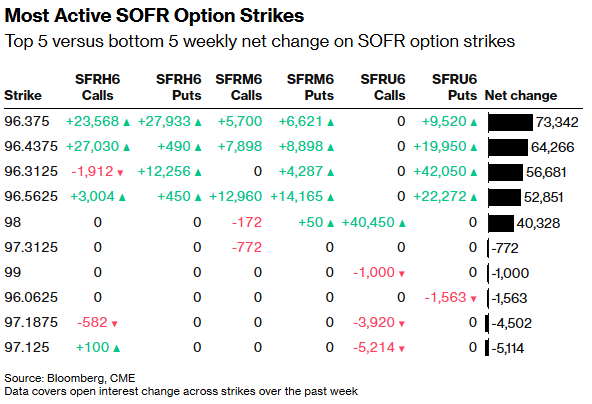
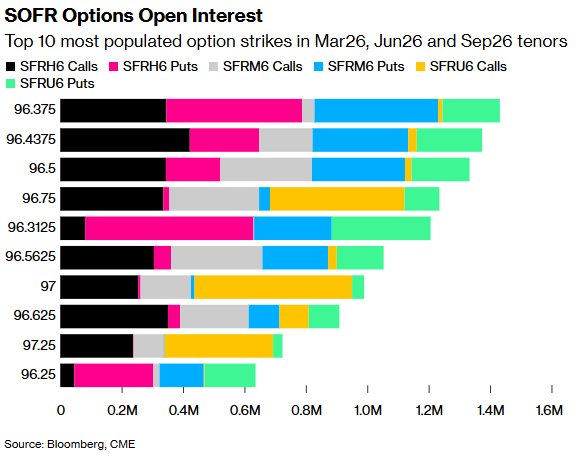
Overall, as of September 26, the most concentrated exercise price for each period was 96.375. There are still a large number of outstanding Mar26 call options, Mar26 put options, and June 26 put options here. Recent transactions surrounding the top exercise price include demand for SFRH6 96.375/96.4375/96.50 bullish option butterfly arbitrage and SFRM6 96.5625/96.4375/96.375 1x3x2 put option butterfly arbitrage.
US bond options premium
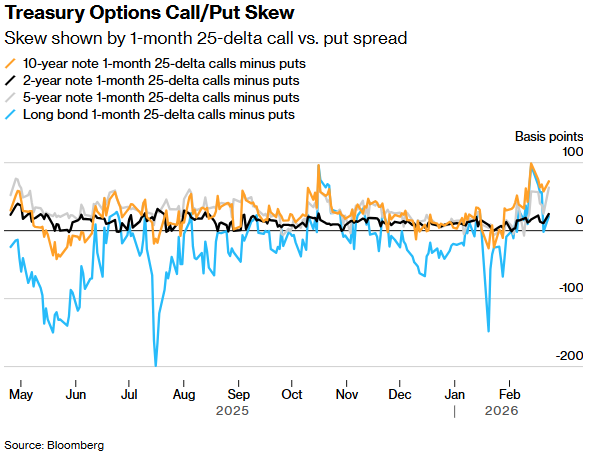
The premium paid to hedge the risk of US bonds has been further expanded, and the cost of call options is higher than that of put options, which indicates that traders are paying a higher price to hedge against the rise (rather than fall) of the bond market. This premium is most evident at the long end of the curve. The skewed indicators for 10-year and long-term bond options show that the popularity of bullish options has reached its highest level in months.