
- LIVE QUOTES
- LEARN
- HELP
 Nasdaq
 Wall Street Journal
EN
What Copart (CPRT)'s Earnings Miss And Margin Pressure Mean For Shareholders
- In February 2026, Copart reported second-quarter revenue of US$1,121.67 million and net income of US$350.73 million, both lower than a year earlier, with earnings per share of US$0.36 missing analyst expectations.
- Despite weaker quarterly performance, Copart’s balance sheet remains strong, with substantial cash reserves, no debt, and ongoing share repurchases that underline management’s confidence in the business.
- We’ll now examine how Copart’s revenue and earnings shortfall, alongside margin pressure, affects the previously positive investment narrative around future growth.
Outshine the giants: these 24 early-stage AI stocks could fund your retirement.
Copart Investment Narrative Recap
To own Copart, you need to believe its digital salvage marketplace can keep attracting insurance and non‑insurance volume, even when accident trends or insurer behavior shift. The latest quarter’s revenue and EPS miss, along with softer margins and a sharp share price reaction, sharpen the short term focus on whether insurance volumes stabilize. The biggest near term risk now is that weaker insurer-sourced units prove more persistent, rather than a temporary bump, but the core long term thesis is not yet clearly broken.
In that context, the February 2026 results matter: Q2 revenue slipped to US$1,121.67 million and net income to US$350.73 million, both below last year and below expectations, with operating margin contracting. At the same time, Copart’s roughly US$6.4 billion of liquidity, including about US$5.1 billion in cash and no debt, gives it financial flexibility to keep investing in technology and yard capacity that underpin the digital auction and value added services catalysts investors often focus on.
Yet investors should also be aware that if insurer volumes keep falling while costs stay elevated, Copart’s strong balance sheet might not fully shield shareholders from...
Read the full narrative on Copart (it's free!)
Copart's narrative projects $6.4 billion revenue and $2.1 billion earnings by 2028. This requires 11.1% yearly revenue growth and an earnings increase of about $0.5 billion from $1.6 billion today.
Uncover how Copart's forecasts yield a $48.89 fair value, a 34% upside to its current price.
Exploring Other Perspectives
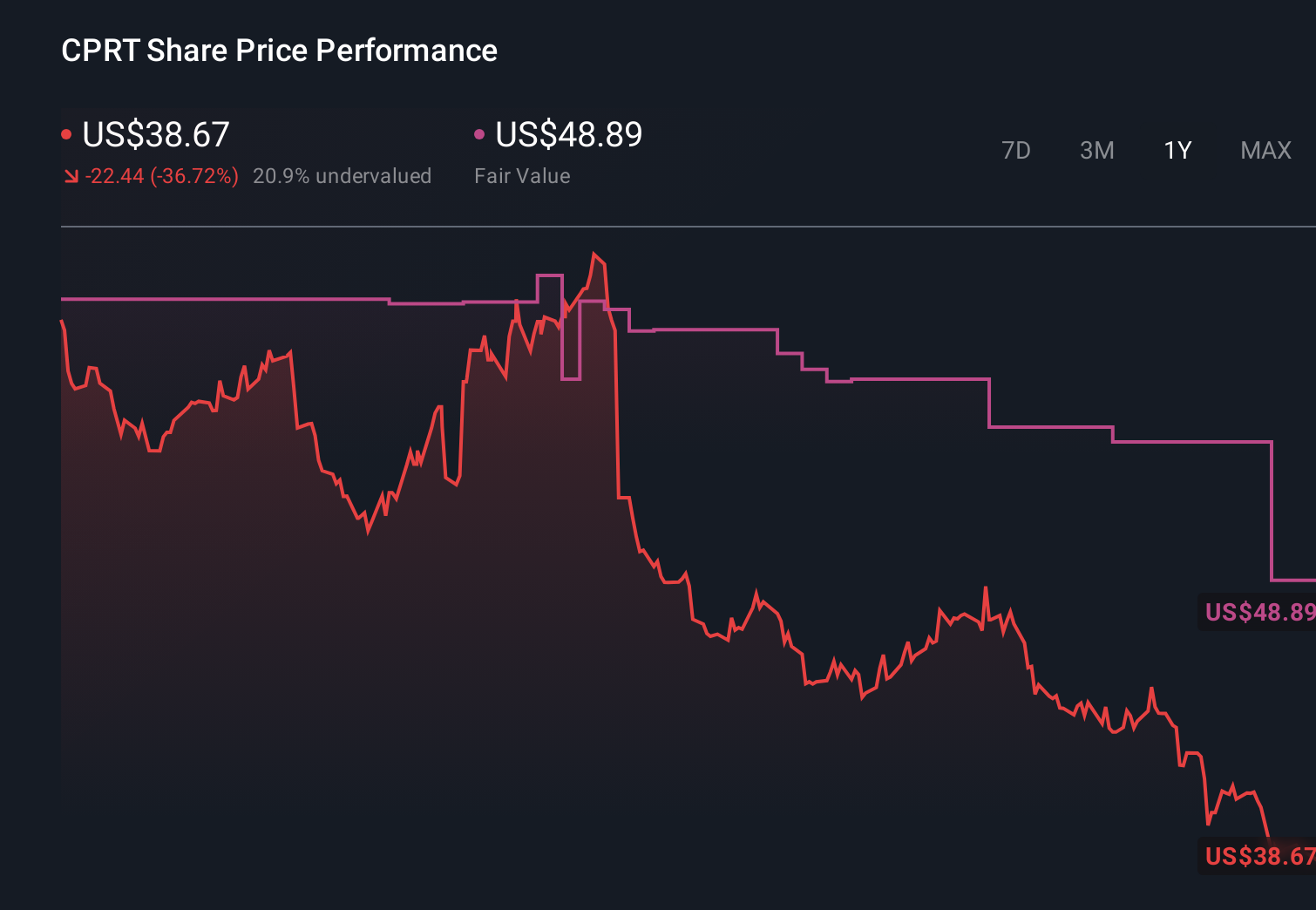
Before this miss, the most optimistic analysts were assuming revenue could reach about US$6.0 billion and earnings about US$1.9 billion by 2028, which looks far more upbeat than a narrative that highlights persistent declines in global insurance units; for you as a shareholder, this split shows how much views can diverge and why weaker recent volumes might lead some to rethink just how realistic those bullish paths really are.
Explore 11 other fair value estimates on Copart - why the stock might be worth as much as 53% more than the current price!
Reach Your Own Conclusion
Don't just follow the ticker - dig into the data and build a conviction that's truly your own.
- A great starting point for your Copart research is our analysis highlighting 4 key rewards that could impact your investment decision.
- Our free Copart research report provides a comprehensive fundamental analysis summarized in a single visual - the Snowflake - making it easy to evaluate Copart's overall financial health at a glance.
Curious About Other Options?
Markets shift fast. These stocks won't stay hidden for long. Get the list while it matters:
- Find 53 companies with promising cash flow potential yet trading below their fair value.
- Capitalize on the AI infrastructure supercycle with our selection of the 34 best 'picks and shovels' of the AI gold rush converting record-breaking demand into massive cash flow.
- Invest in the nuclear renaissance through our list of 85 elite nuclear energy infrastructure plays powering the global AI revolution.
This article by Simply Wall St is general in nature. We provide commentary based on historical data and analyst forecasts only using an unbiased methodology and our articles are not intended to be financial advice. It does not constitute a recommendation to buy or sell any stock, and does not take account of your objectives, or your financial situation. We aim to bring you long-term focused analysis driven by fundamental data. Note that our analysis may not factor in the latest price-sensitive company announcements or qualitative material. Simply Wall St has no position in any stocks mentioned.
Have feedback on this article? Concerned about the content? Get in touch with us directly. Alternatively, email editorial-team@simplywallst.com