
- LIVE QUOTES
- LEARN
- HELP
 Nasdaq
 Wall Street Journal
EN
Why Peabody Energy (BTU) Is Down 6.7% After Posting a 2025 Net Loss but Keeping Dividend
- Peabody Energy Corporation has reported its fourth-quarter and full-year 2025 results, with quarterly sales of US$1,022.3 million and net income of US$10.4 million, and a full-year sales figure of US$3,861.5 million alongside a net loss of US$52.9 million, while also declaring a quarterly dividend of US$0.075 per share payable on March 10, 2026.
- The swing from full-year net income of US$370.9 million in 2024 to a net loss in 2025, even as the board maintained a cash dividend, raises questions about how Peabody balances shareholder payouts with weaker recent profitability.
- Now, we will examine how Peabody's shift to a full-year net loss in 2025 reshapes its existing investment narrative and outlook.
The future of work is here. Discover the 30 top robotics and automation stocks leading the charge in AI-driven automation and industrial transformation.
Peabody Energy Investment Narrative Recap
To own Peabody today, you need to believe that coal can still generate acceptable returns despite a tough 2025 and intensifying decarbonization pressure. The shift to a US$52.9 million full year net loss, after US$370.9 million net income in 2024, puts more focus on near term earnings stability, which remains the key catalyst, and heightens concern around the biggest risk right now: structurally weaker coal demand and margins over time.
The most relevant recent announcement is the board’s decision to maintain a US$0.075 per share quarterly dividend, payable on March 10, 2026. Holding that payout in the face of a full year loss ties directly into the core catalyst of cash generation and capital returns, but also brushes up against the risk that legacy liabilities and a volatile coal market could constrain future distributions if profitability does not improve.
However, investors should also be aware that if coal demand erodes faster than expected and Peabody’s fixed costs and environmental obligations start to bite...
Read the full narrative on Peabody Energy (it's free!)
Peabody Energy's narrative projects $4.9 billion revenue and $468.2 million earnings by 2028. This requires 6.4% yearly revenue growth and roughly a $327 million earnings increase from $140.9 million today.
Uncover how Peabody Energy's forecasts yield a $34.80 fair value, in line with its current price.
Exploring Other Perspectives
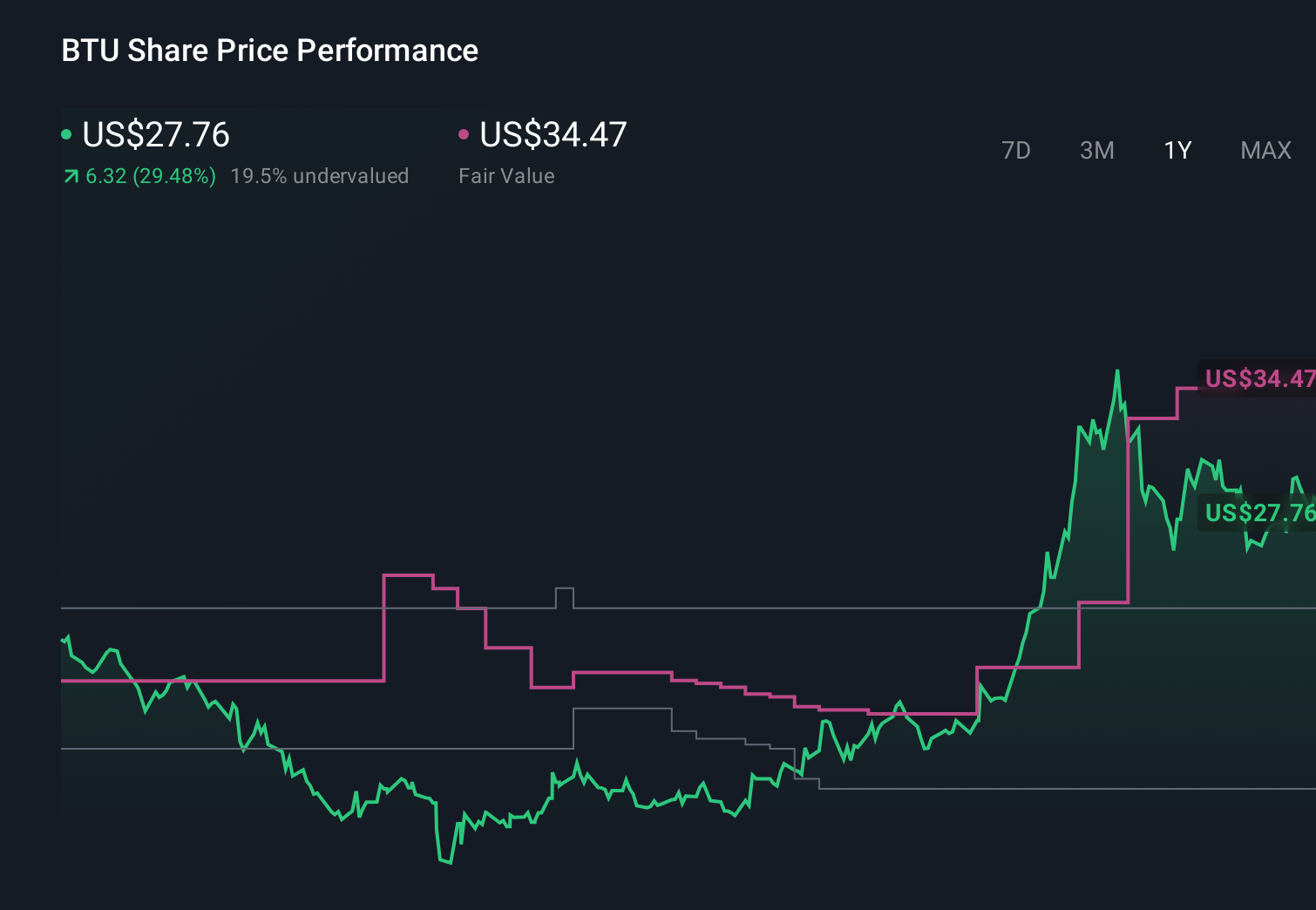
Before this weak 2025 result, the most pessimistic analysts still assumed Peabody could grow revenue to about US$4.3 billion and earnings to roughly US$406 million, but you can see how this latest loss might challenge those expectations and your own view of how coal demand, regulation and cash returns really fit together.
Explore 6 other fair value estimates on Peabody Energy - why the stock might be worth over 2x more than the current price!
Build Your Own Peabody Energy Narrative
Disagree with existing narratives? Create your own in under 3 minutes - extraordinary investment returns rarely come from following the herd.
- A great starting point for your Peabody Energy research is our analysis highlighting 2 key rewards that could impact your investment decision.
- Our free Peabody Energy research report provides a comprehensive fundamental analysis summarized in a single visual - the Snowflake - making it easy to evaluate Peabody Energy's overall financial health at a glance.
No Opportunity In Peabody Energy?
These stocks are moving-our analysis flagged them today. Act fast before the price catches up:
- Find 53 companies with promising cash flow potential yet trading below their fair value.
- The latest GPUs need a type of rare earth metal called Neodymium and there are only 30 companies in the world exploring or producing it. Find the list for free.
- This technology could replace computers: discover 23 stocks that are working to make quantum computing a reality.
This article by Simply Wall St is general in nature. We provide commentary based on historical data and analyst forecasts only using an unbiased methodology and our articles are not intended to be financial advice. It does not constitute a recommendation to buy or sell any stock, and does not take account of your objectives, or your financial situation. We aim to bring you long-term focused analysis driven by fundamental data. Note that our analysis may not factor in the latest price-sensitive company announcements or qualitative material. Simply Wall St has no position in any stocks mentioned.
Have feedback on this article? Concerned about the content? Get in touch with us directly. Alternatively, email editorial-team@simplywallst.com