
- LIVE QUOTES
- LEARN
- HELP
 Nasdaq
 Wall Street Journal
EN
Some Shareholders Feeling Restless Over Blue Star Limited's (NSE:BLUESTARCO) P/E Ratio
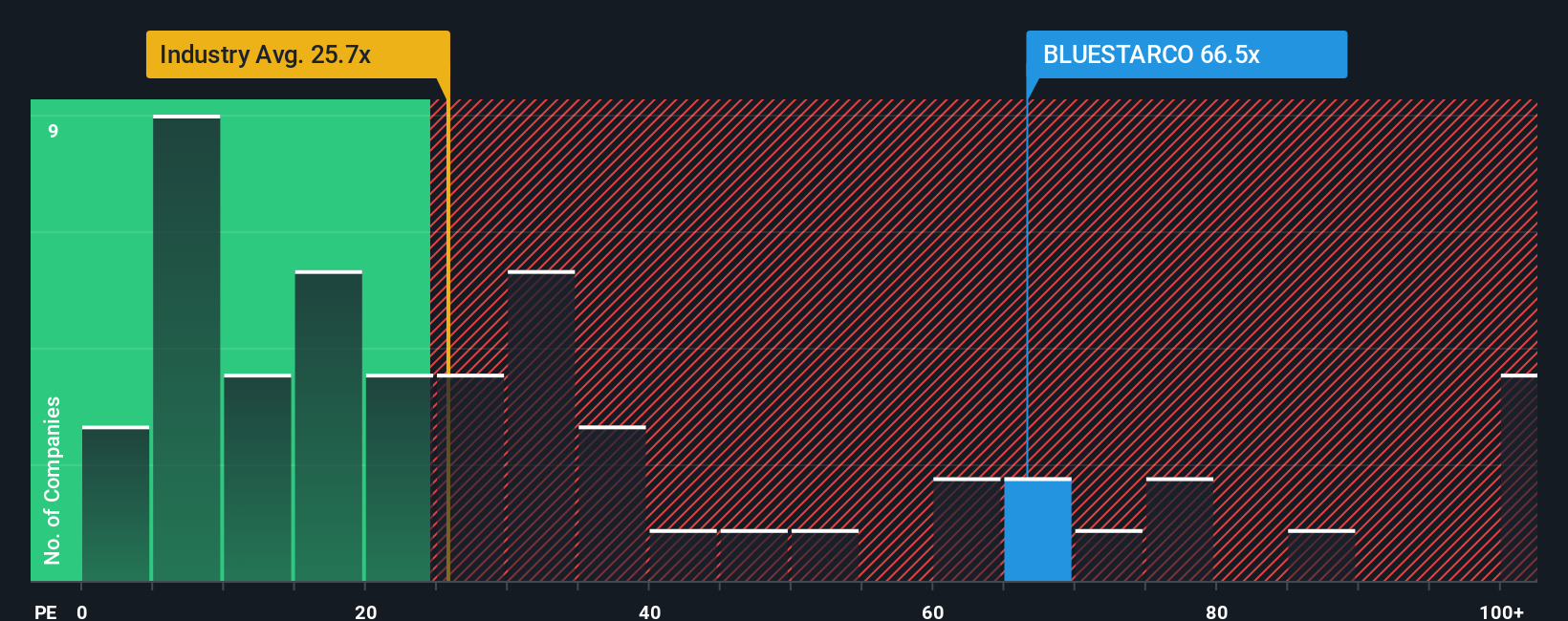
With a price-to-earnings (or "P/E") ratio of 66.5x Blue Star Limited (NSE:BLUESTARCO) may be sending very bearish signals at the moment, given that almost half of all companies in India have P/E ratios under 24x and even P/E's lower than 13x are not unusual. Although, it's not wise to just take the P/E at face value as there may be an explanation why it's so lofty.
With earnings growth that's inferior to most other companies of late, Blue Star has been relatively sluggish. It might be that many expect the uninspiring earnings performance to recover significantly, which has kept the P/E from collapsing. You'd really hope so, otherwise you're paying a pretty hefty price for no particular reason.
Check out our latest analysis for Blue Star
How Is Blue Star's Growth Trending?
In order to justify its P/E ratio, Blue Star would need to produce outstanding growth well in excess of the market.
If we review the last year of earnings growth, the company posted a worthy increase of 3.9%. Pleasingly, EPS has also lifted 113% in aggregate from three years ago, partly thanks to the last 12 months of growth. So we can start by confirming that the company has done a great job of growing earnings over that time.
Looking ahead now, EPS is anticipated to climb by 19% per annum during the coming three years according to the analysts following the company. Meanwhile, the rest of the market is forecast to expand by 20% each year, which is not materially different.
In light of this, it's curious that Blue Star's P/E sits above the majority of other companies. It seems most investors are ignoring the fairly average growth expectations and are willing to pay up for exposure to the stock. Although, additional gains will be difficult to achieve as this level of earnings growth is likely to weigh down the share price eventually.
The Final Word
Typically, we'd caution against reading too much into price-to-earnings ratios when settling on investment decisions, though it can reveal plenty about what other market participants think about the company.
We've established that Blue Star currently trades on a higher than expected P/E since its forecast growth is only in line with the wider market. Right now we are uncomfortable with the relatively high share price as the predicted future earnings aren't likely to support such positive sentiment for long. This places shareholders' investments at risk and potential investors in danger of paying an unnecessary premium.
We don't want to rain on the parade too much, but we did also find 2 warning signs for Blue Star (1 is a bit concerning!) that you need to be mindful of.
If P/E ratios interest you, you may wish to see this free collection of other companies with strong earnings growth and low P/E ratios.
Have feedback on this article? Concerned about the content? Get in touch with us directly. Alternatively, email editorial-team (at) simplywallst.com.
This article by Simply Wall St is general in nature. We provide commentary based on historical data and analyst forecasts only using an unbiased methodology and our articles are not intended to be financial advice. It does not constitute a recommendation to buy or sell any stock, and does not take account of your objectives, or your financial situation. We aim to bring you long-term focused analysis driven by fundamental data. Note that our analysis may not factor in the latest price-sensitive company announcements or qualitative material. Simply Wall St has no position in any stocks mentioned.