
- LIVE QUOTES
- LEARN
- HELP
 Nasdaq
 Wall Street Journal
EN
DCM Shriram (NSE:DCMSHRIRAM) Seems To Use Debt Quite Sensibly
Warren Buffett famously said, 'Volatility is far from synonymous with risk.' When we think about how risky a company is, we always like to look at its use of debt, since debt overload can lead to ruin. As with many other companies DCM Shriram Limited (NSE:DCMSHRIRAM) makes use of debt. But the real question is whether this debt is making the company risky.
When Is Debt Dangerous?
Debt and other liabilities become risky for a business when it cannot easily fulfill those obligations, either with free cash flow or by raising capital at an attractive price. Ultimately, if the company can't fulfill its legal obligations to repay debt, shareholders could walk away with nothing. However, a more common (but still painful) scenario is that it has to raise new equity capital at a low price, thus permanently diluting shareholders. Of course, plenty of companies use debt to fund growth, without any negative consequences. When we think about a company's use of debt, we first look at cash and debt together.
What Is DCM Shriram's Debt?
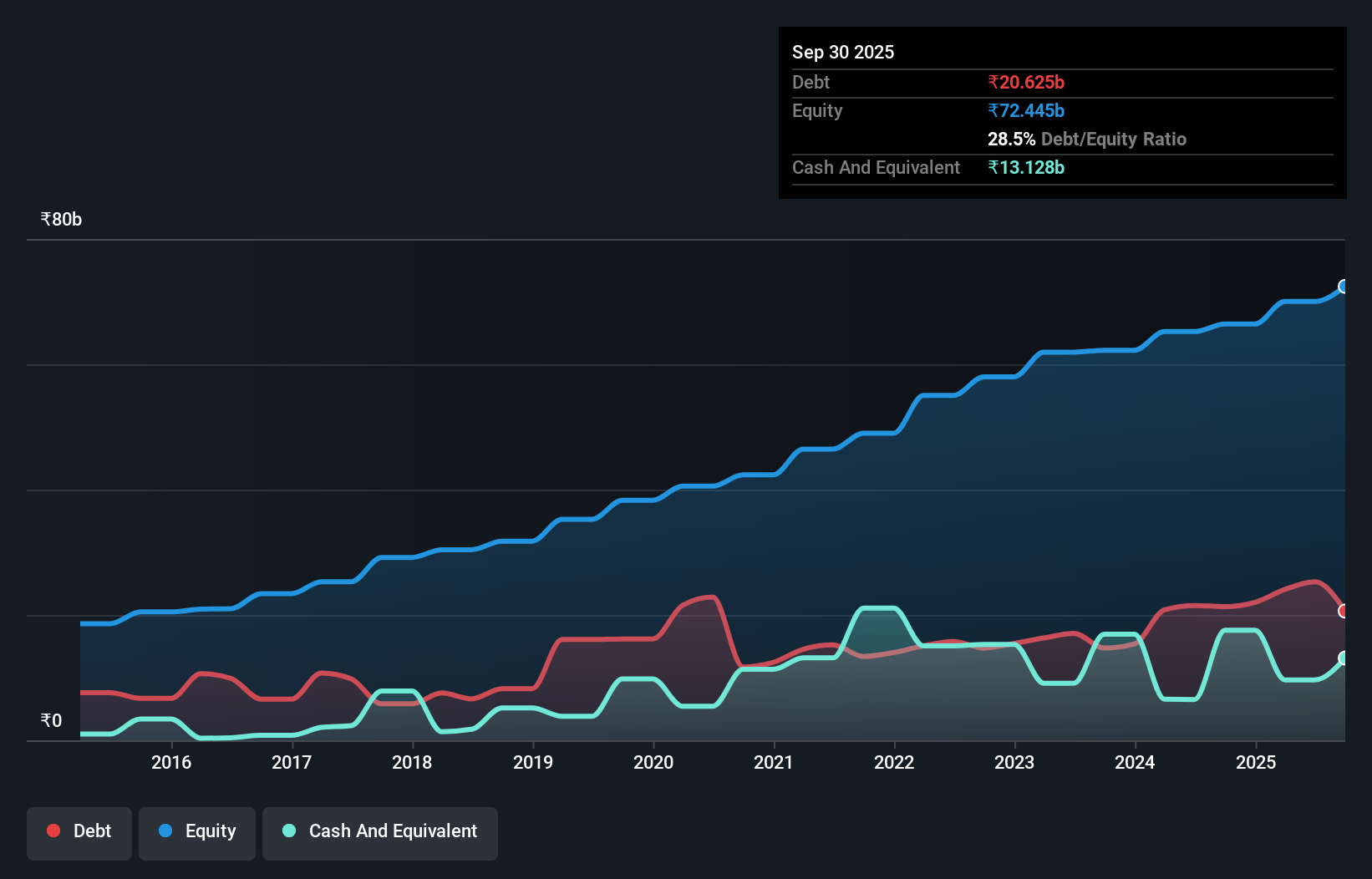
As you can see below, DCM Shriram had ₹20.6b of debt, at September 2025, which is about the same as the year before. You can click the chart for greater detail. However, because it has a cash reserve of ₹13.1b, its net debt is less, at about ₹7.50b.
How Healthy Is DCM Shriram's Balance Sheet?
We can see from the most recent balance sheet that DCM Shriram had liabilities of ₹35.3b falling due within a year, and liabilities of ₹24.5b due beyond that. On the other hand, it had cash of ₹13.1b and ₹10.6b worth of receivables due within a year. So its liabilities outweigh the sum of its cash and (near-term) receivables by ₹36.0b.
Of course, DCM Shriram has a market capitalization of ₹195.4b, so these liabilities are probably manageable. However, we do think it is worth keeping an eye on its balance sheet strength, as it may change over time.
Check out our latest analysis for DCM Shriram
We use two main ratios to inform us about debt levels relative to earnings. The first is net debt divided by earnings before interest, tax, depreciation, and amortization (EBITDA), while the second is how many times its earnings before interest and tax (EBIT) covers its interest expense (or its interest cover, for short). The advantage of this approach is that we take into account both the absolute quantum of debt (with net debt to EBITDA) and the actual interest expenses associated with that debt (with its interest cover ratio).
With net debt sitting at just 0.50 times EBITDA, DCM Shriram is arguably pretty conservatively geared. And it boasts interest cover of 9.9 times, which is more than adequate. On top of that, DCM Shriram grew its EBIT by 36% over the last twelve months, and that growth will make it easier to handle its debt. The balance sheet is clearly the area to focus on when you are analysing debt. But you can't view debt in total isolation; since DCM Shriram will need earnings to service that debt. So when considering debt, it's definitely worth looking at the earnings trend. Click here for an interactive snapshot.
Finally, while the tax-man may adore accounting profits, lenders only accept cold hard cash. So we always check how much of that EBIT is translated into free cash flow. In the last three years, DCM Shriram created free cash flow amounting to 14% of its EBIT, an uninspiring performance. For us, cash conversion that low sparks a little paranoia about is ability to extinguish debt.
Our View
The good news is that DCM Shriram's demonstrated ability to grow its EBIT delights us like a fluffy puppy does a toddler. But truth be told we feel its conversion of EBIT to free cash flow does undermine this impression a bit. When we consider the range of factors above, it looks like DCM Shriram is pretty sensible with its use of debt. While that brings some risk, it can also enhance returns for shareholders. When analysing debt levels, the balance sheet is the obvious place to start. But ultimately, every company can contain risks that exist outside of the balance sheet. Be aware that DCM Shriram is showing 2 warning signs in our investment analysis , and 1 of those shouldn't be ignored...
At the end of the day, it's often better to focus on companies that are free from net debt. You can access our special list of such companies (all with a track record of profit growth). It's free.
Have feedback on this article? Concerned about the content? Get in touch with us directly. Alternatively, email editorial-team (at) simplywallst.com.
This article by Simply Wall St is general in nature. We provide commentary based on historical data and analyst forecasts only using an unbiased methodology and our articles are not intended to be financial advice. It does not constitute a recommendation to buy or sell any stock, and does not take account of your objectives, or your financial situation. We aim to bring you long-term focused analysis driven by fundamental data. Note that our analysis may not factor in the latest price-sensitive company announcements or qualitative material. Simply Wall St has no position in any stocks mentioned.