
- LIVE QUOTES
- LEARN
- HELP
 Nasdaq
 Wall Street Journal
EN
Demand for AI computing power and storage explodes, and chip production capacity expansion begins! Semiconductor equipment welcomes a new round of bull market
The Zhitong Finance App learned that Wall Street financial giant Citigroup recently released a research report saying that in the global AI computing power infrastructure construction wave is in full swing and in the macro context of the “memory chip supercycle”, semiconductor equipment manufacturers — especially the three major semiconductor equipment giants ASML.US (ASML.US), Fanlin Group (LRCX.US), and Applied Materials (AMAT.US), will rapidly expand the production capacity of AI chips (AI GPU/AI ASIC) and DRAM/NAND memory chips The largest beneficiaries. In this research report, Citi predicts that the global semiconductor equipment sector will usher in a “Phase 2 upward cycle”, which means that it is expected to usher in a new round of bull market trajectory after the 2024-25 super bull market.
A team of Citigroup analysts led by Atif Malik, a well-known semiconductor industry analyst on Wall Street, predicts that as demand for AI chips and memory chips continues to surge, the three largest chip manufacturing giants in the world, TSMC, Samsung Electronics, and Intel, as well as memory chip manufacturer SK Hynix, will significantly raise semiconductor capital expenditure (capex) guidance for 2026 and beyond in upcoming financial disclosures, thus predicting that global semiconductor equipment (WFE) spending in 2026 is more likely to move closer to its “most optimistic forecast prospects.”
In terms of stock price trends, the US semiconductor equipment sector has been extremely strong since the beginning of the year. The ADR price of Asmack's US stock reached a record high at the beginning of 2026, rising more than 8% in a single day on January 2, rising 16% since the beginning of 2026, with a market capitalization close to 500 billion US dollars; the stock price of Fanlin Group's US stock market can be described as having repeatedly reached record highs since the second half of 2025, rising as high as 20% since the beginning of 2026; the stock price of applied materials also reached record highs at the beginning of 2026, with an increase of 15% since the beginning of the year.
The Citigroup analyst team emphasized that SK Hynix and Samsung Electronics' largest memory chip competitor Micron Technology raised the capital expenditure for the 2026 fiscal year (ending August 2026) from the previous 18 billion US dollars to 20 billion US dollars in a performance conference call in December 2025, which means a sharp increase of 45% over the previous year, with capital expenses for chip manufacturing plant construction almost doubling. Micron also said capital expenditure will continue to grow in fiscal year 2027. As the most direct competitor between Samsung Electronics and SK Hynix in the memory chip market, Micron's drastic production expansion measures may prompt these two Korean-based memory chip manufacturing giants to take corresponding capital expenditure expansion actions to maintain their market position.
It is worth noting that the market's strong expectations for TSMC's chip production capacity expansion not only focus on large-scale data center AI chip orders brought by the three AI chip leaders Nvidia, AMD, and Broadcom, but also the huge consumer electronics chip orders that Apple can bring every year. In the field of data center enterprise-grade high-performance SSDs (belonging to NAND terminal applications), SSD main control chips for high-performance NVMe (especially PCIe Gen5/Gen6) can be described as extremely dependent on TSMC's high-end process production capacity — this This means that TSMC's current production capacity is bound to be far from being able to meet the “never-ending orders” brought about by AI computing power and storage, and a major expansion of production capacity is imminent.
After Google launched the Gemini 3 AI application ecosystem in late November, this cutting-edge AI application immediately became popular all over the world, driving an instant surge in demand for Google's AI computing power. As soon as Gemini 3 series products were released, they brought huge AI token processing capacity, forcing Google to drastically reduce the amount of free access to Gemini 3 Pro and Nano Banana Pro, and also imposed temporary restrictions on Pro subscribers. Combined with South Korea's recent trade export data, the demand for SK Hynix and Samsung Electronics' HBM storage systems and enterprise-grade SSDs continued to be strong, further verifying that Wall Street called “The AI boom is still in the early stages of construction where the supply of computing power infrastructure is in short supply ”.
As the global hyperscale AI data center construction process led by technology giants such as Microsoft, Google, and Meta becomes more intense, all-round driver chip manufacturing giants are expanding production of advanced process AI chips at 3nm and below, and the expansion of COWS/3D advanced packaging production capacity and DRAM/NAND memory chip production capacity is greatly accelerated, and the long-term bull market logic of the semiconductor equipment sector can be described as getting stronger.
According to Wall Street giants Morgan Stanley, Citi, Loop Capital, and Wedbush, the global AI infrastructure investment wave with AI computing power hardware at the core is far from over. It is only at the beginning. Driven by an unprecedented “AI inference computing power demand storm”, the overall AI infrastructure investment wave, which will continue until 2030, is expected to reach 3 trillion to 4 trillion US dollars.
In 2026, a big wave of production capacity expansion by chip manufacturing giants will hit
According to this research report released by Citigroup, the main investment strategy for chip stocks in 2026 is definitely not a “broad focus on semiconductors,” but clearly falls on the leading semiconductor equipment sector in the stock market (that is, WFE related). Citigroup's semiconductor investment strategy locks in the value transmission chain of “a surge in Capex from major chip manufacturers to the expansion of the total WFE market size, to the expansion of orders/revenue/profit from semiconductor equipment leaders”, and bets that the semiconductor equipment boom will continue to rise in 2026.
Citigroup's latest estimates show that the global WFE market size model for 2026 is about US$115 billion (meaning +10% year-on-year, far higher than the average growth level of the past ten years), and points out that the three chip manufacturers (TSMC, Samsung, and Intel) together account for about 59% of this; at the same time, it emphasizes that the observed growth trend shows that the overall WFE in 2026 will be “closer” to its $126 billion bull market forecast scenario.
In particular, for TSMC, the king of chip foundries in the world, Citigroup expects TSMC's 2026 Capex guidance range to be about US$46-48 billion, and has determined that it may be drastically revised throughout the year (Citibank's communication with institutional investors “could reach 50 billion US dollars”). TSMC raised the 2025 capital expenditure range to 40 billion to 42 billion US dollars in the previous lower limit of the 38 billion to 42 billion US dollars range during the performance conference call in October last year.
According to Citi, the “computational power-storage-advanced chip manufacturing” chain driven by the AI infrastructure frenzy determines that semiconductor equipment capex stickiness is strong compared to any previous cycle: massive computing power requirements based on AI training/inference not only drive demand for advanced process logic chips, but also significantly increase the demand intensity of high-end storage chips (especially HBM/enterprise-level SSD-related); against the backdrop of increasing complexity of chip manufacturing processes, the “number of cutting-edge advanced processes/steps” per wafer has increased, and the device side shows that it is easier to demand continuity and orders Increased visibility.
Citi's WFE model split hypothesis clearly states NAND +30%, DRAM +12%, and Foundry/Logic +10% (its model caliber), indicating that the agency believes that 2026 will not be supported by a single AI computing power sector, but rather a more balanced expansion of advanced chip manufacturing processes. This is often more beneficial to semiconductor equipment leaders with a wide coverage and complete product portfolio (such as focusing on various aspects such as deposition/etching/cleaning/measurement/advanced packaging).
According to the latest semiconductor industry outlook data recently released by the World Semiconductor Trade Statistics Organization (WSTS), the global chip demand expansion trend is expected to continue to be strong in 2026, and MCU chips and analog chips, which have continued to weaken since the end of 2022, are also expected to enter a strong recovery curve.
WSTS expects that after a strong rebound in 2024, the global semiconductor market will grow by 22.5% in 2025, with a total value of 772.2 billion US dollars, which is higher than the forecast given by WSTS in spring; the total value of the semiconductor market in 2026 is expected to expand significantly to 9755 billion US dollars on the basis of strong growth in 2025, close to the market size target of 1 trillion US dollars in 2030 predicted by SEMI, which means it is expected to increase 26% year over year.
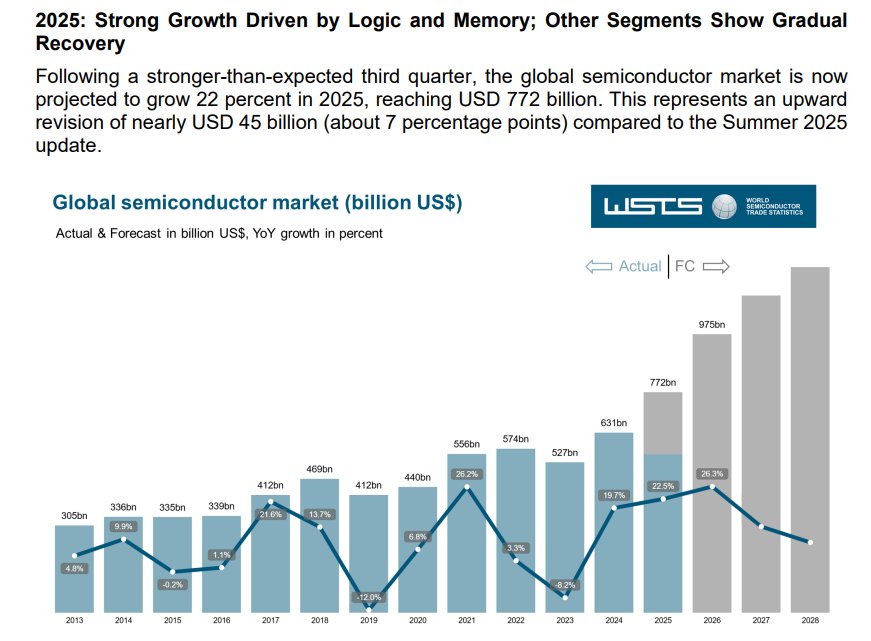
WSTS said that this strong growth trend for two consecutive years will be mainly due to continued strong momentum in the logic chip field dominated by AI GPUs and the storage sector dominated by HBM storage systems, DDR5 RDIMMs, and enterprise-grade data center SSDs. It is expected that both fields will achieve extremely strong double-digit growth, thanks to the continued strong expansion of demand in fields such as artificial intelligence inference systems and cloud computing infrastructure.
Lithography, etching, thin film deposition and advanced packaging equipment are entering a surge in demand
The Citigroup analyst team said that the “Phase 2 upward cycle” means that the valuation anchor shifts from “bottoming out of valuation” to “continuous profit improvement”: when the overall WFE market shifts from a benchmark scenario to a bull market scenario, the profit elasticity of leading companies in the semiconductor equipment field may even outweigh revenue elasticity (scale effect+increased capacity utilization + increased share of high-end processes), so Citigroup chose to express the “upward slope” outlook.
Asmack, Fanlin Group, and Applied Materials, the three major semiconductor equipment giants, can be described as covering lithography, etching, thin film deposition, and advanced packaging equipment, and these semiconductor equipment segments are the best semiconductor equipment fields to benefit from the AI infrastructure frenzy and storage supercycle.
The EUV lithography machine launched by Dutch-based lithography giant ASML Holding NV (ASML Holding NV) can be said to be an unprecedented global AI boom since 2023. Under the global AI boom, the largest chipmakers such as TSMC and Samsung Electronics have created essential semiconductor devices that provide the most core driving force for the world's most cutting-edge AI applications such as ChatGPT and Claude. Also, in the macro context of the current round of “storage supercycle” which is likely to continue until 2027, SK Hynix and Storage giants such as Micron Technology are building machine systems necessary for core storage devices such as HBM storage systems and enterprise SSD/DDR in data centers.
The performance transition of AI GPU/AI ASIC accelerators is highly dependent on advanced logic nodes (3nm to 2nm, or more advanced 1.8nm, 1.6nm), and the key layers of these nodes must use EUV or even high-NA EUV to achieve smaller line widths and higher yield; Asmack's EUV/high-NA EUV devices clearly target the mass production needs of 3nm and sub-2nm logic and DRAM with the world's leading performance, and are a “bottleneck capital product” for the expansion of advanced manufacturing processes. At the same time, AI training/inference also simultaneously ignites the “storage side”: HBM storage systems with AI GPU/AI ASICs not only require DRAM manufacturing nodes to continue to shrink, but also require etching, thin film deposition, CMP processes, and the most critical stacking and interconnection links (TSV/hybrid bonding advanced packaging, etc.) to significantly increase manufacturing steps and equipment density.
In its latest technical interpretation, Applied Materials indicated that the HBM manufacturing process added about 19 additional material engineering steps compared to traditional DRAM, and claimed that its most advanced semiconductor equipment covered about 75% of these steps, and also released a major bonding system for advanced packaging/memory chip stacking. Therefore, HBM and advanced packaging manufacturing equipment can be described as a strong growth vector for the company in the medium to long term, and new chip manufacturing node devices such as GAA (surround gate) /backside power supply (BPD) will be the core driving force for the company's next round of strong growth. Compared to applied materials, the advantages of Lam Research (Lam Research) fully focus on the high depth ratio (HAR) etching/deposition and related process capabilities required for advanced HBM storage, and 3D NAND/advanced DRAM structures and interconnections are also highly dependent on Fanlin's exclusive HAR process.