
- LIVE QUOTES
- LEARN
- HELP
 Nasdaq
 Wall Street Journal
EN
The stock price “dropped” for half a year. Did Legendary Creatures (LEGN.US) unearthed a valuation trap or a gold pit?
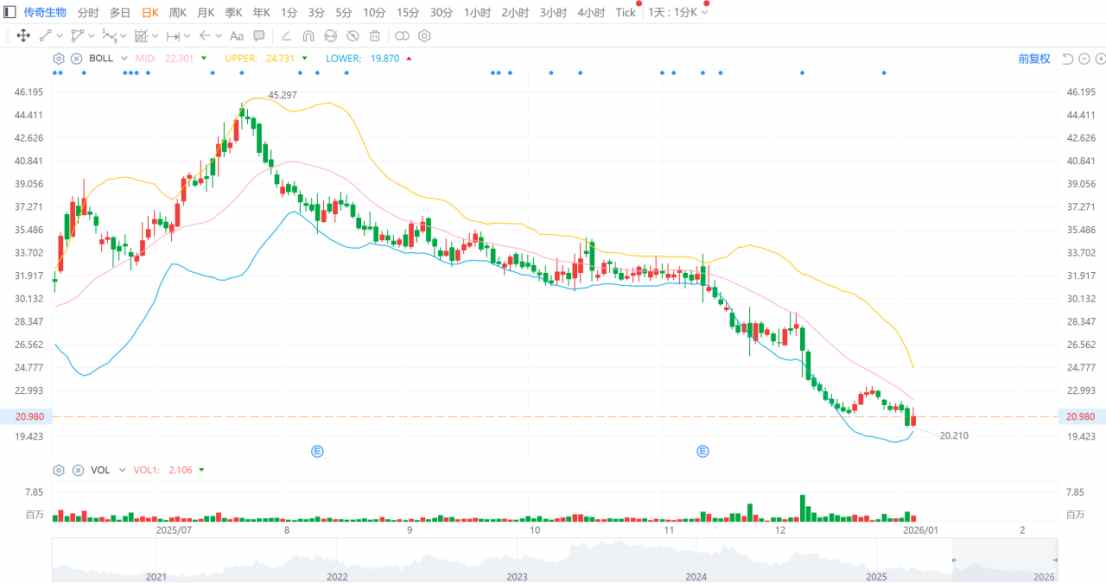
On January 6, LEGN.US (LEGN.US) stock price experienced a wave of decline within 5 minutes of opening. Although a sharp rebound followed to drive the highest daily increase of more than 6%, that wave of decline fixed the lowest point of Legendary Biotech's stock price in 2026 at $20.21.
If the intraday high of $45.29 on July 23, 2025 is used as a starting point, Legendary Biotech's stock price apparently experienced a wave of “backdrops” over a period of five and a half months, with the biggest drop in the range reaching 55.38%.
Legendary Creature's performance clearly “stunned” many investors. After all, on July 21, two days before Legendary Biotech's stock price reached a high point in 2025, the company also made headlines in major investment bank research reports. Of the 21 analysts, 20 gave a “buy” rating, with an average target price of $76.42. There is room for an increase of 83.74% compared to its closing price of $41.59 on July 18.
Now, with the company's phased stock price being refreshed to a low point, the market's valuation judgment on it has reached a crossroads that had never been thought of before: is Legendary Creature losing room for growth or is the gold pit getting deeper and deeper?
From a low level of fluctuation to an accelerated decline
Looking back at the BOLL line over the 5-and-a-half-month period of stock price decline, it can be seen that after peaking in the intraday market on July 23 last year, Legendary Biotech emerged from a period of rapid decline that continued for 14 trading days, and the stock price quickly fell from BOLL's online trajectory to the lower track.
This period is a typical technical regression in response to a large increase in stock prices in the previous period. As can be seen from the combined volume, within this period of decline, Legendary Biotech's trading volume did not exceed 2 million shares in each trading day, which is significantly lower than the previous stock price increase period, indicating that investor sentiment inside and outside the market is relatively stable, and this round of market performance is more in line with market expectations.
Next, investors can see two stages with clearly different trend styles, namely from August 11 to November 11 of last year and November 12 of last year to the present.
Let's look at the first segment of the market. In the process from August 11 to November 11 last year, it can be seen from a technical perspective that although the BOLL line opened downward, it gradually narrowed, leading the stock price to fluctuate sideways from a downward trend. During this period, the company's stock price basically fluctuated mechanically along the middle and lower trajectory of the BOLL line, and the overall trend showed an insignificant bearish decline. Even though there was a wave of trends impacting the BOLL line trajectory in mid-October, no obvious support for an increase in trading volume was observed, and no effective physical K-line breakthrough was formed. Technically, it was a “fake breakthrough” in the BOLL line index. Subsequent company stock prices remained sideways until November 11.
In terms of volume, the daily trading volume of legendary creatures continues to be weak at this stage, indicating that off-market holders are in a wait-and-see state of holding coins, and the market lacks carrying capacity, causing stock prices to fluctuate sideways and trading volume is scarce.
However, on November 12, when Legendary Biotech's stock price fell 2.67% on the same day, showing a clear trading volume in the early stages. Since then, the BOLL line also began to expand downward, and the company's stock price began to fall rapidly along the lower BOLL line. Although the trend stopped falling on November 25, after only 7 trading days, Legendary Creatures closed down 7.15% on December 8 and came out of a “nine consecutive negative”, with obvious signs of accelerating the decline.
Judging from the situation in recent trading days, although the continuous decline along the BOLL line shows clear signs of overselling, regardless of the strength of the recent stock price rebound and daily trading volume performance, it shows a lack of OTC carrying capacity, and investors clearly wait and see. However, Legendary Biotech's closing on January 6 was compounded by a narrowing of the BOLL line opening, which seems to indicate another stoppage trend.
Is there a “panic stampede” or a “return of value” behind the sharp drop?
In fact, the logic behind the two periods of decline that occurred after November 12 was not the same.
On November 12, Legendary Biotech revealed its 2025 Q3 financial results. Needless to say, the highlights clearly came from the sales performance of core products. Financial reports show that the company's core product, BCMA Car-T therapy Carvykti (Sidaki Orense), performed well in the current period, with sales reaching US$524 million in a single quarter, an increase of 83% over the previous year, a record high since launch. Driven by new high sales in a single quarter, Carvykti's sales reached US$1,332 billion in the first nine months of 2025, doubling 112% year on year. It is expected to achieve profit within the year, or help the company achieve its overall profit target in 2026.
However, the expected results clearly failed to arouse investors' desire to buy. On the contrary, the other side of Legend Biotech's current earnings report began to accelerate the fall of some market chips into the bag.
At present, Legendary Biotech's revenue mainly consists of two parts: licensing revenue and partnership revenue. The 25Q3 financial report shows that the company's current licensing revenue was only US$10.5 million, compared to US$17.1 million for the same period in 2024. Last quarter, Legend Biotech's license revenue just plummeted from $90.8 million in the same period in 2024 to $35.3 million. In other words, as R&D progress progressed, Legendary Biotech did not receive new license revenue for the past 2 quarters, and the milestone payments obtained in the early stages are gradually being exhausted.
On the other hand, the cooperative revenue linked to the sales of Carvykti terminals was not reflected in the company's profit side due to the sharp increase in sales of this product. The reason for this is due to the huge capital expenses and operating expenses brought about by the company's expansion of production, which brought the company's overall cost to 113 million US dollars in the current period. The year-on-year growth rate surpassed the revenue growth rate by 116%.
At the end of the day, however, these financial problems are only a phased performance of Carvykti's global production capacity climb, and do not affect the underlying logic of the legendary organism's intrinsic value growth. That is, with Carvykti as the world's first and only approved second-line treatment for multiple myeloma, BCMA CAR-T therapy continues to advance in the treatment path of this indication, and eventually becomes the cornerstone drug for multiple myeloma treatment, thus enjoying broad market dividends.
Therefore, feedback on the performance of the secondary market is that Legendary Biotech's decline was quickly stopped after the 25Q3 earnings report. However, just as the company's stock price began to rebound towards the BOLL line on December 5, a critical blow from partner Johnson & Johnson seemed to hit the legendary creature's life.
On December 9, Johnson & Johnson announced Phase 3 MajesteC-3 clinical data for its self-developed BCMA/CD3 dual antibody (Tecvayli) combined with CD38 monoclonal antibody (Darzalex) at the ASH2025 conference.
In terms of main clinical endpoints, the 36-month PFS rate in the Tec-Dara combination treatment group reached 83.4%, the control group DPD/DVD reached 29.7%, and the DPD/DVD median PFS in the control group reached 18.1 months. The Tec-Dara combination treatment group had not yet reached, and HR reached 0.17, which significantly mitigated disease progression.
It is worth mentioning that compared to the legendary BCMA CAR-T drug Carvykti, the 34-month long-term follow-up study of the similar study CARTITUDE-4 released last year, its 30-month median PFS rate was 59.4%, which is clearly lower than the treatment data for Tec-Dara's current combined treatment group. Also, compared with Carvykti's 34-month follow-up data, the Tec-Dara combination treatment group has surpassed its 84.6% response rate and 76.4% OS rate, and is consistent with Carvykti in terms of negative residual lesion rate.
In this context, the Tec-Dara combination treatment group is still a 100% equity product of Johnson & Johnson as a spot product, so there is a “benefit-oriented resource bias” by Johnson & Johnson on this combination therapy in the market, which is an important reason affecting the valuation of Legendary Biotech and causing its stock price to plummet.
It is easy to see that the market's relationship between the Tec-Dara combination treatment group and Carvykti is a competitive relationship by default, but in reality, as the timing of application of CAR-T and bispecific antibody therapy in the treatment process advances, the question of the optimal order of use becomes more critical. From an immunological point of view, continuous exposure to bispecific antibodies may cause T cell depletion, which in turn affects the efficacy of subsequent CAR-T treatments. Furthermore, “treatment-free intervals” (treatment-free intervals) are also a major advantage of CAR-T treatment.
On the other hand, Gilead has now joined hands with ArcellX to enter MM indications, and key phase II clinical data for its product Anito-cel has been read. Although the clinical performance of Anito-cel is far less than that of Carvykti, which has completed the Cartude-4 clinical study for more advanced 2-4 line treatments, there is little chance of a “stepping on the head” in the short term, but its safety potential still makes the market worry that future pricing power and market share of CARVYKTI in the indication market will be affected by competition, monopoly price or premium Big discount.
However, in the context of the high pricing and long-term maintenance value of MM drugs, if Johnson & Johnson wants to maintain an advantage in the CAR-T treatment market for this indication, Carvykti is undoubtedly the only option available, and the emergence of the Tec-Dara combination treatment group is more like another weight for Johnson & Johnson in the MM market. Adding the two products can only further stabilize Johnson & Johnson's market advantage, and this will not affect the pace at which Johnson & Johnson exploits Carvykti's potential. Judging from this logic, the current market sales rate of Legendary Biotech, which has gone through a sharp decline, is only 4.26 times, which is far lower than the industry average of 9.27 times. It is clearly very attractive to investors who are optimistic.