
- LIVE QUOTES
- LEARN
- HELP
 Nasdaq
 Wall Street Journal
EN
Sumitomo Chemical Company (TSE:4005) Takes On Some Risk With Its Use Of Debt
Warren Buffett famously said, 'Volatility is far from synonymous with risk.' So it seems the smart money knows that debt - which is usually involved in bankruptcies - is a very important factor, when you assess how risky a company is. We can see that Sumitomo Chemical Company, Limited (TSE:4005) does use debt in its business. But is this debt a concern to shareholders?
What Risk Does Debt Bring?
Generally speaking, debt only becomes a real problem when a company can't easily pay it off, either by raising capital or with its own cash flow. Ultimately, if the company can't fulfill its legal obligations to repay debt, shareholders could walk away with nothing. However, a more usual (but still expensive) situation is where a company must dilute shareholders at a cheap share price simply to get debt under control. Of course, debt can be an important tool in businesses, particularly capital heavy businesses. When we think about a company's use of debt, we first look at cash and debt together.
What Is Sumitomo Chemical Company's Net Debt?
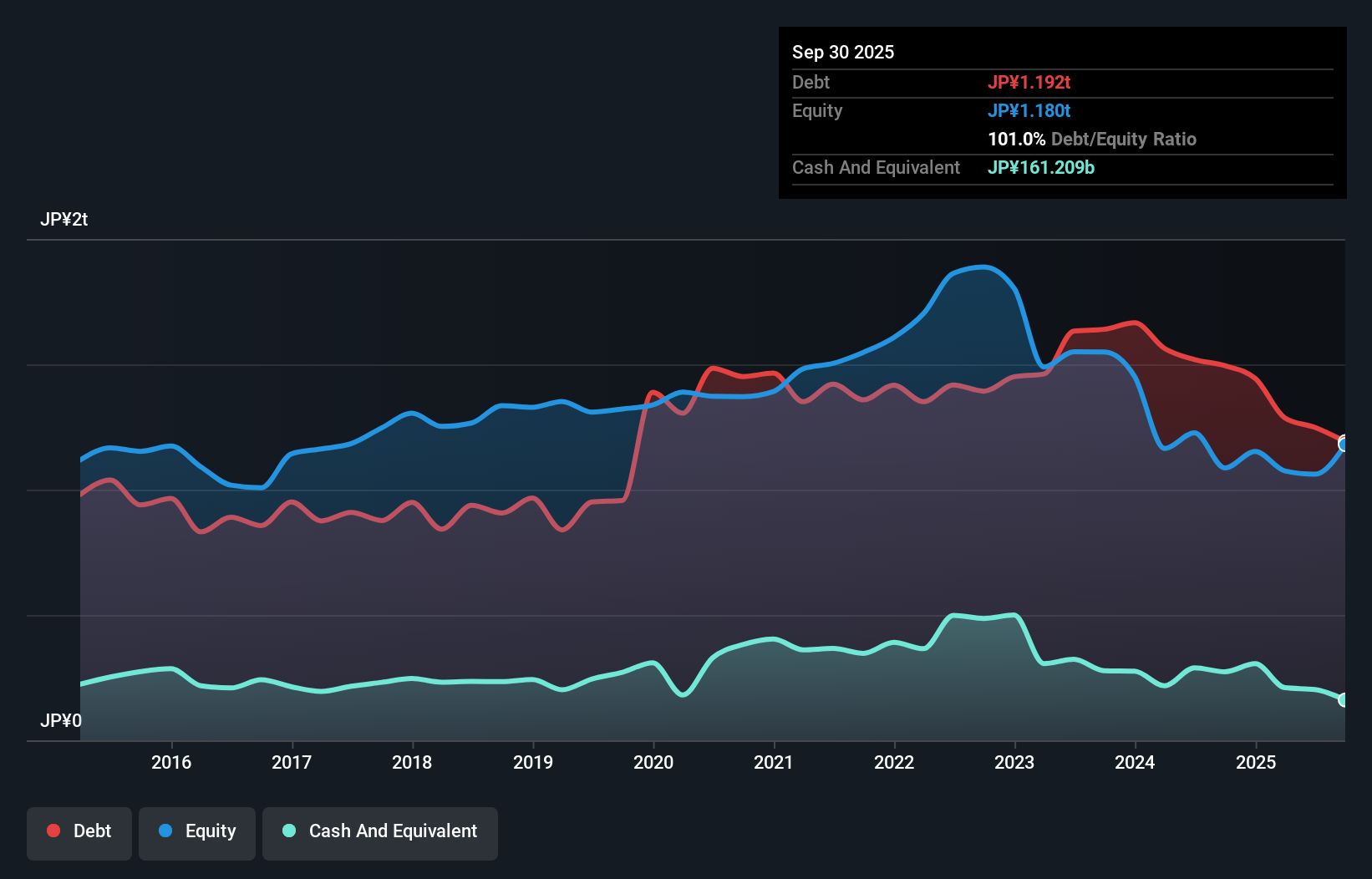
As you can see below, Sumitomo Chemical Company had JP¥1.19t of debt at September 2025, down from JP¥1.49t a year prior. On the flip side, it has JP¥161.2b in cash leading to net debt of about JP¥1.03t.
How Healthy Is Sumitomo Chemical Company's Balance Sheet?
The latest balance sheet data shows that Sumitomo Chemical Company had liabilities of JP¥932.6b due within a year, and liabilities of JP¥1.25t falling due after that. Offsetting these obligations, it had cash of JP¥161.2b as well as receivables valued at JP¥581.5b due within 12 months. So its liabilities outweigh the sum of its cash and (near-term) receivables by JP¥1.44t.
This deficit casts a shadow over the JP¥742.6b company, like a colossus towering over mere mortals. So we'd watch its balance sheet closely, without a doubt. At the end of the day, Sumitomo Chemical Company would probably need a major re-capitalization if its creditors were to demand repayment.
Check out our latest analysis for Sumitomo Chemical Company
In order to size up a company's debt relative to its earnings, we calculate its net debt divided by its earnings before interest, tax, depreciation, and amortization (EBITDA) and its earnings before interest and tax (EBIT) divided by its interest expense (its interest cover). This way, we consider both the absolute quantum of the debt, as well as the interest rates paid on it.
Sumitomo Chemical Company's net debt is 3.5 times its EBITDA, which is a significant but still reasonable amount of leverage. However, its interest coverage of 1k is very high, suggesting that the interest expense on the debt is currently quite low. Notably, Sumitomo Chemical Company made a loss at the EBIT level, last year, but improved that to positive EBIT of JP¥173b in the last twelve months. There's no doubt that we learn most about debt from the balance sheet. But it is future earnings, more than anything, that will determine Sumitomo Chemical Company's ability to maintain a healthy balance sheet going forward. So if you want to see what the professionals think, you might find this free report on analyst profit forecasts to be interesting.
But our final consideration is also important, because a company cannot pay debt with paper profits; it needs cold hard cash. So it's worth checking how much of the earnings before interest and tax (EBIT) is backed by free cash flow. During the last year, Sumitomo Chemical Company produced sturdy free cash flow equating to 64% of its EBIT, about what we'd expect. This free cash flow puts the company in a good position to pay down debt, when appropriate.
Our View
Mulling over Sumitomo Chemical Company's attempt at staying on top of its total liabilities, we're certainly not enthusiastic. But on the bright side, its interest cover is a good sign, and makes us more optimistic. Once we consider all the factors above, together, it seems to us that Sumitomo Chemical Company's debt is making it a bit risky. That's not necessarily a bad thing, but we'd generally feel more comfortable with less leverage. The balance sheet is clearly the area to focus on when you are analysing debt. However, not all investment risk resides within the balance sheet - far from it. These risks can be hard to spot. Every company has them, and we've spotted 3 warning signs for Sumitomo Chemical Company (of which 1 is potentially serious!) you should know about.
If you're interested in investing in businesses that can grow profits without the burden of debt, then check out this free list of growing businesses that have net cash on the balance sheet.
Have feedback on this article? Concerned about the content? Get in touch with us directly. Alternatively, email editorial-team (at) simplywallst.com.
This article by Simply Wall St is general in nature. We provide commentary based on historical data and analyst forecasts only using an unbiased methodology and our articles are not intended to be financial advice. It does not constitute a recommendation to buy or sell any stock, and does not take account of your objectives, or your financial situation. We aim to bring you long-term focused analysis driven by fundamental data. Note that our analysis may not factor in the latest price-sensitive company announcements or qualitative material. Simply Wall St has no position in any stocks mentioned.