
- LIVE QUOTES
- LEARN
- HELP
 Nasdaq
 Wall Street Journal
EN
Is It Too Late To Consider Palomar Holdings (PLMR) After 175% Three-Year Surge?
- Investors may be wondering if Palomar Holdings at about US$136 a share still offers value, or if most of the easy gains are already on the table.
- The stock has posted returns of 0.9% over 7 days, 16.9% over 30 days, 3.2% year to date, 29.0% over 1 year and 175.0% over 3 years. This naturally raises questions about how much of the story is already reflected in the current price.
- Recent attention on Palomar has focused on how the market is pricing its growth profile, balance sheet quality and specialty insurance focus, as investors reassess risk across the sector. These factors help frame the current share price and are useful context before you weigh up what the company might be worth.
- On our checks, Palomar scores 2 out of 6 on valuation, as shown in this valuation score. Next we will look at what different valuation methods suggest about the stock and then finish with a simple framework that can help you make sense of these numbers in a more practical way.
Palomar Holdings scores just 2/6 on our valuation checks. See what other red flags we found in the full valuation breakdown.
Approach 1: Palomar Holdings Excess Returns Analysis
The Excess Returns model looks at how much profit a company is expected to generate over and above the return that equity investors typically require, then capitalises those surplus profits into an intrinsic value per share.
For Palomar Holdings, the inputs are anchored on its equity base and earnings power. Book Value is $33.14 per share, while Stable EPS is $10.39 per share, based on weighted future Return on Equity estimates from 7 analysts. The Average Return on Equity is 21.76%, compared with a Cost of Equity of $3.32 per share, which results in an Excess Return of $7.07 per share.
The model also uses a Stable Book Value of $47.75 per share, sourced from weighted future Book Value estimates from 6 analysts. Combining these assumptions, the Excess Returns framework produces an estimated intrinsic value of about $239 per share.
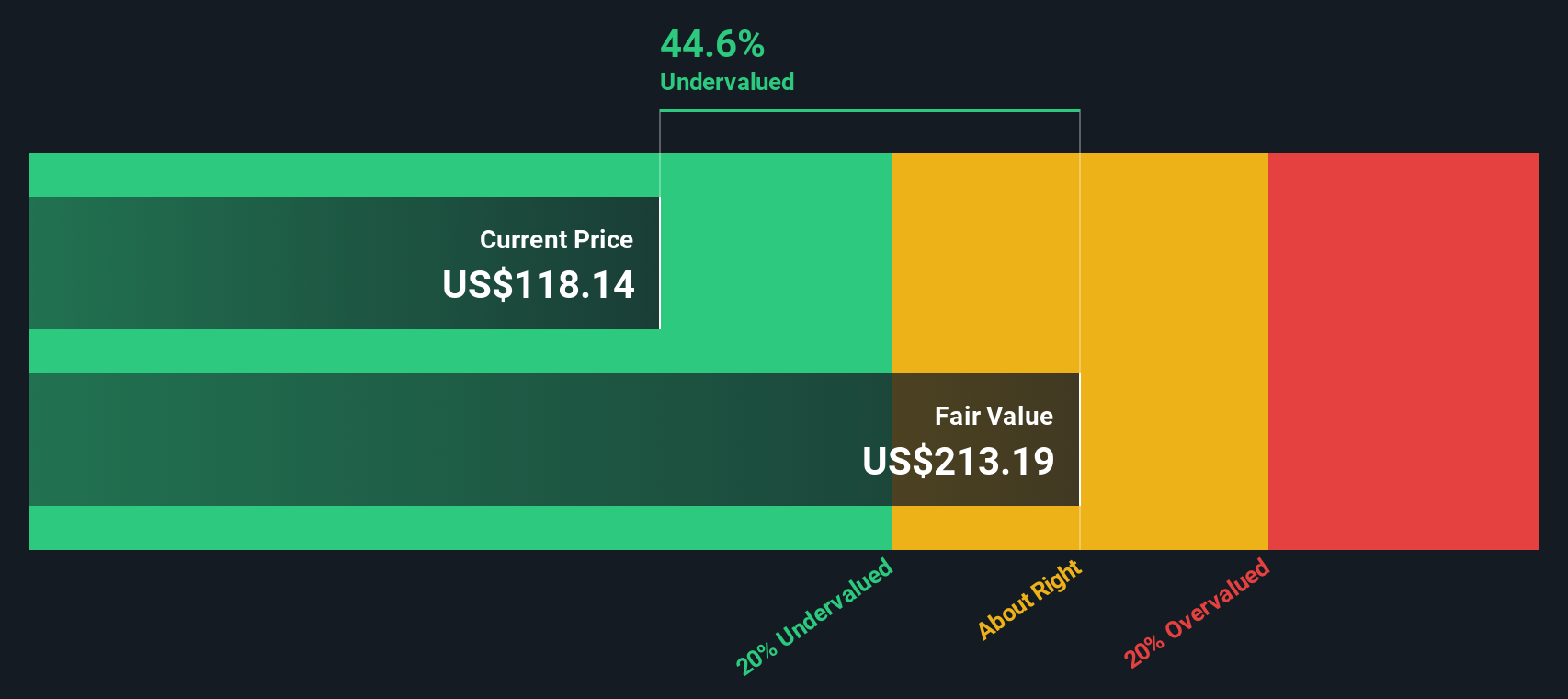
Against a current share price of about $136, this indicates the stock is 43.1% undervalued using this method.
Result: UNDERVALUED
Our Excess Returns analysis suggests Palomar Holdings is undervalued by 43.1%. Track this in your watchlist or portfolio, or discover 882 more undervalued stocks based on cash flows.
Approach 2: Palomar Holdings Price vs Earnings
For a profitable company like Palomar Holdings, the P/E ratio is a useful way to link what you pay per share to the earnings the business is currently generating. It gives you a quick sense of how many dollars investors are paying for each dollar of earnings today.
What counts as a “normal” P/E often reflects two things: how fast investors expect earnings to grow and how much risk they see in those earnings. Higher expected growth or lower perceived risk can support a higher P/E, while slower expected growth or higher risk usually justifies a lower one.
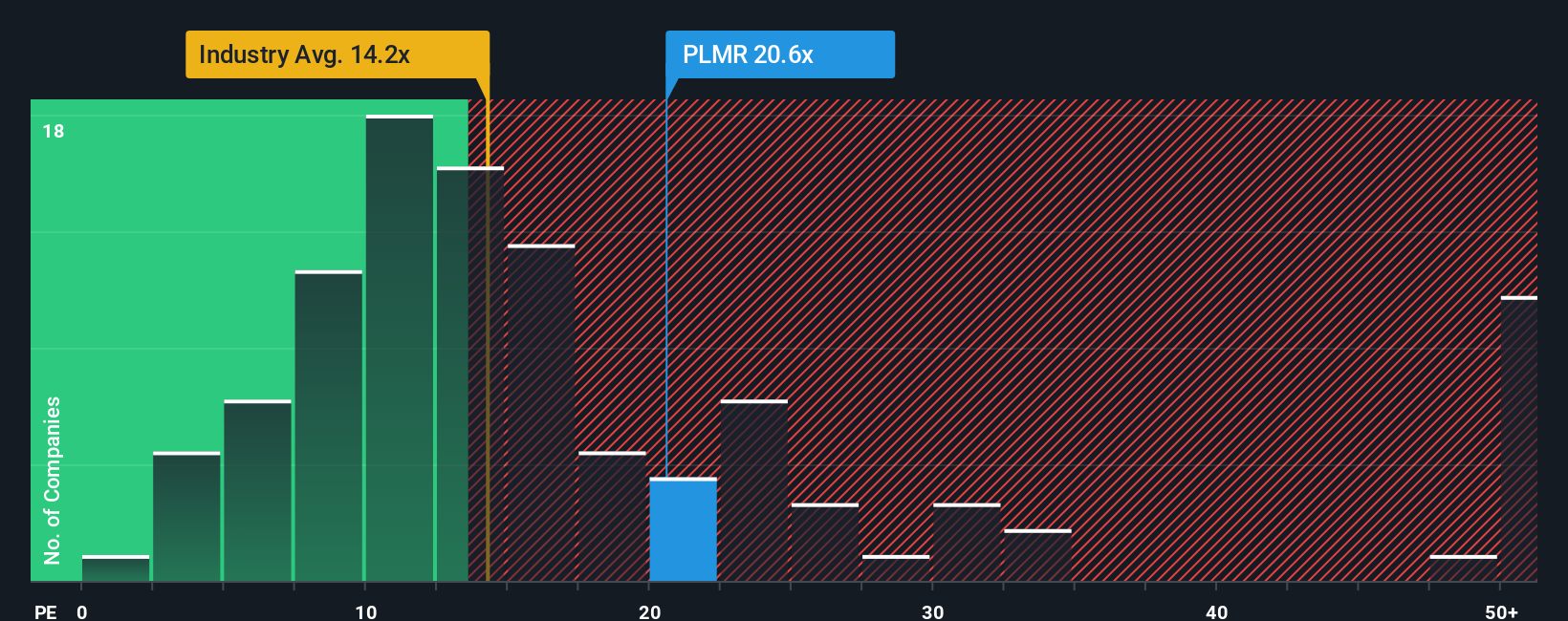
Palomar currently trades on a P/E of 20.50x. That sits above the Insurance industry average of 13.04x and above the peer group average of 15.98x. Simply Wall St’s Fair Ratio for Palomar is 15.49x. This Fair Ratio is a proprietary view of what P/E might be reasonable once you consider earnings growth characteristics, profit margins, the company’s size, its industry and the key risks.
Because it incorporates these fundamentals, the Fair Ratio can be more informative than a simple comparison with industry or peer averages. Against this Fair Ratio of 15.49x, Palomar’s current P/E of 20.50x suggests the shares are pricing in a higher multiple than the model implies.
Result: OVERVALUED
P/E ratios tell one story, but what if the real opportunity lies elsewhere? Discover 1450 companies where insiders are betting big on explosive growth.
Upgrade Your Decision Making: Choose your Palomar Holdings Narrative
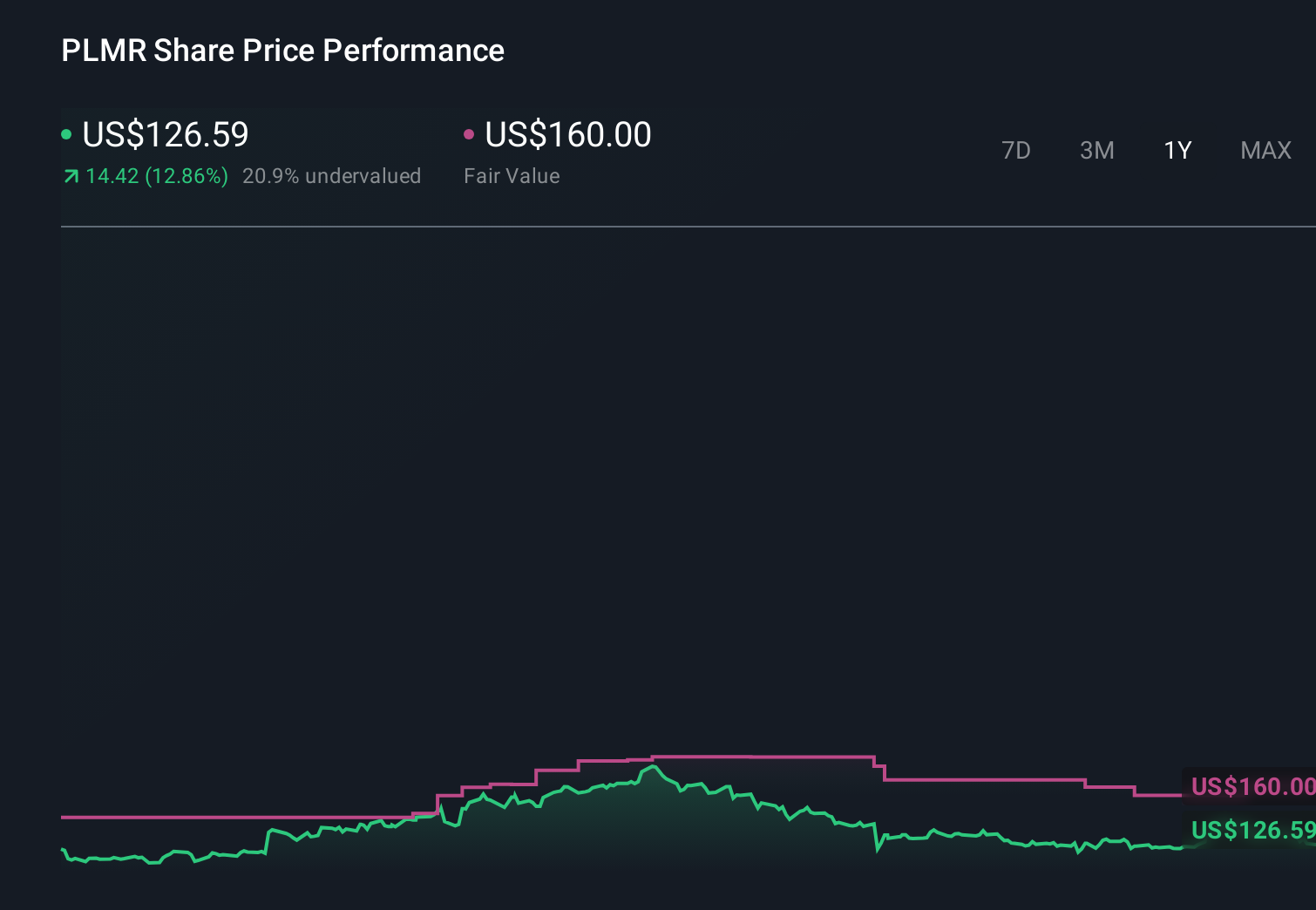
Earlier we mentioned that there is an even better way to understand valuation. On Simply Wall St’s Community page you can use Narratives to spell out your story for Palomar Holdings, link that story to specific assumptions about future revenue, earnings and margins, translate those into a Fair Value, then compare that Fair Value to the current price as new news or earnings arrive. This means two investors can look at the same data and reach very different yet clearly explained views. For example, one Narrative might lean toward the higher fair value of about US$239 per share based on stronger earnings power, while another might sit closer to the lower analyst target of about US$134 if the focus is on sector headwinds and P/E risk.
Do you think there's more to the story for Palomar Holdings? Head over to our Community to see what others are saying!
This article by Simply Wall St is general in nature. We provide commentary based on historical data and analyst forecasts only using an unbiased methodology and our articles are not intended to be financial advice. It does not constitute a recommendation to buy or sell any stock, and does not take account of your objectives, or your financial situation. We aim to bring you long-term focused analysis driven by fundamental data. Note that our analysis may not factor in the latest price-sensitive company announcements or qualitative material. Simply Wall St has no position in any stocks mentioned.
Have feedback on this article? Concerned about the content? Get in touch with us directly. Alternatively, email editorial-team@simplywallst.com