
- LIVE QUOTES
- LEARN
- HELP
 Nasdaq
 Wall Street Journal
EN
Will Apple Launch A Foldable iPhone Before 2027? You Can't Peek Inside Cupertino— But Traders Are Wagering On It
Even as Apple Inc. (NASDAQ:AAPL) stays silent on its product roadmap, prediction markets are increasingly confident the company will unveil a foldable iPhone before the decade’s end.
Prediction Markets Bet Apple Will Fold Before 2027
Speculation around a foldable iPhone has moved beyond analyst notes and supply-chain whispers and into real-money markets.
On Polymarket, traders currently assign a 76% probability that Apple will release a foldable iPhone before 2027, up sharply from about 42% in mid-December.
Roughly $2,990 has been wagered on the outcome so far, reflecting growing conviction that Apple is nearing a major hardware shift.
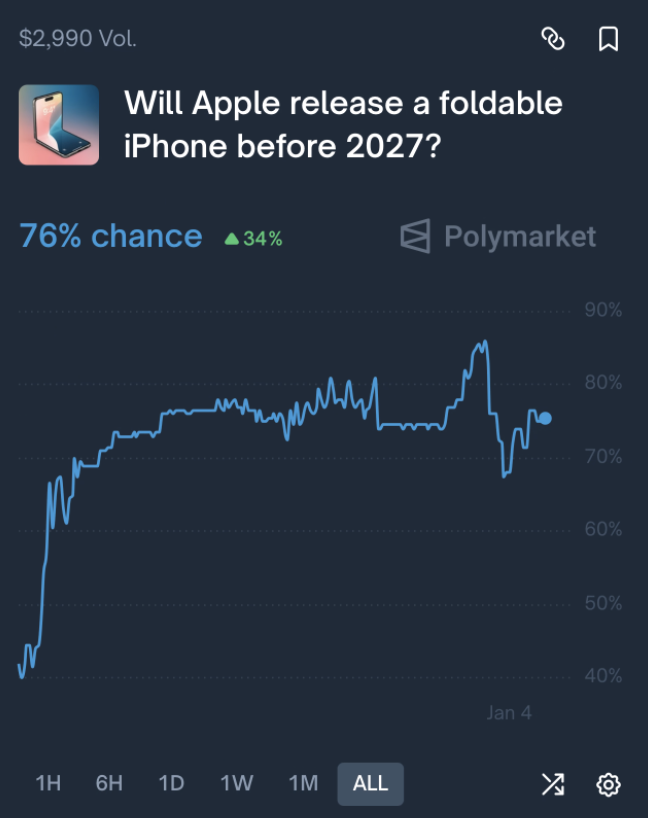
Polymarket prices represent crowd sentiment rather than confirmed information, but past markets have often reacted quickly to leaks, reports, and manufacturing signals.
Kalshi Traders Focus On One Question: How Expensive?
While Polymarket tracks timing, Kalshi traders are betting on price — and they are expecting a premium device.

Kalshi's contracts suggest a strong consensus that a foldable iPhone would debut at the high end of Apple's lineup. Traders assign roughly 92% odds that the device would cost at least $1,800, 80% odds that it would be priced above $2,000, and 65% odds that it would reach $2,200 or more.
The market's implied forecast price hovers around $2,290, signaling expectations that Apple would position the foldable as an ultra-premium product rather than a mass-market iPhone.

Why Traders Think Apple Is Getting Close
Apple has never publicly confirmed plans for a foldable phone, but the company has filed numerous foldable-related patents over the years.
Meanwhile, rivals including Samsung Electronics Co. (OTC:SSNLF), Alphabet Inc.'s (NASDAQ:GOOG) (NASDAQ:GOOGL) Google, and Huawei Technologies already sell foldable smartphones, putting pressure on Apple to eventually respond — though typically on its own timeline.
Reports suggesting a possible fall 2026 launch window have helped fuel trading activity, even as Apple maintains its long-standing policy of not commenting on unannounced products.
Last month, a fresh leak indicated that the rumored foldable iPhone will focus on being ultra-thin and durable, even if that means sidelining familiar features like Face ID.
Samsung has revealed what may be one of last year's most consequential foldable devices, introducing the Galaxy Z TriFold—a three-panel phone that folds twice to open into an approximately 10-inch, tablet-sized display—signaling a potential reset of expectations for foldables.
By showcasing the device now, with U.S. availability slated for early 2026, Samsung is staking an early lead and setting the pace rather than allowing Apple to define the category.
Benzinga Edge Stock Rankings show that Apple has a strong medium and long-term outlook, despite its shares remaining under short-term pressure. Click here to see how it stacks up against its peers.

Read Next:
- Apple Faces 2026 iPhone Sales Slump, But Still Best Positioned Vs. Peers, Counterpoint Research Says
Disclaimer: This content was partially produced with the help of Benzinga Neuro and was reviewed and published by Benzinga editors.
Image via Shutterstock