
- LIVE QUOTES
- LEARN
- HELP
 Nasdaq
 Wall Street Journal
EN
Here's Why It's Unlikely That V.S. Industry Berhad's (KLSE:VS) CEO Will See A Pay Rise This Year
Key Insights
- V.S. Industry Berhad's Annual General Meeting to take place on 9th of January
- Total pay for CEO Sem Gan includes RM1.05m salary
- Total compensation is 2,763% above industry average
- Over the past three years, V.S. Industry Berhad's EPS fell by 43% and over the past three years, the total loss to shareholders 45%
The results at V.S. Industry Berhad (KLSE:VS) have been quite disappointing recently and CEO Sem Gan bears some responsibility for this. At the upcoming AGM on 9th of January, shareholders can hear from the board including their plans for turning around performance. They will also get a chance to influence managerial decision-making through voting on resolutions such as executive remuneration, which may impact firm value in the future. The data we present below explains why we think CEO compensation is not consistent with recent performance.
See our latest analysis for V.S. Industry Berhad
Comparing V.S. Industry Berhad's CEO Compensation With The Industry
According to our data, V.S. Industry Berhad has a market capitalization of RM1.8b, and paid its CEO total annual compensation worth RM1.9m over the year to July 2025. That's a notable decrease of 15% on last year. Notably, the salary which is RM1.05m, represents a considerable chunk of the total compensation being paid.
For comparison, other companies in the Malaysian Electronic industry with market capitalizations ranging between RM810m and RM3.2b had a median total CEO compensation of RM67k. Accordingly, our analysis reveals that V.S. Industry Berhad pays Sem Gan north of the industry median. Moreover, Sem Gan also holds RM97m worth of V.S. Industry Berhad stock directly under their own name, which reveals to us that they have a significant personal stake in the company.
| Component | 2025 | 2024 | Proportion (2025) |
| Salary | RM1.1m | RM1.8m | 55% |
| Other | RM861k | RM453k | 45% |
| Total Compensation | RM1.9m | RM2.2m | 100% |
Speaking on an industry level, nearly 74% of total compensation represents salary, while the remainder of 26% is other remuneration. In V.S. Industry Berhad's case, non-salary compensation represents a greater slice of total remuneration, in comparison to the broader industry. If total compensation veers towards salary, it suggests that the variable portion - which is generally tied to performance, is lower.
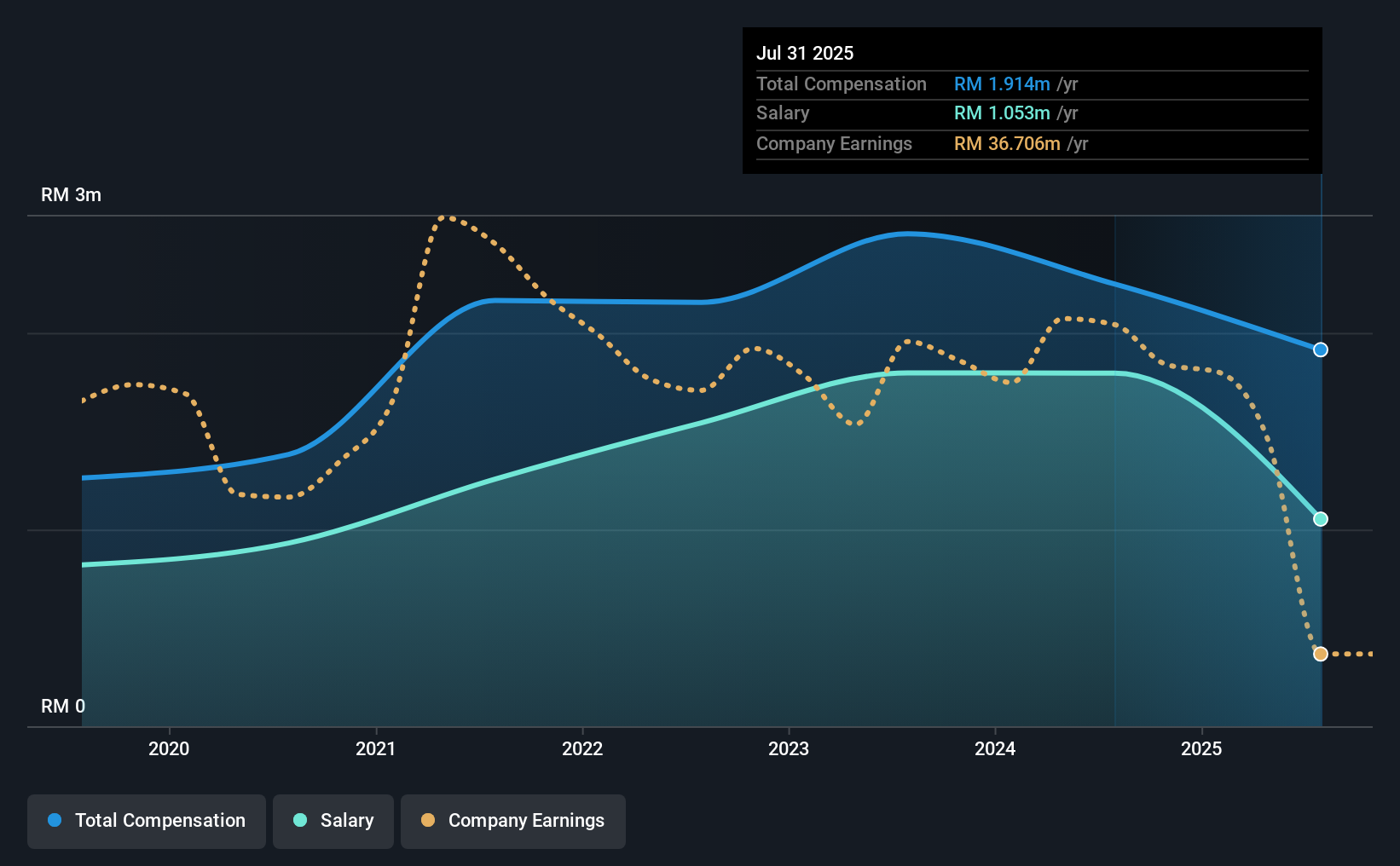
V.S. Industry Berhad's Growth
V.S. Industry Berhad has reduced its earnings per share by 43% a year over the last three years. Its revenue is down 11% over the previous year.
Few shareholders would be pleased to read that EPS have declined. And the impression is worse when you consider revenue is down year-on-year. So given this relatively weak performance, shareholders would probably not want to see high compensation for the CEO. Historical performance can sometimes be a good indicator on what's coming up next but if you want to peer into the company's future you might be interested in this free visualization of analyst forecasts.
Has V.S. Industry Berhad Been A Good Investment?
Few V.S. Industry Berhad shareholders would feel satisfied with the return of -45% over three years. Therefore, it might be upsetting for shareholders if the CEO were paid generously.
In Summary...
Given that shareholders haven't seen any positive returns on their investment, not to mention the lack of earnings growth, this may suggest that few of them would be willing to award the CEO with a pay rise. At the upcoming AGM, management will get a chance to explain how they plan to get the business back on track and address the concerns from investors.
While it is important to pay attention to CEO remuneration, investors should also consider other elements of the business. That's why we did some digging and identified 1 warning sign for V.S. Industry Berhad that you should be aware of before investing.
Arguably, business quality is much more important than CEO compensation levels. So check out this free list of interesting companies that have HIGH return on equity and low debt.
Have feedback on this article? Concerned about the content? Get in touch with us directly. Alternatively, email editorial-team (at) simplywallst.com.
This article by Simply Wall St is general in nature. We provide commentary based on historical data and analyst forecasts only using an unbiased methodology and our articles are not intended to be financial advice. It does not constitute a recommendation to buy or sell any stock, and does not take account of your objectives, or your financial situation. We aim to bring you long-term focused analysis driven by fundamental data. Note that our analysis may not factor in the latest price-sensitive company announcements or qualitative material. Simply Wall St has no position in any stocks mentioned.