
- LIVE QUOTES
- LEARN
- HELP
 Nasdaq
 Wall Street Journal
EN
Is GOODPEOPLE (KOSDAQ:033340) Using Too Much Debt?
David Iben put it well when he said, 'Volatility is not a risk we care about. What we care about is avoiding the permanent loss of capital.' It's only natural to consider a company's balance sheet when you examine how risky it is, since debt is often involved when a business collapses. Importantly, GOODPEOPLE Co., Ltd. (KOSDAQ:033340) does carry debt. But the more important question is: how much risk is that debt creating?
Why Does Debt Bring Risk?
Debt assists a business until the business has trouble paying it off, either with new capital or with free cash flow. Ultimately, if the company can't fulfill its legal obligations to repay debt, shareholders could walk away with nothing. While that is not too common, we often do see indebted companies permanently diluting shareholders because lenders force them to raise capital at a distressed price. Of course, plenty of companies use debt to fund growth, without any negative consequences. When we examine debt levels, we first consider both cash and debt levels, together.
What Is GOODPEOPLE's Net Debt?
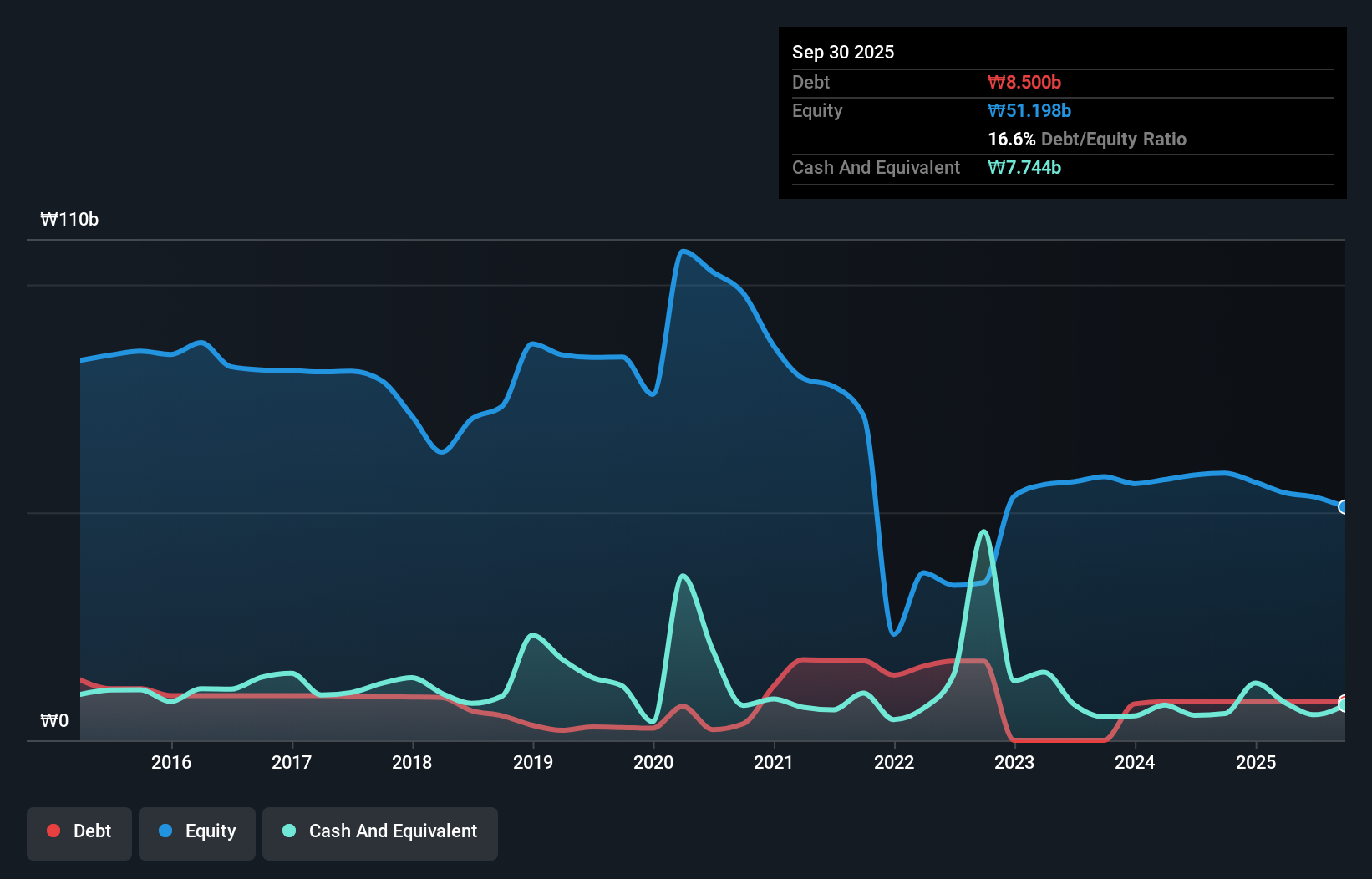
The chart below, which you can click on for greater detail, shows that GOODPEOPLE had ₩8.50b in debt in September 2025; about the same as the year before. However, it also had ₩7.74b in cash, and so its net debt is ₩756.1m.
A Look At GOODPEOPLE's Liabilities
According to the last reported balance sheet, GOODPEOPLE had liabilities of ₩15.5b due within 12 months, and liabilities of ₩9.09b due beyond 12 months. Offsetting this, it had ₩7.74b in cash and ₩8.27b in receivables that were due within 12 months. So its liabilities total ₩8.62b more than the combination of its cash and short-term receivables.
Of course, GOODPEOPLE has a market capitalization of ₩175.2b, so these liabilities are probably manageable. But there are sufficient liabilities that we would certainly recommend shareholders continue to monitor the balance sheet, going forward. Carrying virtually no net debt, GOODPEOPLE has a very light debt load indeed. When analysing debt levels, the balance sheet is the obvious place to start. But it is GOODPEOPLE's earnings that will influence how the balance sheet holds up in the future. So if you're keen to discover more about its earnings, it might be worth checking out this graph of its long term earnings trend.
Check out our latest analysis for GOODPEOPLE
In the last year GOODPEOPLE had a loss before interest and tax, and actually shrunk its revenue by 8.0%, to ₩79b. That's not what we would hope to see.
Caveat Emptor
Importantly, GOODPEOPLE had an earnings before interest and tax (EBIT) loss over the last year. To be specific the EBIT loss came in at ₩5.0b. When we look at that and recall the liabilities on its balance sheet, relative to cash, it seems unwise to us for the company to have any debt. Quite frankly we think the balance sheet is far from match-fit, although it could be improved with time. Another cause for caution is that is bled ₩8.3b in negative free cash flow over the last twelve months. So suffice it to say we do consider the stock to be risky. There's no doubt that we learn most about debt from the balance sheet. However, not all investment risk resides within the balance sheet - far from it. We've identified 1 warning sign with GOODPEOPLE , and understanding them should be part of your investment process.
If you're interested in investing in businesses that can grow profits without the burden of debt, then check out this free list of growing businesses that have net cash on the balance sheet.
Have feedback on this article? Concerned about the content? Get in touch with us directly. Alternatively, email editorial-team (at) simplywallst.com.
This article by Simply Wall St is general in nature. We provide commentary based on historical data and analyst forecasts only using an unbiased methodology and our articles are not intended to be financial advice. It does not constitute a recommendation to buy or sell any stock, and does not take account of your objectives, or your financial situation. We aim to bring you long-term focused analysis driven by fundamental data. Note that our analysis may not factor in the latest price-sensitive company announcements or qualitative material. Simply Wall St has no position in any stocks mentioned.