
- LIVE QUOTES
- LEARN
- HELP
 Nasdaq
 Wall Street Journal
EN
IPO Preview | From smart vision to AI and HPC, can Longxun Semiconductor's visit to Hong Kong start a second growth curve?
In a wave of A-share technology companies seeking a “secondary listing” of H shares to expand international capital channels, another star company in the semiconductor sector has taken a critical step.
Recently, Longxun Semiconductor (688486.SH), which is listed on the Science and Technology Innovation Board of the Shanghai Stock Exchange, officially began its H-share IPO process.
As a typical Fabless (fabless) chip design company, Longxun Semiconductor focuses on the development and sale of integrated circuits, and its product matrix is firmly locked in the two major growth tracks of smart video chips and high-speed interconnect chips. According to Frost & Sullivan's report, in the 2024 global video bridge chip market, Longxun Semiconductor ranked fifth in the world in terms of revenue, leading the way among mainland Chinese manufacturers.
With its core competencies in SerDes, high-speed interface protocol processing, and high-definition audio and video processing, the company is trying to fully leap from traditional advantage fields such as smart vision terminals and smart vehicles to a sea of AI and high-performance computing (HPC) stars.
Facing cyclical fluctuations, complex geopolitical environments, and the evolution of technological paradigms in the semiconductor industry, can Longxun Semiconductor use its full-stack self-developed technology base to create a new pattern of multi-modal data interconnection in a wider international capital market?
Steady growth in performance, building technical barriers to audio and video interconnection
The Zhitong Finance App learned that Longxun Semiconductor uses the mainstream Fabless business model in the industry. This model enables it to focus valuable resources on R&D, design and sales with the highest added value, thereby maintaining rapid response to market demand and continuous product innovation capabilities.
Currently, the company's products are mainly divided into two categories: 1. Smart video chips: As the company's core business, this product line covers video bridge chips that convert and process video signals between different interfaces or protocols (such as HDMI, DisplayPort, MIPI, etc.); 2. Interconnect chips: chips used to achieve high-speed data interconnection between CPU, GPU, storage and display units.
During the record period, the company's revenue showed a strong growth trend. Revenue from 2022 to 2024 was RMB 241 million, RMB 323 million and RMB 466 million, respectively, with a compound annual growth rate (CAGR) of 39.1%; revenue for the first nine months of 2025 reached 389 million yuan, an increase of 16.7% over the same period in 2024.
In the same period, the company's profits were RMB 69.21 million, RMB 103 million and RMB 144 million respectively; in the first nine months of 2025, the company's net profit increased by 32.5% year-on-year to $125 million.
It is worth mentioning that Longxun Semiconductor's profitability is at a high level in the industry. The gross margins from 2022 to 2024 were 58.8%, 53.6%, and 54.3%, respectively, mainly due to its continuously optimized product portfolio and autonomous control of core technology.
Longxun Semiconductor has established a significant leading position in the highly competitive and highly concentrated mixed-signal chip market. In terms of revenue in 2024, it ranked first in mainland China and the top five in the world in the field of video bridging chips, and has become an important force in breaking overseas monopolies and promoting autonomous and controllable processes.
On the technical side, Longxun Semiconductor's proprietary ClearEdge technology platform integrates three basic technology pillars: high-bandwidth SerDes, high-speed protocol processing and data encryption, high-definition video processing, and display drivers.
Among them, SerDes technology, as the “power engine” for high-speed connections, can now stably support a transmission rate of 20 Gbps per channel and is moving in the direction of 32 Gbps, which is essential for large-scale AI training and ultra-high definition video transmission. Through this full-stack self-development strategy, the company has built a rich product matrix with more than 200 chip models, covering a full range of coverage from basic functional chips to advanced system-level solutions.
This platform-based design approach enables Longxun Semiconductor's technical capabilities to be rapidly reused and expanded in different application scenarios such as smart vision terminals, smart vehicles, and AR/VR, thereby significantly shortening the development cycle of new products and effectively reducing development costs.
In terms of downstream application distribution, smart vision terminals are still the basic market of Longxun Semiconductor, contributing 79.3% of total revenue in the first nine months of 2025. Chips in this field are widely used in drones, robots, commercial displays and video conferencing systems. By supporting mainstream interface protocols such as HDMI 2.1 and DP 2.1, they achieve lossless transmission of visual details.
At the same time, the smart vehicle sector has grown into one of the company's strongest growth engines. Its revenue share quickly climbed from 8.0% in 2022 to 18.0% in 2024, with a compound annual growth rate of 109.2%. At present, the company has 14 chips that have passed the strict AEC-Q100 vehicle certification, and the products are widely integrated into cockpit displays and autonomous driving sensing systems of European high-end automobile manufacturers and leading domestic new energy brands. This ability to adapt to cross-industry scenarios helps to diversify the operating risks of a single market, and also provides space for the company to continue to penetrate the global supply chain in the future.
Exploring new volume in policy dividends and technology iterations
Currently, the global semiconductor industry is in a complex environment of accelerated technology iteration, heated market competition, and profound adjustments in the geopolitical landscape. For Longxun Semiconductor, seeking an “A+H” dual capital platform is not only a development requirement, but also a strategic layout aimed at dealing with future uncertainty.
Behind the high growth potential, Longxun Semiconductor still faces potential risks such as cyclical fluctuations in the semiconductor industry, international trade restrictions, and high supply chain concentration. To this end, the company is actively establishing a “dual track” supply system covering domestic and international supplies to hedge against potential disruptions by deepening strategic collaboration with leading global foundry companies.
According to Frost & Sullivan's report, the global semiconductor market grew from RMB 3.0 trillion in 2020 to RMB 4.2 trillion in 2024, and is expected to continue to grow strongly over the next few years, reaching 7.1 trillion yuan by 2029.
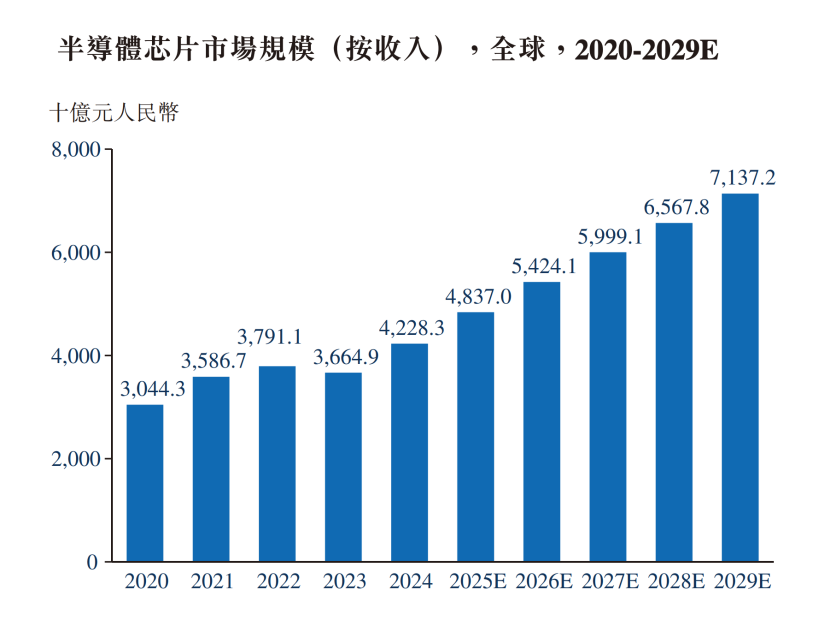
Behind this wave of global growth, the Chinese government has raised the integrated circuit industry to a high level of national strategy. Through a series of policy documents such as the “14th Five-Year Plan” and the earlier “National Integrated Circuit Industry Development Promotion Outline”, the Chinese government clearly proposed to enhance the self-sufficiency guarantee capabilities of core electronic components and key basic materials, and improve the supply chain system for key industries such as integrated circuits. This long-term and multi-dimensional national strategic support has created unprecedented development opportunities and market space for local chip design companies with core R&D capabilities, such as Longxun Semiconductor.
With this listing in Hong Kong, Longxun Semiconductor's fund-raising use points to the strengthening of R&D investment, expansion of overseas business networks, and strategic mergers and acquisitions within the global semiconductor industry, indicating that the company's management is trying to use the leverage of the capital market to further diversify risks and enhance global brand influence through an international layout while strengthening the core technology moat.
Furthermore, standing at a new starting point for Hong Kong stock IPOs, Longxun Semiconductor's future incremental space also points to high-value application scenarios such as AI, smart vehicles, and AR/VR. The company plans to focus its net fund-raising on improving R&D capabilities and diversifying product matrices, particularly to accelerate the commercialization process of high-speed protocol chips such as PCIe/CXL, SATA and USB in the AI PC and server markets.
As smart cockpits evolve in the direction of multi-screen interaction and panoramic sensing for autonomous driving, and spatial computing equipment's strict requirements for real-time rendering and low-power transmission, Longxun Semiconductor is trying to define a new standard for its “data highway” in a wider range of global competition through self-developed next-generation technologies such as ADP Link-II.
Facing intense domestic and overseas market games and an evolving regulatory environment, it remains to be seen whether Longxun Semiconductor can successfully overcome the many tests of technological iteration and supply chain globalization balance, and further release its scarce value as an underlying infrastructure for intelligent interaction in the capital market.