
- LIVE QUOTES
- LEARN
- HELP
 Nasdaq
 Wall Street Journal
EN
Retail investors are Sigachi Industries Limited's (NSE:SIGACHI) biggest owners and were hit after market cap dropped ₹1.3b
Key Insights
- Sigachi Industries' significant retail investors ownership suggests that the key decisions are influenced by shareholders from the larger public
- The top 8 shareholders own 50% of the company
- Insider ownership in Sigachi Industries is 35%
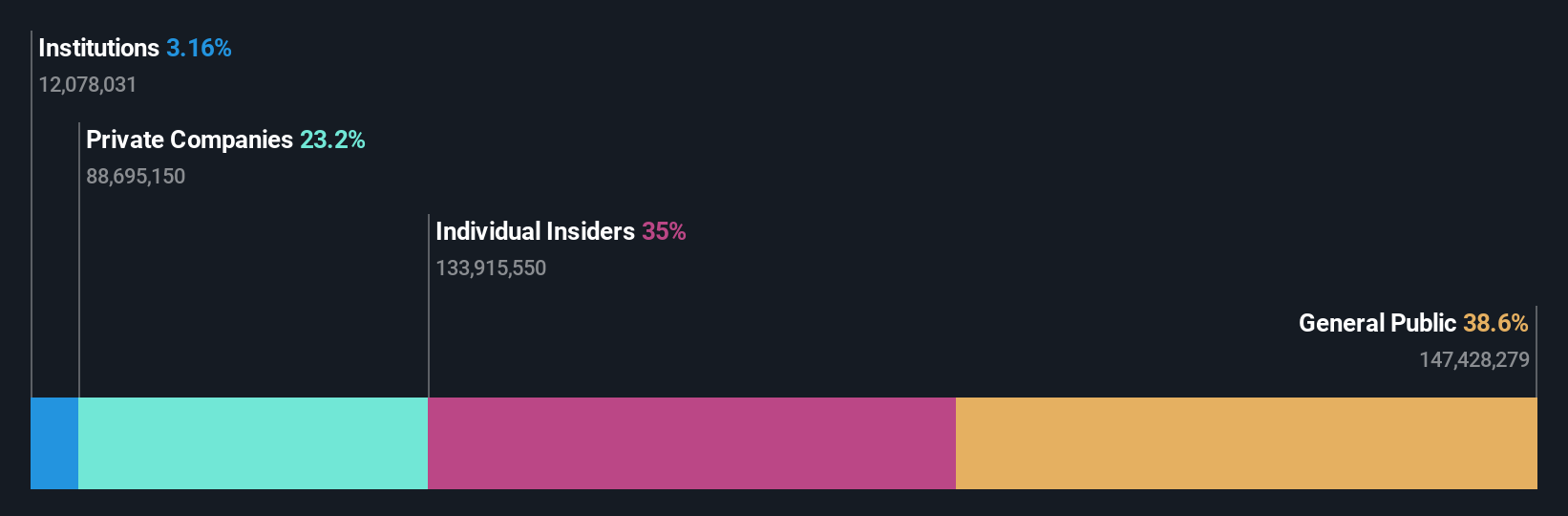
Every investor in Sigachi Industries Limited (NSE:SIGACHI) should be aware of the most powerful shareholder groups. The group holding the most number of shares in the company, around 39% to be precise, is retail investors. Put another way, the group faces the maximum upside potential (or downside risk).
While insiders, who own 35% shares weren’t spared from last week’s ₹1.3b market cap drop, retail investors as a group suffered the maximum losses
Let's delve deeper into each type of owner of Sigachi Industries, beginning with the chart below.
Check out our latest analysis for Sigachi Industries
What Does The Institutional Ownership Tell Us About Sigachi Industries?
Many institutions measure their performance against an index that approximates the local market. So they usually pay more attention to companies that are included in major indices.
Since institutions own only a small portion of Sigachi Industries, many may not have spent much time considering the stock. But it's clear that some have; and they liked it enough to buy in. If the business gets stronger from here, we could see a situation where more institutions are keen to buy. When multiple institutional investors want to buy shares, we often see a rising share price. The past revenue trajectory (shown below) can be an indication of future growth, but there are no guarantees.

Hedge funds don't have many shares in Sigachi Industries. Our data shows that RPS Projects & Developers Private Limited is the largest shareholder with 19% of shares outstanding. Meanwhile, the second and third largest shareholders, hold 7.1% and 6.8%, of the shares outstanding, respectively. Two of the top three shareholders happen to be Senior Key Executive and Chairman of the Board, respectively. That is, insiders feature higher up in the heirarchy of the company's top shareholders. Furthermore, CEO Amit Sinha is the owner of 6.0% of the company's shares.
We did some more digging and found that 8 of the top shareholders account for roughly 50% of the register, implying that along with larger shareholders, there are a few smaller shareholders, thereby balancing out each others interests somewhat.
While it makes sense to study institutional ownership data for a company, it also makes sense to study analyst sentiments to know which way the wind is blowing. As far as we can tell there isn't analyst coverage of the company, so it is probably flying under the radar.
Insider Ownership Of Sigachi Industries
While the precise definition of an insider can be subjective, almost everyone considers board members to be insiders. Company management run the business, but the CEO will answer to the board, even if he or she is a member of it.
I generally consider insider ownership to be a good thing. However, on some occasions it makes it more difficult for other shareholders to hold the board accountable for decisions.
Our most recent data indicates that insiders own a reasonable proportion of Sigachi Industries Limited. Insiders own ₹4.1b worth of shares in the ₹12b company. We would say this shows alignment with shareholders, but it is worth noting that the company is still quite small; some insiders may have founded the business. You can click here to see if those insiders have been buying or selling.
General Public Ownership
With a 39% ownership, the general public, mostly comprising of individual investors, have some degree of sway over Sigachi Industries. This size of ownership, while considerable, may not be enough to change company policy if the decision is not in sync with other large shareholders.
Private Company Ownership
We can see that Private Companies own 23%, of the shares on issue. It might be worth looking deeper into this. If related parties, such as insiders, have an interest in one of these private companies, that should be disclosed in the annual report. Private companies may also have a strategic interest in the company.
Next Steps:
It's always worth thinking about the different groups who own shares in a company. But to understand Sigachi Industries better, we need to consider many other factors. Take risks for example - Sigachi Industries has 3 warning signs (and 1 which can't be ignored) we think you should know about.
Of course this may not be the best stock to buy. So take a peek at this free free list of interesting companies.
NB: Figures in this article are calculated using data from the last twelve months, which refer to the 12-month period ending on the last date of the month the financial statement is dated. This may not be consistent with full year annual report figures.
Have feedback on this article? Concerned about the content? Get in touch with us directly. Alternatively, email editorial-team (at) simplywallst.com.
This article by Simply Wall St is general in nature. We provide commentary based on historical data and analyst forecasts only using an unbiased methodology and our articles are not intended to be financial advice. It does not constitute a recommendation to buy or sell any stock, and does not take account of your objectives, or your financial situation. We aim to bring you long-term focused analysis driven by fundamental data. Note that our analysis may not factor in the latest price-sensitive company announcements or qualitative material. Simply Wall St has no position in any stocks mentioned.