
- LIVE QUOTES
- LEARN
- HELP
 Nasdaq
 Wall Street Journal
EN
Will silver move from an “asymmetric profiteer” to a “high volatility tiebreaker” and will sprint to $100 in the bubble dispute in 2026?
The Zhitong Finance App learned that after experiencing a record high and falling rapidly after breaking through $84 on Monday, the price of silver once again rebounded sharply upward, and rebounded as much as 6% on Tuesday. At a time when the market is widely speculating on whether this precious metal has entered the bubble zone, the research team from Societe Generale (Societe Generale) said that the quantitative model it has prepared does mark the current silver trading market as showing “bubble-like” behavior. However, the agency's commodities research team urged investors not to take this signal in full.
The French commercial bank applied its log-periodic power law singularity (LPPLS) framework to silver price trends. This quantitative model is designed to detect “hyperexponential acceleration,” which often precedes market crashes. The model concludes that it identifies the current boom in the silver market as a potential bubble.
Dr. Mike Haigh, head of fixed income, forex and commodities business research at Societe Generale Bank, and his colleagues wrote, “If we rely on this model alone, we can indeed claim that the silver market is in a bubble. However, we strongly warn against this.”
Analysts believe that how you view the price trend of silver largely depends on how you draw technical charts. On a standard linear scale, the recent trend above $80 per ounce seems dramatic and largely driven by speculative sentiment. “However, when plotted in depth on a logarithmic scale, this upward round looks much more stable and is more consistent with the long-term compound growth trend of silver over the past 25 years.” The Societe Generale Bank research team wrote.
The report said, “A logarithmic scale always tells a better story of growth and is closer to the truth,” but analysts also acknowledge that even in logarithmic form, this year's increase appears abnormal, but this is definitely not enough to indicate that the bubble alert will push silver into a sharp decline like a bear market.
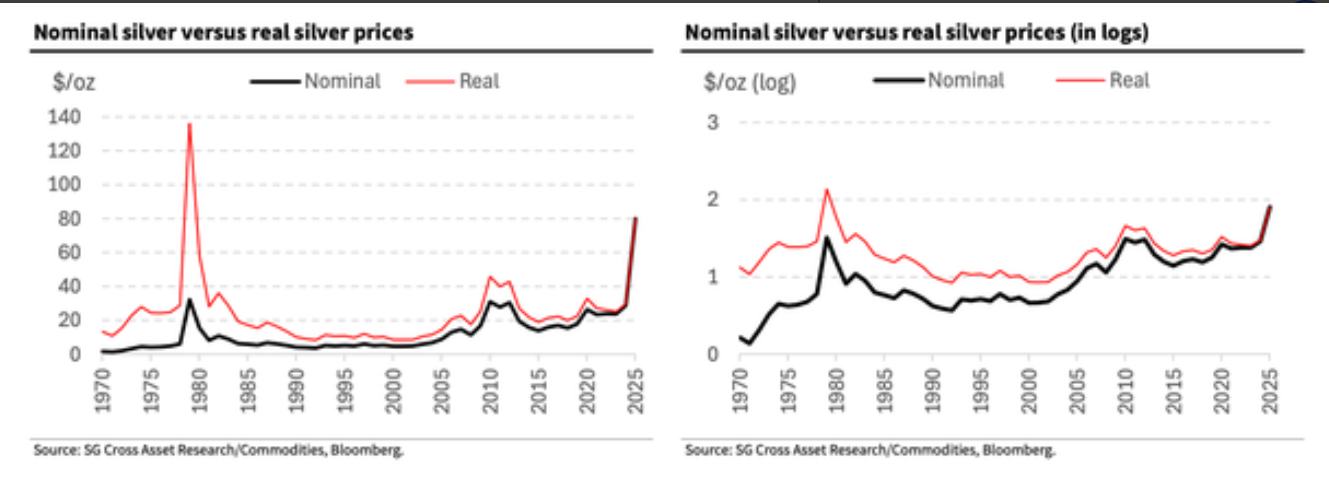
Société Générale's research team emphasized that the LPPLS model is more suitable as a diagnostic tool to identify unstable market conditions rather than as an “oracle” for prediction. They pointed out that compared to gold, silver's lack of relative liquidity makes it easier to trigger bubble warning signals, because insufficient liquidity amplifies the flock effect, feedback loops, and price instability mechanisms.
Analysts prefer to interpret bubble signals as “indicators of potential instability,” and believe that it is normal to make a moderately healthy correction to extreme price fluctuations. However, they do not believe that their model can predict fundamental changes in silver's momentum. The core reason is that precious metals investment prospects have undergone a structural shift. This transformation is driven by the trend of de-dollarization, high global trade patterns, economic growth uncertainty, and geopolitical uncertainty.
Is the final chapter of “Silver Rhapsody” $100?
Silver has recovered most of its losses after experiencing its biggest single-day decline in more than five years, but this also means that “Silver Rhapsody” may have moved from “asymmetric profiteering” to a so-called “high volatility chapter.” Even if it continues to reach new highs in the future, the volatility may be much more intense than it is now. As supply shortages remain, the metal is still expected to achieve a 35% increase this month and is likely to continue to hit $100 after the “bubble alarm” sounds. By the close of trading on Tuesday, the price of silver climbed above $78 an ounce, after a sharp drop of more than 9% on the previous trading day.
Despite the moderate correction, gold and silver prices are still expected to record their best annual performance since 1979. Strong purchases by major central banks around the world, large-scale capital inflows from tradable open index funds (ETFs), and the Federal Reserve cut interest rates three times in a row all provided support for precious metals prices. Lower borrowing costs are a positive factor for products that do not generate interest.
In a nutshell, the core logic of this round of sharp silver gains is: “macro-level expectations of a decline in the Fed's benchmark interest rate+structural supply+strengthening of the industrial growth narrative + momentum capital/speculative power/FOMO (fear of missing out) sentiment” to jointly push the price of silver into an unparalleled “precious metals acceleration period.”
The repricing of the industrial demand narrative can be described as a novel logic of this round of silver price surges, as indicated by the World Silver Association in its latest research report: the AI data center construction process is in full swing, the electrification/new energy (including photovoltaic) transformation trend, and the global trend of switching to electric vehicles, etc., compounded by a continuous supply and demand gap, so that silver is no longer just “following gold”; the World Silver Association said that the 17% compound annual growth rate of the photovoltaic industry, the compound annual growth rate of the electric vehicle industry, and the explosive expansion of AI global data centers together form a white gap Demand for silver The three pillars of growth.
The World Silver Association's report predicts that these industries will continue to drive demand for silver in the industrial sector until 2030. The association highlights that the IT power capacity of global data centers has increased 53 times from 0.93 gigawatts in 2000 to nearly 50 gigawatts in 2025. According to the association, this exponential growth means larger servers, switches and cooling systems around the world, and the core components of each system require silver.
The World Silver Association emphasizes that the large-scale penetration and application of silver in data centers is based on three characteristics: maximum conductivity ensures minimal energy loss in server power transmission, which is critical for data centers requiring 99.999% uptime; excellent thermal conductivity helps equipment maintain a safe temperature range and reduces cooling energy consumption (cooling systems account for 7-30% of the total energy consumption of data centers); and high corrosion resistance protects components in environments with high electrical loads and temperature fluctuations.
According to some senior analysts and traders who focus on commodities, the recent surge in price of silver, which far exceeds crude oil, and the gap between supply and demand supports the best performance of silver prices since 1979, laying an important foundation for silver to break through the 100 US dollar super mark, but they also generally believe that “impacting/touching 100 US dollars/ounce” is an “extreme bull market target.”
Philippe Gijsels, a senior strategist from BNP Paribas (BNP Paribas), believes that silver's gains will continue until 2026, driven by the Fed's interest rate cut cycle and strong market fervor, and he expects gold to hit $100 per ounce by the end of 2026. Keith Neumeyer, CEO of First Majestic, has publicly expressed his long-term judgment on the three-digit price of silver (over $100 per ounce) in interviews several times since this year.
Paul Williams, managing director of Solomon Global, said that the dual nature of silver as an industrial metal and a store of value continues to attract global capital inflows, and the factors supporting the long-term bull market are still strengthening. Williams previously predicted that silver would break through $100 by the end of 2026 when it was close to $50 in October.
Lyn Alden, a well-known macro strategist and founder of the investment newsletter “Lyn Alden Investment Strategy”, recently said in an exclusive interview with VRIC Media that silver is more likely to hit the $100 mark in 2026, but it is likely that it will no longer be a “low risk and high return” opportunity. “Now I think this is a more symmetric high-risk trade, and I wouldn't be shocked if it goes up to $100 next year, or falls to $40 next year.” The strategist emphasized that she is still “holding long positions in silver” but is “lowering her future return on investment expectations” because it “has fulfilled most of her previous theories.”
Josh Phair, founder and CEO of precious metals manufacturer and distributor Scottsdale Mint, said in an interview: “We are in the midst of a battle for metals resources.” “The US is rapidly building these data centers, and the US must own it (silver) to protect its position in the world. If inflation is taken into account, the price of silver is still low.” “If the 1980 price of 50 dollars of silver were adjusted for the rate of inflation, the value would have exceeded 200 dollars. So we can even say that the price of silver is still quite low today.” he added.