
- LIVE QUOTES
- LEARN
- HELP
 Nasdaq
 Wall Street Journal
EN
Traders' “last resort” in 2025, Bitcoin hit the 90,000 mark for the second day in a row and failed
In the last few trading days of December, Bitcoin traders are trying to take the “last resort”, hoping to erase last year's decline before the end of the year. However, this effort was once again thwarted. The Zhitong Finance App learned that on Tuesday, after Bitcoin hit the 90,000 dollar mark for the second day in a row, its gains stalled again.
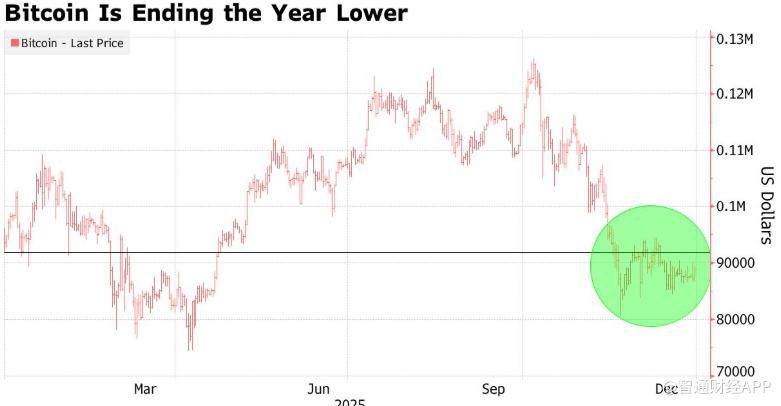
Since experiencing a sharp correction in October, Bitcoin has basically fluctuated in the range of about 85,000 to 95,000 US dollars. This reincarnation has clearly weakened the trend of Bitcoin since this year. Currently, it is down about 5% from December last year, and is expected to record its first annual decline in three years. Notably, Bitcoin once rose about 30% in early October and reached a new all-time high, but then quickly regained its gains.
Jasper De Maere, a trading strategist at market maker Wintermute, pointed out in Tuesday's report that market liquidity is low during the New Year's Eve period, and price fluctuations may be significantly amplified. “Until liquidity returns to normal, excessive interpretation of very short-term signals should be avoided.”
At the beginning of this year, Bitcoin strengthened as the market anticipated that the Trump administration might adopt a more “crypto-friendly” policy. But then, uncertainty surrounding tariff policies hit global financial markets, and Bitcoin was not spared. On October 10, a large number of highly leveraged positions were centrally closed, causing a heavy blow to the market. In contrast, other risk assets such as US stocks have gradually recovered their declines, and Bitcoin has not strengthened until now.
Furthermore, demand for Bitcoin spot ETFs has cooled down, becoming an important factor in suppressing prices. According to the data, the cumulative net capital outflow from Bitcoin ETFs in the fourth quarter reached 6 billion US dollars. Against the backdrop of the currency price continuing to fall below 90,000 US dollars, institutional funding attitudes tend to be cautious.
Overall, with poor liquidity, continued capital outflows, and macroeconomic uncertainty, the Bitcoin market is still under pressure at the end of the year, and it may be difficult to escape the pattern of range-bound fluctuations in the short term.