
- LIVE QUOTES
- LEARN
- HELP
 Nasdaq
 Wall Street Journal
EN
Isuzu Motors Limited's (TSE:7202) Stock Is Going Strong: Is the Market Following Fundamentals?
Isuzu Motors' (TSE:7202) stock is up by a considerable 32% over the past three months. Since the market usually pay for a company’s long-term fundamentals, we decided to study the company’s key performance indicators to see if they could be influencing the market. Particularly, we will be paying attention to Isuzu Motors' ROE today.
Return on Equity or ROE is a test of how effectively a company is growing its value and managing investors’ money. Simply put, it is used to assess the profitability of a company in relation to its equity capital.
How To Calculate Return On Equity?
The formula for return on equity is:
Return on Equity = Net Profit (from continuing operations) ÷ Shareholders' Equity
So, based on the above formula, the ROE for Isuzu Motors is:
11% = JP¥180b ÷ JP¥1.6t (Based on the trailing twelve months to September 2025).
The 'return' is the profit over the last twelve months. Another way to think of that is that for every ¥1 worth of equity, the company was able to earn ¥0.11 in profit.
View our latest analysis for Isuzu Motors
What Is The Relationship Between ROE And Earnings Growth?
Thus far, we have learned that ROE measures how efficiently a company is generating its profits. Based on how much of its profits the company chooses to reinvest or "retain", we are then able to evaluate a company's future ability to generate profits. Generally speaking, other things being equal, firms with a high return on equity and profit retention, have a higher growth rate than firms that don’t share these attributes.
A Side By Side comparison of Isuzu Motors' Earnings Growth And 11% ROE
At first glance, Isuzu Motors seems to have a decent ROE. Further, the company's ROE compares quite favorably to the industry average of 7.8%. This certainly adds some context to Isuzu Motors' decent 15% net income growth seen over the past five years.
As a next step, we compared Isuzu Motors' net income growth with the industry and found that the company has a similar growth figure when compared with the industry average growth rate of 18% in the same period.
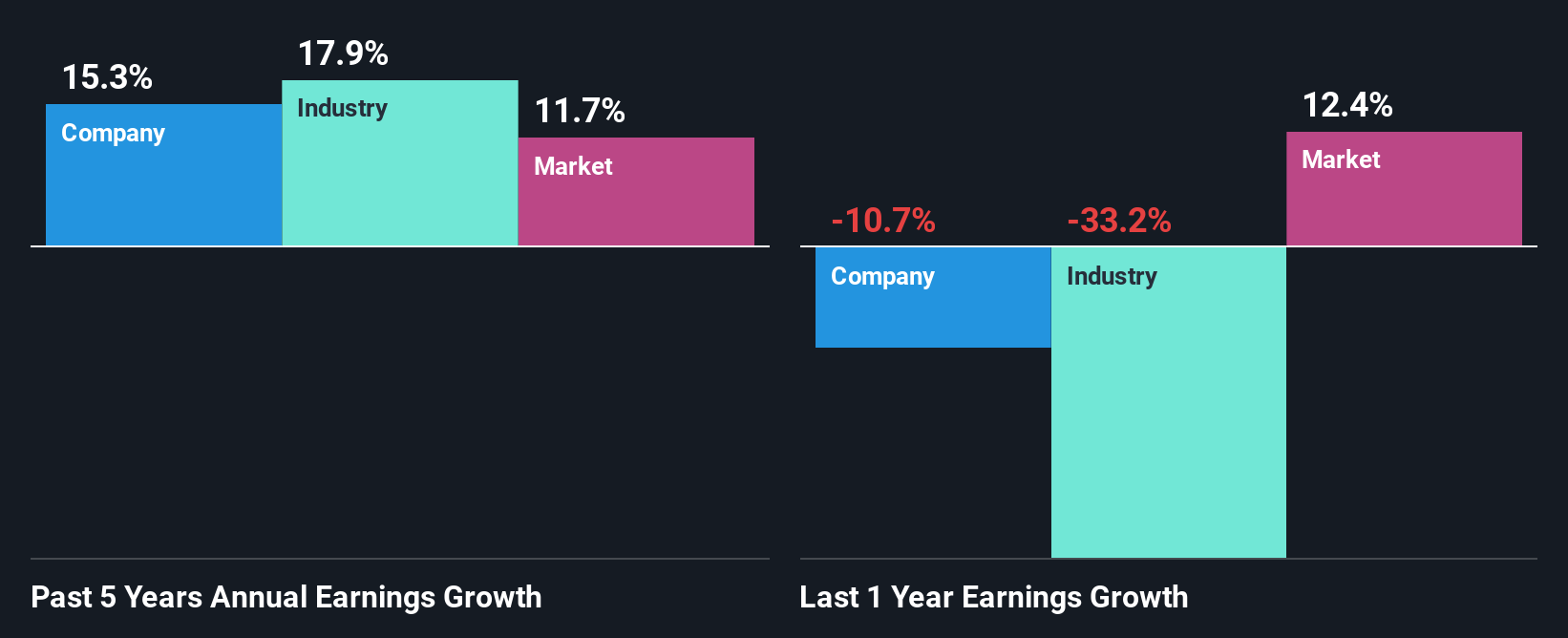
Earnings growth is an important metric to consider when valuing a stock. What investors need to determine next is if the expected earnings growth, or the lack of it, is already built into the share price. By doing so, they will have an idea if the stock is headed into clear blue waters or if swampy waters await. What is 7202 worth today? The intrinsic value infographic in our free research report helps visualize whether 7202 is currently mispriced by the market.
Is Isuzu Motors Making Efficient Use Of Its Profits?
With a three-year median payout ratio of 44% (implying that the company retains 56% of its profits), it seems that Isuzu Motors is reinvesting efficiently in a way that it sees respectable amount growth in its earnings and pays a dividend that's well covered.
Moreover, Isuzu Motors is determined to keep sharing its profits with shareholders which we infer from its long history of paying a dividend for at least ten years.
Summary
Overall, we are quite pleased with Isuzu Motors' performance. Particularly, we like that the company is reinvesting heavily into its business, and at a high rate of return. Unsurprisingly, this has led to an impressive earnings growth. On studying current analyst estimates, we found that analysts expect the company to continue its recent growth streak. Are these analysts expectations based on the broad expectations for the industry, or on the company's fundamentals? Click here to be taken to our analyst's forecasts page for the company.
Have feedback on this article? Concerned about the content? Get in touch with us directly. Alternatively, email editorial-team (at) simplywallst.com.
This article by Simply Wall St is general in nature. We provide commentary based on historical data and analyst forecasts only using an unbiased methodology and our articles are not intended to be financial advice. It does not constitute a recommendation to buy or sell any stock, and does not take account of your objectives, or your financial situation. We aim to bring you long-term focused analysis driven by fundamental data. Note that our analysis may not factor in the latest price-sensitive company announcements or qualitative material. Simply Wall St has no position in any stocks mentioned.