
- LIVE QUOTES
- LEARN
- HELP
 Nasdaq
 Wall Street Journal
EN
The 10-year Japanese bond yield recorded the biggest annual increase in 31 years! As financial concerns intensify, it may become a “gray rhinoceros” market in 2026
The Zhitong Finance App learned that due to concerns about the Japanese government's financial situation, the yield on the benchmark 10-year Japanese treasury bond rose more than 2 basis points to 2.077% on Tuesday, not far from the 2.1% level hit on December 22. This level is the highest level since February 1999. According to the data, the yield has surged nearly 1 percentage point in 2025, the biggest annual increase since 1994.
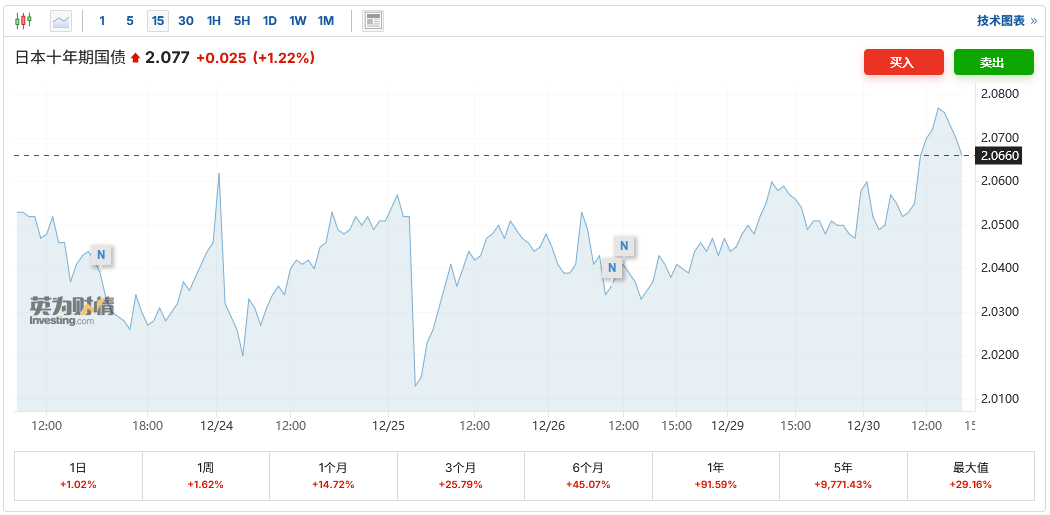
Japan's treasury bonds experienced sharp fluctuations in 2025 as the Bank of Japan cut back on debt purchases, continued high inflation, and the Japanese government implemented large-scale fiscal stimulus plans. Since the beginning of November, Japan's long-term treasury bond yields have risen sharply, successively reaching record highs due to concerns that the fiscal stimulus plan introduced by Japanese Prime Minister Sanae Takaichi would damage Japan's fiscal sustainability.
On December 16, the Japanese Diet approved the supplementary budget for fiscal year 2025 (April 2025 to March 2026). The fiscal expenditure was as high as 18.3 trillion yen, claiming to be the largest after the pandemic. This budget is in the name of dealing with rising prices and promoting economic growth. Of this, 11.7 trillion yen will be raised through the issuance of new treasury bonds. On Friday, the Japanese government finalized the 2026 fiscal year budget at a cabinet meeting. The total general accounting budget is about 122.3092 trillion yen. This scale surpassed the 2025 fiscal year of approximately 115 trillion yen, setting a new record high in history.
Meanwhile, the Bank of Japan raised interest rates this month and hinted that it will continue to tighten monetary policy. The minutes of the Bank of Japan meeting released on Monday show that Bank of Japan officials believe that the current real interest rate in Japan is still very low, which suggests that there is room for further interest rate hikes in the future. However, due to market disappointment with the Bank of Japan's failure to give clear guidance on the timing of future monetary tightening, the yen weakened after the Bank of Japan announced an interest rate hike. This in turn boosted market expectations that the Bank of Japan would raise interest rates to curb the depreciation of the yen.
Against this backdrop, Japan's short-term treasury bond yields are also facing upward pressure. As of press release, the yield on two-year Japanese treasury bonds, which are sensitive to monetary policy, rose 3 basis points to 1.173% on Tuesday; the yield has risen more than 20% over the past month.
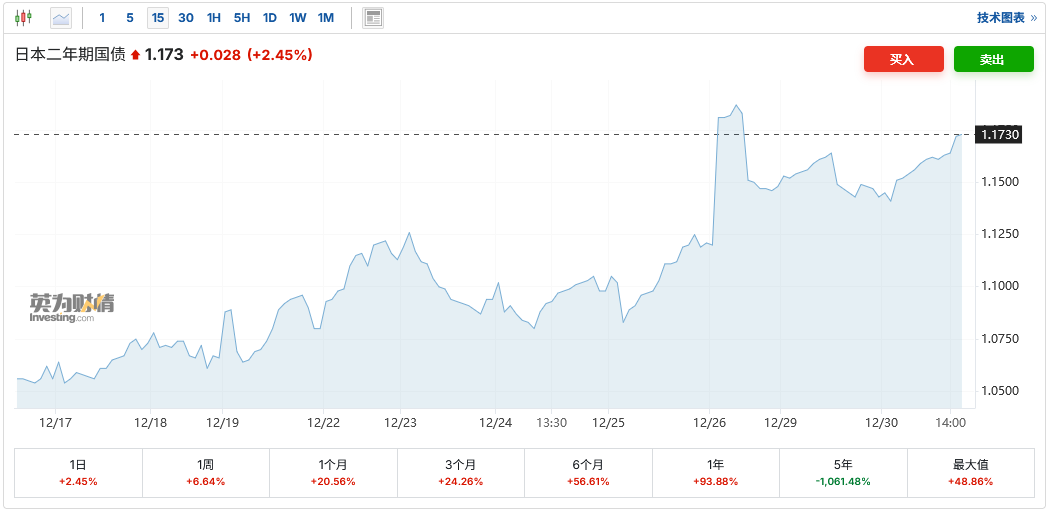
Yusuke Matsuo, a senior market economist at Mizuho Securities, said that July 2026 seems to be the most likely time for the Bank of Japan to raise interest rates next, but if the exchange rate of yen against the US dollar continues to weaken, the timing may change. “Defending the yen may become a de facto priority,” he said in a report. This may cause the Bank of Japan to consider increasing the pace of interest rate hikes, so we need to be vigilant.”
Has Japanese treasury bond yield climbed into a “gray rhinoceros” in the global financial market?
Notably, the rise in Japanese bond yields is critical to today's US and global financial markets. Japan has been suffering from deflation for many years, and since 2016, the Bank of Japan has been implementing yield control policies. Under this policy, the Bank of Japan keeps interest rates on short-term loans at a negative level and strives to keep the yield on ten-year Japanese treasury bonds at zero. These low interest rates, combined with interest rates far higher than Japan in other regions of the world, have prompted global investors to borrow yen and exchange them for dollars and euros to invest in European and American stock markets, bond markets, and emerging markets.
The challenge facing global financial markets is that the narrowing of interest spreads between Japanese treasury bonds and US treasury bonds may lead to the liquidation of arbitrage transactions based on yen and the return of capital to Japan, leading to a correction in other markets. For example, in August 2024, Japanese treasury yields soared, and large-scale liquidation of Japanese yen arbitrage transactions caused turmoil in the global market.
Among them, the US market is particularly vulnerable to shocks. Japan is the largest overseas holder of US debt. If Japanese investors decide to withdraw their capital to the country due to rising domestic bond yields, the US bond market will lose a critical buyer. However, fluctuations in US bond yields will directly affect the valuation of US stocks. Manish Cabra, an American stock strategist at Société Générale, believes that “the Bank of Japan's hawkish actions pose a greater threat to the US stock market than the Federal Reserve or US domestic policies.”
Currently, there are signs that both the Bank of Japan and the government are uneasy about increased volatility in the bond market. Bank of Japan Governor Kazuo Ueda pointed out on December 9 that long-term bond yields are rising at a “relatively rapid” rate. To avoid market turbulence, the Bank of Japan plans to slow down its exit from the bond market. Starting next fiscal year, the Bank of Japan will reduce monthly bond purchases by 200 billion yen each quarter instead of the current 400 billion yen quarterly reduction. Kazuo Ueda also said that if necessary, the Bank of Japan will increase the scale of bond purchases under special circumstances to stabilize the market.
Furthermore, the Japanese authorities plan to reduce sales of government bonds during the 2026 fiscal year beginning in April next year, with a focus on cutting ultra-long-term debt. Japan's Ministry of Finance said on Friday that the total amount of government bonds issued to institutional investors through auctions in the 2026 fiscal year will be 168.5 trillion yen (about 1.1 trillion US dollars), a decrease of 3.8 trillion yen from the initial plan for the previous fiscal year. Among them, the total sales of 20-year, 30-year, and 40-year treasury bonds will decrease by 7.2 trillion yen to 17.4 trillion yen, and according to the initial budget, the issuance of ultra-long-term treasury bonds will drop to the lowest level since 2009. Meanwhile, the issuance volume of 10-year treasury bonds will remain unchanged, while sales of 2-year and 5-year treasury bonds will increase.