
- LIVE QUOTES
- LEARN
- HELP
 Nasdaq
 Wall Street Journal
EN
Insiders of Nerdy, Inc. (NYSE:NRDY) must be frustrated after market cap dropped US$18m since recent purchases
Key Insights
- Insiders appear to have a vested interest in Nerdy's growth, as seen by their sizeable ownership
- The top 4 shareholders own 53% of the company
- Insiders have bought recently
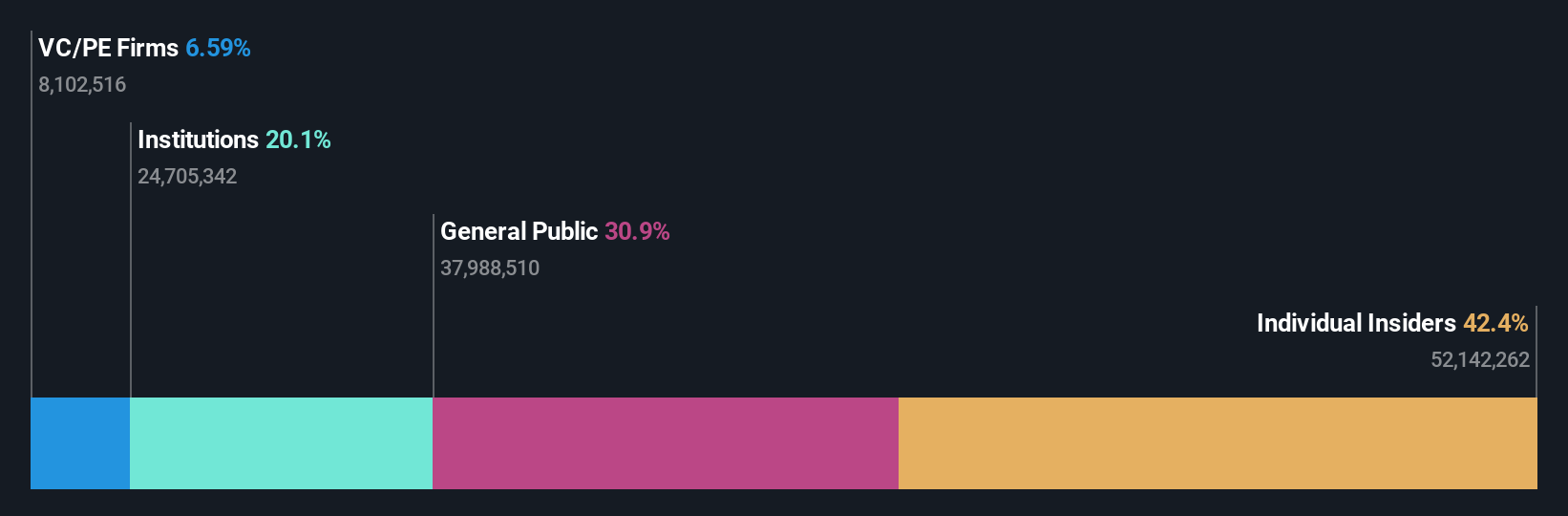
A look at the shareholders of Nerdy, Inc. (NYSE:NRDY) can tell us which group is most powerful. And the group that holds the biggest piece of the pie are individual insiders with 42% ownership. That is, the group stands to benefit the most if the stock rises (or lose the most if there is a downturn).
It's interesting to note that insiders have been buying shares recently. Their expectations, however, were not satisfied, as the market cap dropped to US$210m over the past week.
Let's delve deeper into each type of owner of Nerdy, beginning with the chart below.
See our latest analysis for Nerdy
What Does The Institutional Ownership Tell Us About Nerdy?
Institutional investors commonly compare their own returns to the returns of a commonly followed index. So they generally do consider buying larger companies that are included in the relevant benchmark index.
Nerdy already has institutions on the share registry. Indeed, they own a respectable stake in the company. This implies the analysts working for those institutions have looked at the stock and they like it. But just like anyone else, they could be wrong. It is not uncommon to see a big share price drop if two large institutional investors try to sell out of a stock at the same time. So it is worth checking the past earnings trajectory of Nerdy, (below). Of course, keep in mind that there are other factors to consider, too.

Nerdy is not owned by hedge funds. Looking at our data, we can see that the largest shareholder is the CEO Charles Cohn with 40% of shares outstanding. In comparison, the second and third largest shareholders hold about 6.6% and 3.5% of the stock.
On looking further, we found that 53% of the shares are owned by the top 4 shareholders. In other words, these shareholders have a meaningful say in the decisions of the company.
While it makes sense to study institutional ownership data for a company, it also makes sense to study analyst sentiments to know which way the wind is blowing. Quite a few analysts cover the stock, so you could look into forecast growth quite easily.
Insider Ownership Of Nerdy
The definition of company insiders can be subjective and does vary between jurisdictions. Our data reflects individual insiders, capturing board members at the very least. Management ultimately answers to the board. However, it is not uncommon for managers to be executive board members, especially if they are a founder or the CEO.
Most consider insider ownership a positive because it can indicate the board is well aligned with other shareholders. However, on some occasions too much power is concentrated within this group.
Our most recent data indicates that insiders own a reasonable proportion of Nerdy, Inc.. It has a market capitalization of just US$210m, and insiders have US$89m worth of shares in their own names. This may suggest that the founders still own a lot of shares. You can click here to see if they have been buying or selling.
General Public Ownership
The general public, who are usually individual investors, hold a 31% stake in Nerdy. While this size of ownership may not be enough to sway a policy decision in their favour, they can still make a collective impact on company policies.
Private Equity Ownership
Private equity firms hold a 6.6% stake in Nerdy. This suggests they can be influential in key policy decisions. Some might like this, because private equity are sometimes activists who hold management accountable. But other times, private equity is selling out, having taking the company public.
Next Steps:
I find it very interesting to look at who exactly owns a company. But to truly gain insight, we need to consider other information, too. Case in point: We've spotted 1 warning sign for Nerdy you should be aware of.
If you would prefer discover what analysts are predicting in terms of future growth, do not miss this free report on analyst forecasts.
NB: Figures in this article are calculated using data from the last twelve months, which refer to the 12-month period ending on the last date of the month the financial statement is dated. This may not be consistent with full year annual report figures.
Have feedback on this article? Concerned about the content? Get in touch with us directly. Alternatively, email editorial-team (at) simplywallst.com.
This article by Simply Wall St is general in nature. We provide commentary based on historical data and analyst forecasts only using an unbiased methodology and our articles are not intended to be financial advice. It does not constitute a recommendation to buy or sell any stock, and does not take account of your objectives, or your financial situation. We aim to bring you long-term focused analysis driven by fundamental data. Note that our analysis may not factor in the latest price-sensitive company announcements or qualitative material. Simply Wall St has no position in any stocks mentioned.