
- LIVE QUOTES
- LEARN
- HELP
 Nasdaq
 Wall Street Journal
EN
Traders weigh the timing of the Bank of Japan's interest rate hike and the risk of government intervention, and the yen rebounded slightly
The Zhitong Finance App learned that the yen recovered part of its decline on Monday because the market weighed the timing of further interest rate hikes by the Bank of Japan and the possibility that the Japanese authorities would intervene during a quiet period of year-end trading. As of press release, the USD/JPY exchange rate fell slightly by 0.19% to 156.27 yen per dollar.
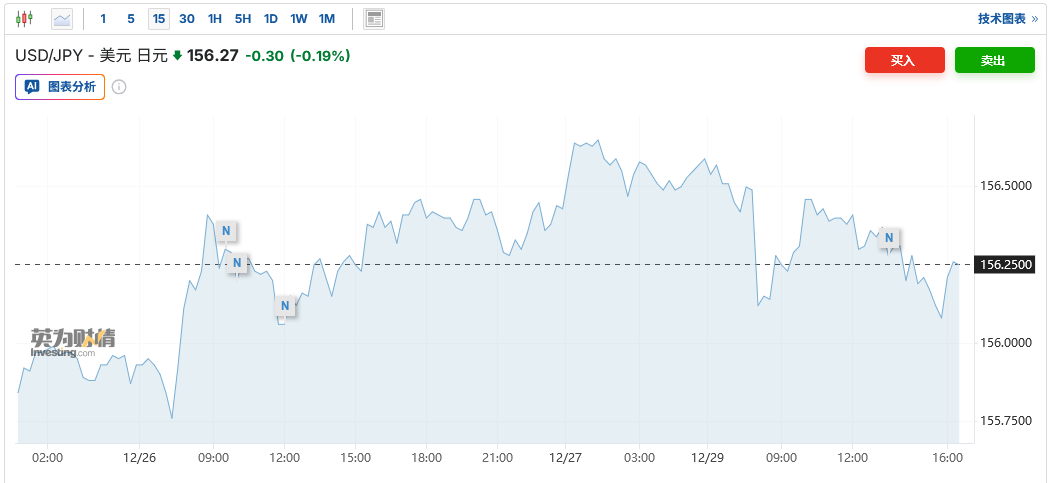
The Bank of Japan raised the policy interest rate by 25 basis points to 0.75% in December, the highest level since 1995. Bank of Japan Governor Kazuo Ueda said at a press conference after the meeting that if the price outlook is realized as expected, the central bank will continue to tighten its policy. The minutes of the Bank of Japan meeting released on Monday show that Bank of Japan officials believe that the current real interest rate in Japan is still very low, which suggests that there is room for further interest rate hikes in the future. However, due to market disappointment with the Bank of Japan's failure to give clear guidance on the timing of future monetary tightening, the yen weakened after the central bank announced an interest rate hike.
Last week, Japan's Finance Minister Satsuki Katayama (Satsuki Katayama) issued the strongest warning to speculators as the yen continues to weaken, saying that if currency trends do not match fundamentals, the Japanese authorities “have absolute freedom” to take bold action. Katayama Satsuki said, “(The depreciation of the yen) this trend clearly does not match fundamentals; it is speculative.” “In response to this trend, we have made it clear that we will take bold action, as stated in the joint statement of the Japanese and US finance ministers.”
Bart Wakabayashi, manager of the Tokyo branch of State Street Bank, pointed out that although such verbal warnings from the Japanese authorities helped limit the yen's decline, pessimism about the yen was reflected in other foreign exchange crosses. He said, “I think it's quite painful to hold a long position in the yen. The market is still trying to figure out what role the yen now plays in terms of safe-haven attributes.”
The Bank of Japan's gradual austerity is difficult to reverse the structural decline of the yen, and Wall Street sings empty and loud
Pessimism about the yen is reflected not only in the foreign exchange market, but also in Wall Street views. After the Bank of Japan's December rate hike failed to provide a continuous boost to the yen, voices that were bearish on the yen grew louder, which further strengthened the market view that there is no “quick fix” for the structural weakness of the yen.
Strategists at institutions such as J.P. Morgan Chase and BNP Paribas expect that by the end of 2026, the yen may depreciate to 160 yen or even weaker per dollar. Factors driving this judgment include the still huge spread between the US and Japan, negative real interest rates, and continued capital outflows. These institutions believe that as long as the Bank of Japan continues to adopt progressive austerity and the risk of fiscally driven inflation persists, this trend will be difficult to reverse.
Junya Tanase, Japan's chief foreign exchange strategist at J.P. Morgan Chase, said, “The fundamentals of the yen are quite weak, and there won't be much change next year.” He gave one of Wall Street's most pessimistic predictions. It is expected that the USD/JPY exchange rate will reach 164 by the end of 2026. He pointed out that cyclical forces may further harm the yen next year, and the impact of the Bank of Japan's tightening policy will be weakened as the market takes higher interest rate expectations into other regions.
Parisha Saimbi, an emerging Asian foreign exchange and interest rate strategist at BNP Paribas, said that next year's global macro environment should be “relatively favorable to risk sentiment, and in this environment, arbitrage strategies will usually be favorable.” She expects the USD/JPY exchange rate to rise to 160 by the end of 2026. She added that steady demand for arbitrage, the cautious Bank of Japan, and the US Federal Reserve, which may be more hawkish than expected, may keep the dollar exchange rate high against the yen.
It is worth mentioning that Japan's outflow of foreign investment is another source of pressure. The net purchase amount of Japanese retail investors allocating overseas stocks through investment trusts hovered around the ten-year high of 9.4 trillion yen (about 60 billion US dollars) set last year, highlighting the continued preference of households for overseas assets. Analysts believe this trend is likely to continue until 2026 and continue to suppress the yen.
Capital outflows at the corporate level may be a more enduring driver. Shusuke Yamada, Japan's chief foreign exchange and interest rate strategist at Bank of America Securities, pointed out in a report earlier this month that Japan's OFDI has maintained a steady pace in recent years and is hardly affected by cyclical factors or changes in interest spreads. It is particularly noteworthy that the scale of foreign mergers and acquisitions of Japanese companies has risen to a multi-year high this year.
Tohru Sasaki, chief strategist at Fukuoka Financial Group, said, “There has been almost no change in the weak yen situation. The point is that the Bank of Japan has not actively raised interest rates, and real interest rates are still deeply negative.” He expects the USD/JPY exchange rate to reach 165 by the end of 2026. “I think the Federal Reserve has basically completed the cycle of cutting interest rates. If the market starts to fully take this into account, it will also be another factor driving up the USD/JPY exchange rate.”
However, there are still some yen observers who are convinced that as the Bank of Japan continues to promote policy normalization, the yen will strengthen in the longer term. Goldman Sachs Group anticipates that within the next ten years, the yen may eventually rise to the level of 1 US dollar to 100 yen, but it also admits that there are multiple negative factors in the short term.