
- LIVE QUOTES
- LEARN
- HELP
 Nasdaq
 Wall Street Journal
EN
Bank of Japan meeting minutes suggest interest rate hikes are far from over: actual interest rates are “the lowest in the world”
The Zhitong Finance App learned that some members of the Bank of Japan's monetary policy committee said at an interest rate meeting earlier this month (when the Bank of Japan raised the benchmark interest rate) that Japan's actual interest rate is still very low, which suggests that Japan's domestic borrowing costs may rise further in the future.
According to a summary of internal discussions at the Bank of Japan released on Monday, at the two-day monetary policy meeting that ended on December 19, one of the nine members said, “Japan's actual policy interest rate is one of the lowest levels in the world, and it can even be said that it is the lowest on a cliffside.” The member said that it is appropriate for the Bank of Japan to adjust the degree of monetary easing, and mentioned the impact of exchange rate changes on prices.
At this interest rate meeting, the Bank of Japan's Monetary Policy Committee raised the benchmark interest rate to 0.75%, the highest policy interest rate level in 30 years. The publication of this summary comes at a time when senior traders in the financial market are looking for clues to determine how quickly the Bank of Japan's next rate hike might be. According to the minutes, a policy committee member said that the Bank of Japan should adjust its policy at intervals of several months in the short term. This pace is generally in line with the median expectations of observers concerned about the Bank of Japan.
Economists generally said in a survey that they expect the Bank of Japan to announce another rate hike in about six months. Many economists believe that the terminal interest rate for this round of interest rate hikes is 1.5%. Former Bank of Japan executive board member Hayakawa Hideo said earlier this month that the central bank may raise the policy interest rate to a maximum of 1.50% before the beginning of 2027.
Overall, the minutes of the Bank of Japan's monetary policy meeting released on Monday clearly show that the Bank of Japan's policy interest rate has not yet reached a neutral level. One of the members pointed out, “It can be said that we are still quite far from the neutral interest rate level.”
At a press conference after the monetary policy decision on December 19, Bank of Japan Governor Kazuo Ueda said that it is difficult to accurately define this level — that is, the policy interest rate is a neutral interest rate point that is neither considered stimulating nor restrictive. A Bank of Japan study indicates that the neutral interest rate may be within a wide range of 1% to 2.5%, and many members of the Bank of Japan declined to give a more accurate range during interviews.
The summary shows that some members of the Monetary Policy Committee echoed Kazuo Ueda's views on neutral interest rates and emphasized the difficulty of accurate this level. One said that this level should be interpreted with considerable flexibility; the other said that the Bank of Japan should not target a specific level, but should maintain a very flexible model in terms of policy approach.
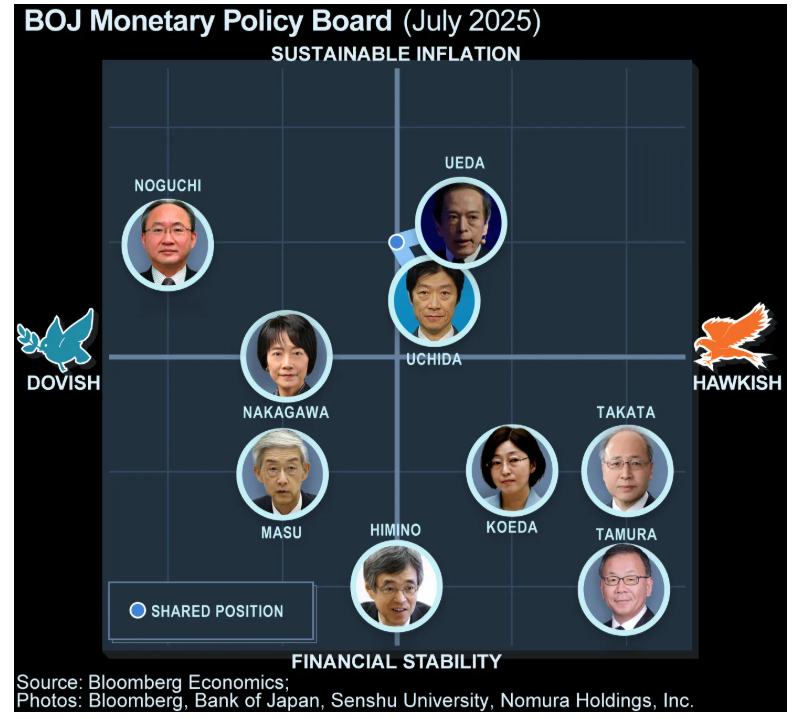
The minutes also showed that some members of the Monetary Policy Committee are concerned about the continued weakening of the yen. This is probably one of the core considerations before the Bank of Japan's policy action on December 19. However, the summary shows that the yen was only mentioned once in this month's discussions. However, when the Bank of Japan raised the benchmark interest rate in January, the conference summary showed that the yen was mentioned seven times.
Prior to this month's meeting, the yen had fallen to its weakest level in about 10 months, and the trend of the dollar against the yen was even close to the important mark of 160 — in the past, there had been intervention by the Japanese financial authorities in the foreign exchange market near this level. Even after the Bank of Japan and the Federal Reserve both took policy actions, the interest rate spread between the US and Japan narrowed, and the yen was still weak, prompting the Japanese financial authorities to step up their verbal warnings about excessive market fluctuations.
The summary also shows that although the government led by Japanese Prime Minister Sanae Takaichi is not opposed to the Bank of Japan's latest interest rate hike, it is cautious. A Cabinet Office official said at the meeting: “We must pay close attention to the future development of factors such as fixed investment and corporate profits.” Takaichi is a staunch supporter of loose monetary policy and took office as prime minister in October. Her inauguration raised questions about whether the Bank of Japan, led by Kazuo Ueda, can continue to implement a normalization policy, but the political costs of inflation and the depreciation of the yen are thought to have limited Takaichi Sanae's resistance to normalizing Japan's monetary policy.
Prior to the action earlier this month, the market had largely factored in this interest rate hike because Ueda Kazuo said in a pact before the monetary policy decision in December that conditions were gradually being put in place to reduce the degree of monetary easing.
For the Japanese treasury bond market, which has bucked the trend and moved towards an interest rate hike cycle in recent years as the Bank of Japan began a “interest rate cut frenzy,” the two giant blades of interest rate hike expectations and the Japanese government's stimulatory finance can be described as forcing Japanese bond yields, which have been sluggish for a long time since the Abe era, to skyrocket.
The main logic behind Japanese treasury bond yields, particularly those on 20-year, 30-year, and 40-year long-term bonds, is clearly different from the US and European markets. The main reason is that expectations of interest rate hikes by the Bank of Japan continue to heat up, and the Takaichi Sanae government's huge incremental stimulus plan at the level of 10 trillion yen led to a disheartening “term premium” floating across the ocean from the US to Japan, and has completely taken the Japanese stock exchange market by storm. Ultimately, Japanese bond yields have been booming since this year, and the yen exchange rate has continued to depreciate.
According to the latest market news, Bank of Japan Governor Ueda Kazuo suggested that interest rates may be raised further next year by expressing growing confidence in the central bank's goal of sustainable price growth; Japanese Prime Minister Takaichi Sanae said on Thursday that the total budget for the fiscal year beginning in April 2026 was about 122.3 trillion yen (786 billion US dollars), an increase of about 6.3% over the 115.2 trillion yen already disbursed this fiscal year. The increase in expenditure even exceeded the growth rate of inflation, setting the largest initial budget record in history. Given that Japan is still the most heavily indebted country among advanced economies, fiscal spending of this scale is bound to further boost long-term treasury bond yields, which have continued to soar since this year.