
- LIVE QUOTES
- LEARN
- HELP
 Nasdaq
 Wall Street Journal
EN
Before leaving office in 2026, Powell left a sentence for Wall Street: US stocks are already very expensive
The Zhitong Finance App learned that there are only a few trading days left in 2025, and it is safe to say that the stock market has once again failed investors. By the close of trading on December 24, the widely watched Dow Jones Industrial Average, the benchmark S&P 500, and the Nasdaq Composite Index, which is driven by growth stocks, had risen 15%, 18%, and 22%, respectively.
While investors — including Wall Street analysts and commentators — generally expect this steady upward trend to continue into the new year, not everyone is so optimistic.
One of the mild-mannered Wall Street critics is one of America's most influential policymakers: Federal Reserve Chairman Jerome Powell.
Federal Reserve Chairman Powell points out a stock market risk that can no longer be hidden
Generally, Powell and other Federal Reserve governors avoid directly commenting on stock market performance. The central mission of the Federal Reserve is to formulate monetary policy to achieve the goals of maximum employment and price stability; however, fluctuations in the stock market can only be considered secondary compared to these core goals.
That being said, Powell, whose term of office expires in May 2026, recently clearly mentioned the potential impact of stock market valuations on Federal Open Market Committee (FOMC) policy formulation in response to questions. As a decision-making body composed of 12 members (Powell also ranked among them), the FOMC's core responsibilities include adjusting federal funds interest rates and carrying out open market operations (such as trading long-term treasury bonds to control market returns) to achieve monetary policy goals of maximum employment and price stability.
Powell said, “We do look at the overall financial situation and ask ourselves if our policies are affecting these conditions in the expected way. But you're right. For example, according to many indicators, stock prices are already at a fairly high valuation level.” The response focused on the last sentence: “Stock prices are already at a fairly high valuation level.”
Although valuation is subjective — you think it's expensive, others may think it's reasonable — there is an objective indicator that has been verified by history that provides solid support for Powell's assertion that “the market is at an all-time high”: the S&P 500 Index's Shiller P/E (Shiller P/E) ratio, also known as the cyclically adjusted price-earnings ratio (CAPE ratio). The indicator corrects price-earnings ratio fluctuations through ten-year average earnings, and accurately captures the core fact that current stock prices are indeed at a fairly high valuation level.
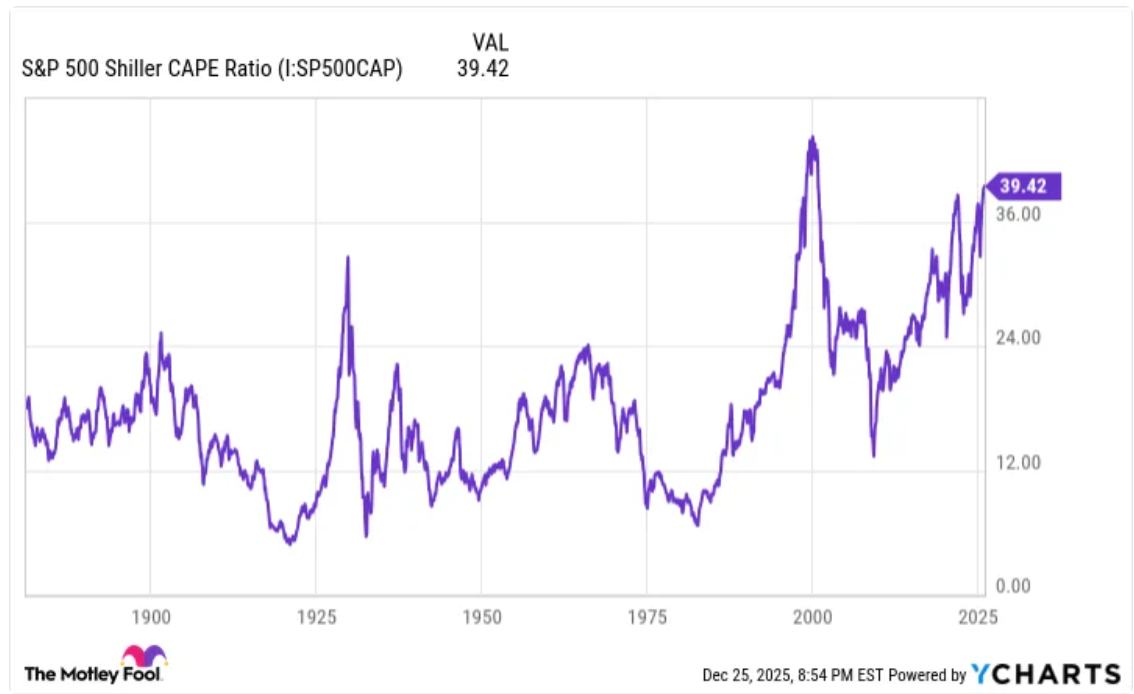
Figure 1
The indicator dates back to January 1871, for a total of 155 years. The average value for the period was 17.32 times, but the closing on December 24 had risen to 40.74 times, only one step away from the current bull market high of 41.20 times, and close to the historical peak of 44.19 times before the burst of the Internet bubble in December 1999.
Historical experience shows that Schiller's price-earnings ratio of more than 30 times has never been maintained for long. It's only happened six times in 155 years, including the present; after the first five, the Dow Jones, S&P 500, and/or Nasdaq Composite all ended up falling 20% to 89%.
Don't forget that when the overall market valuation is far above the historical normal, the average will not return overnight. Even if Powell leaves office in May 2026, his last words will still resonate on Wall Street.
Schiller's price-earnings ratio is not a tool for selecting time, and the Federal Reserve Chairman's statement could be wrong — it took more than three years for the stock market to peak after Greenspan's famous “irrational prosperity” speech — but it is almost unquestionable that this indicator has maintained a victory in terms of risk in the stock market.
Time will heal all of Wall Street's short-term wounds
From history alone, it can be asserted that a sharp pullback, a bear market, or even an elevator-style sharp decline is not “if”, but “when.” Most investors certainly hate emotion-driven declines, but these storms also have their own glimmer of light.
While it is uncomfortable to witness a glaring red line in an account, a pullback, bear market, or even a crash are healthy and unavoidable parts of the investment cycle. Wall Street's pendulum swings in both directions, and occasional declines are nothing more than a “ticket” paid to enter the world's most powerful rich-making machine.
However, stock market cycles are not a mirror image of each other—this is critical.
In June 2023, shortly after the S&P 500 rebounded more than 20% from its 2022 bear low and officially entered a new round of bull market, Bespoke Investment Group published a set of data on X (originally Twitter), comparing the duration of each round of the S&P 500 bull market and bear market over the past 94 years.
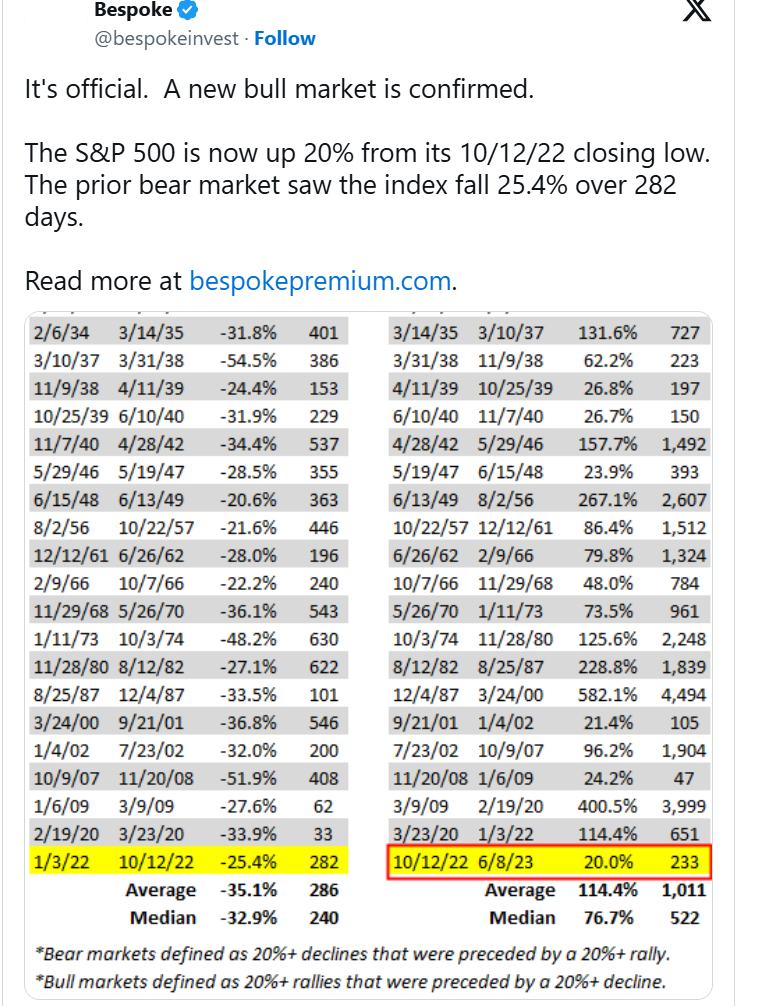
Figure 2
On the one hand, from the beginning of the Great Depression in September 1929, the S&P 500 average bear market ended after only 286 natural days—or about 9.5 months—; most of the emotion-driven “elevator-style” declines were fleeting.
On the other hand, from September 1929 to June 2023, the average S&P 500 bull market reached 1,011 natural days, 3.5 times the length of a typical bear market. Although the market has ups and downs, time is disproportionately spent rising. In fact, every previous pullback, bear market, and crash experienced by the Dow Jones, S&P 500, and Nasdaq was ultimately undone by the subsequent bull market.
So while Powell's comments on valuation point to the historical headwinds that could hit Wall Street in 2026, time has proven time and time again: for long-term investors, it always heals all short-term wounds.