
- LIVE QUOTES
- LEARN
- HELP
 Nasdaq
 Wall Street Journal
EN
The South Korean authorities have shown a “firm determination” to defend the currency, and the won continued to rise to a new high since the beginning of November
The Zhitong Finance App learned that after the South Korean authorities recently expressed “firm determination” to defend the local currency, the Korean won continued to rise on Friday, and the exchange rate of the won against the US dollar rose to the highest level since early November. As of press release, the USD/KRW exchange rate fell 0.27% to 1442.06, and fell to 1429.82 during the day. The exchange rate has declined 2.28% over the past week.
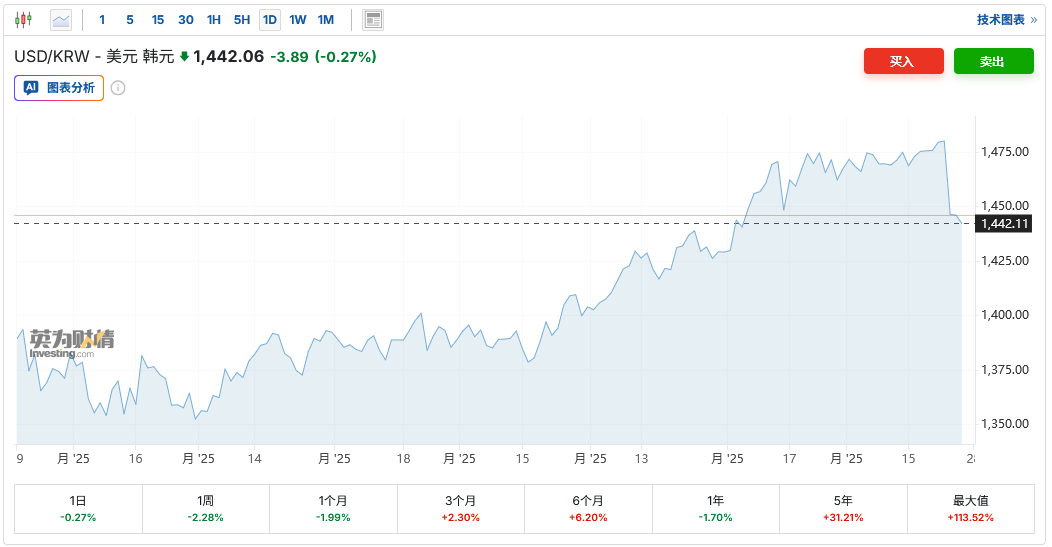
South Korean authorities said on Wednesday that the excessive weakness of the won is not a good thing, and the foreign exchange market will soon see the government's “firm determination.” The Bank of Korea and South Korea's Ministry of Finance jointly stated on Wednesday that they have held several meetings in the past two weeks to discuss the recent weakening of the Korean won. South Korea's Ministry of Finance also announced that it will adopt a number of new tax measures to stabilize the foreign exchange market.
The won strengthened sharply immediately after the South Korean authorities made these remarks on Wednesday. Previously, the won depreciated to 1,485 won per dollar, approaching its lowest level since the 2009 global financial crisis. In the second half of this year, the won was the worst performing currency in Asia, falling about 8% against the US dollar.
Christopher Wong, foreign exchange strategist at OCBC Bank, said, “The South Korean authorities' verbal intervention on Christmas Eve was still effective. At the same time, the recovery in risk appetite, the weakening dollar, and the strong central price of the RMB all contributed to the rise in the Korean won.” He added that if the USD/KRW exchange rate closes below 1415, further decline is likely in 2026.
Currently, the South Korean authorities are making every effort to contain the depreciation of the won, as a sharp weakening of the won may increase the risk of imported inflation, accelerate capital outflows, and weaken the confidence of foreign investors in the country's financial stability, which in turn may cause a vicious cycle.
The South Korean authorities are easing foreign exchange controls to increase domestic dollar liquidity, seek cooperation from major exporters, and step up efforts to ease the pressure brought about by residents' overseas investment needs. Earlier this month, the Bank of Korea signed a foreign exchange agreement with the National Pension Service (NPS) with a limit of 65 billion US dollars. The National Pension Service has previously begun selling dollars to support the Korean won exchange rate.
The Bank of Korea has also decided to temporarily exempt banks and other financial institutions from foreign exchange stabilization taxes starting next month, and will pay interest on statutory foreign exchange deposit reserves held by financial institutions. South Korean brokerage firms have also decided to suspend new marketing activities for overseas stocks.
South Korea's Ministry of Finance said on Wednesday that it will launch a new tax incentive plan for returning investment accounts to encourage overseas investment capital to return to the domestic market. According to the latest relevant plan, after selling overseas stocks, when exchanging the proceeds into won and investing in domestic stocks for a long time, individual investors in Korea will be temporarily exempted from income tax on the sales of overseas stocks within 1 year.
Furthermore, the Korean government will support large brokerage firms to quickly launch forward sales products for individual investors, as many retail investors currently lack sufficient foreign exchange risk management tools. South Korea's Ministry of Finance also said that in order to reduce double taxation of dividends received by domestic parent companies from overseas subsidiaries, the government will increase the dividend income exclusion rate from the current 95% to 100%.
An economist at Shinhan Bank said, “The won has now weakened to such an extent — so far away negative factors, such as France's failure to agree on next year's budget and Europe's concerns about France's credit rating downgrade, have had an impact on it, because the won is very sensitive to negative news and less sensitive to positive news.” “Currently, South Korea's foreign exchange administration is determined to lock in the upper limit of the USD/KRW exchange rate before the end of the year, but if no other factors drive the exchange rate down, the won exchange rate is likely to remain between 1,470 and 1,480 won in the short term.”