
- LIVE QUOTES
- LEARN
- HELP
 Nasdaq
 Wall Street Journal
EN
Is Environment Friendly Holdings (TSE:3777) Using Debt Sensibly?
Some say volatility, rather than debt, is the best way to think about risk as an investor, but Warren Buffett famously said that 'Volatility is far from synonymous with risk.' It's only natural to consider a company's balance sheet when you examine how risky it is, since debt is often involved when a business collapses. We note that Environment Friendly Holdings Corp. (TSE:3777) does have debt on its balance sheet. But is this debt a concern to shareholders?
When Is Debt Dangerous?
Debt assists a business until the business has trouble paying it off, either with new capital or with free cash flow. In the worst case scenario, a company can go bankrupt if it cannot pay its creditors. However, a more frequent (but still costly) occurrence is where a company must issue shares at bargain-basement prices, permanently diluting shareholders, just to shore up its balance sheet. Of course, the upside of debt is that it often represents cheap capital, especially when it replaces dilution in a company with the ability to reinvest at high rates of return. The first step when considering a company's debt levels is to consider its cash and debt together.
How Much Debt Does Environment Friendly Holdings Carry?
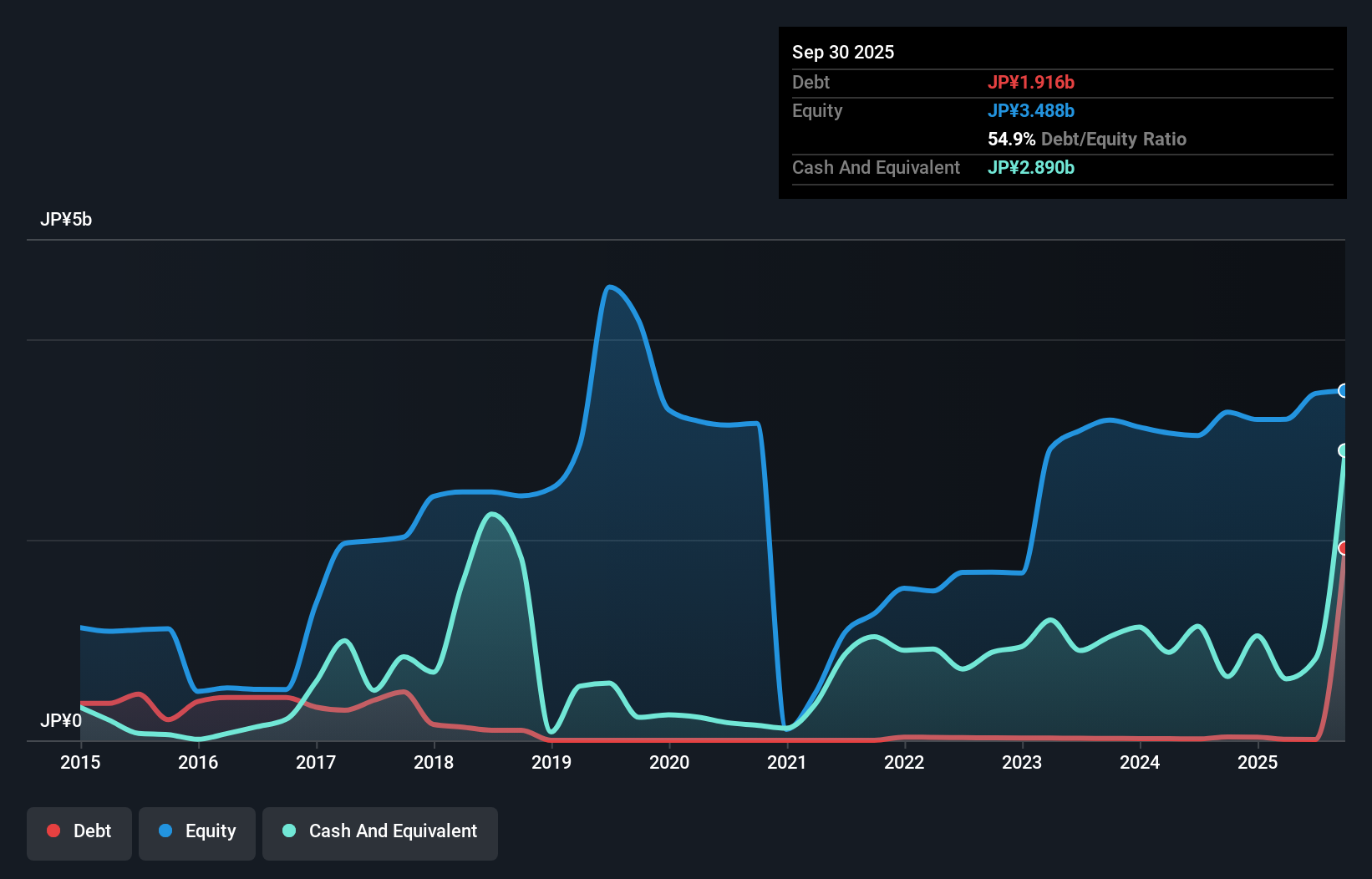
As you can see below, at the end of September 2025, Environment Friendly Holdings had JP¥1.92b of debt, up from JP¥34.0m a year ago. Click the image for more detail. However, its balance sheet shows it holds JP¥2.89b in cash, so it actually has JP¥974.0m net cash.
How Healthy Is Environment Friendly Holdings' Balance Sheet?
The latest balance sheet data shows that Environment Friendly Holdings had liabilities of JP¥639.0m due within a year, and liabilities of JP¥1.56b falling due after that. Offsetting this, it had JP¥2.89b in cash and JP¥161.0m in receivables that were due within 12 months. So it can boast JP¥854.0m more liquid assets than total liabilities.
This short term liquidity is a sign that Environment Friendly Holdings could probably pay off its debt with ease, as its balance sheet is far from stretched. Succinctly put, Environment Friendly Holdings boasts net cash, so it's fair to say it does not have a heavy debt load! The balance sheet is clearly the area to focus on when you are analysing debt. But you can't view debt in total isolation; since Environment Friendly Holdings will need earnings to service that debt. So if you're keen to discover more about its earnings, it might be worth checking out this graph of its long term earnings trend.
Check out our latest analysis for Environment Friendly Holdings
In the last year Environment Friendly Holdings had a loss before interest and tax, and actually shrunk its revenue by 63%, to JP¥6.5b. That makes us nervous, to say the least.
So How Risky Is Environment Friendly Holdings?
By their very nature companies that are losing money are more risky than those with a long history of profitability. And we do note that Environment Friendly Holdings had an earnings before interest and tax (EBIT) loss, over the last year. Indeed, in that time it burnt through JP¥470m of cash and made a loss of JP¥200m. But the saving grace is the JP¥974.0m on the balance sheet. That means it could keep spending at its current rate for more than two years. Even though its balance sheet seems sufficiently liquid, debt always makes us a little nervous if a company doesn't produce free cash flow regularly. The balance sheet is clearly the area to focus on when you are analysing debt. However, not all investment risk resides within the balance sheet - far from it. Be aware that Environment Friendly Holdings is showing 2 warning signs in our investment analysis , and 1 of those shouldn't be ignored...
At the end of the day, it's often better to focus on companies that are free from net debt. You can access our special list of such companies (all with a track record of profit growth). It's free.
Have feedback on this article? Concerned about the content? Get in touch with us directly. Alternatively, email editorial-team (at) simplywallst.com.
This article by Simply Wall St is general in nature. We provide commentary based on historical data and analyst forecasts only using an unbiased methodology and our articles are not intended to be financial advice. It does not constitute a recommendation to buy or sell any stock, and does not take account of your objectives, or your financial situation. We aim to bring you long-term focused analysis driven by fundamental data. Note that our analysis may not factor in the latest price-sensitive company announcements or qualitative material. Simply Wall St has no position in any stocks mentioned.