
- LIVE QUOTES
- LEARN
- HELP
 Nasdaq
 Wall Street Journal
EN
National Bank of Canada (TSE:NA) Is Increasing Its Dividend To CA$1.24
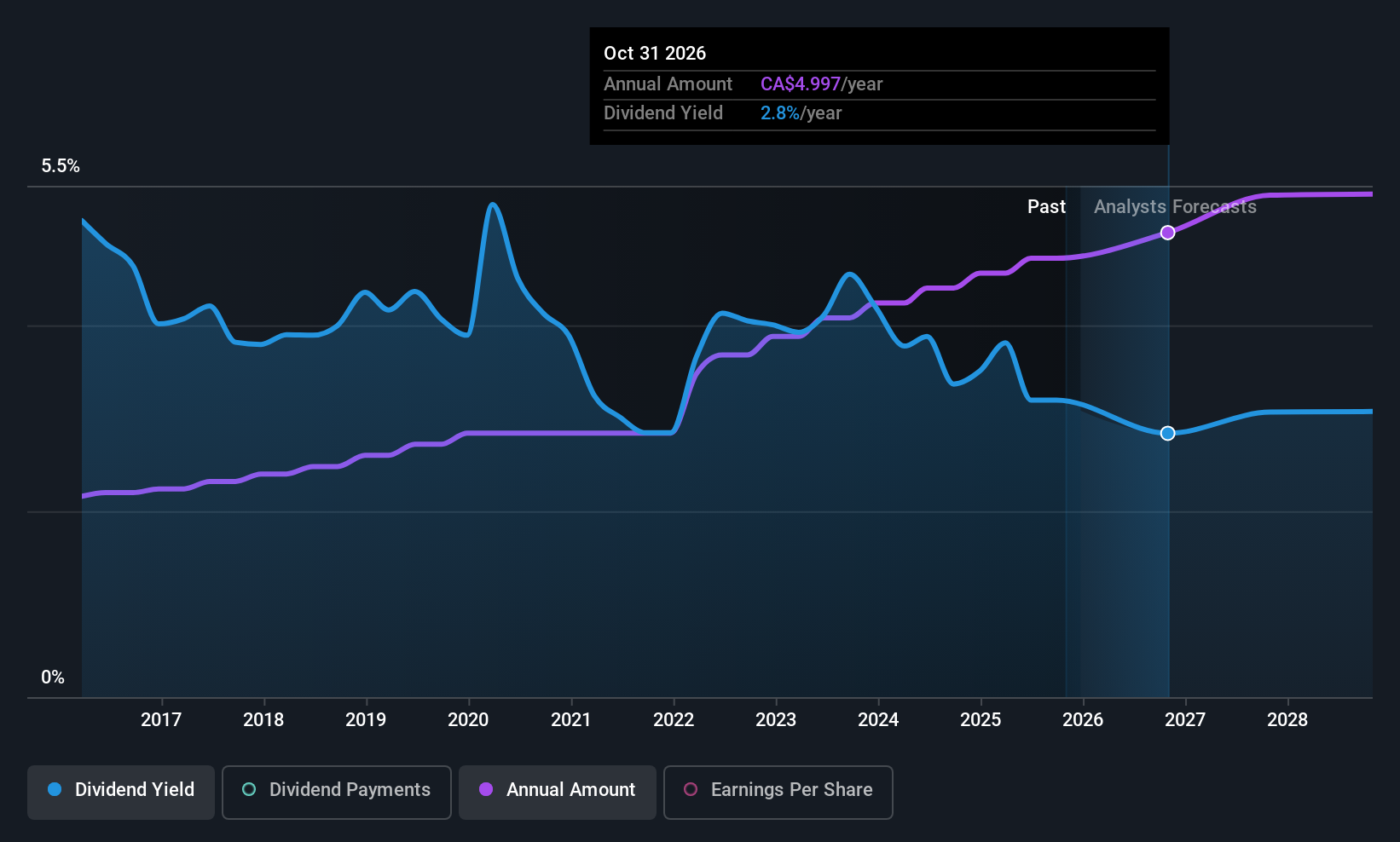
The board of National Bank of Canada (TSE:NA) has announced that it will be paying its dividend of CA$1.24 on the 1st of February, an increased payment from last year's comparable dividend. Although the dividend is now higher, the yield is only 2.8%, which is below the industry average.
National Bank of Canada's Payment Expected To Have Solid Earnings Coverage
While yield is important, another factor to consider about a company's dividend is whether the current payout levels are feasible.
Having distributed dividends for at least 10 years, National Bank of Canada has a long history of paying out a part of its earnings to shareholders. Based on National Bank of Canada's last earnings report, the payout ratio is at a decent 46%, meaning that the company is able to pay out its dividend with a bit of room to spare.
Over the next 3 years, EPS is forecast to expand by 38.0%. The future payout ratio could be 39% over that time period, according to analyst estimates, which is a good look for the future of the dividend.
View our latest analysis for National Bank of Canada
National Bank of Canada Has A Solid Track Record
The company has an extended history of paying stable dividends. Since 2015, the annual payment back then was CA$2.00, compared to the most recent full-year payment of CA$4.96. This means that it has been growing its distributions at 9.5% per annum over that time. The growth of the dividend has been pretty reliable, so we think this can offer investors some nice additional income in their portfolio.
The Dividend Looks Likely To Grow
Investors who have held shares in the company for the past few years will be happy with the dividend income they have received. We are encouraged to see that National Bank of Canada has grown earnings per share at 11% per year over the past five years. Shareholders are getting plenty of the earnings returned to them, which combined with strong growth makes this quite appealing.
An additional note is that the company has been raising capital by issuing stock equal to 15% of shares outstanding in the last 12 months. Trying to grow the dividend when issuing new shares reminds us of the ancient Greek tale of Sisyphus - perpetually pushing a boulder uphill. Companies that consistently issue new shares are often suboptimal from a dividend perspective.
We Really Like National Bank of Canada's Dividend
In summary, it is always positive to see the dividend being increased, and we are particularly pleased with its overall sustainability. The company is easily earning enough to cover its dividend payments and it is great to see that these earnings are being translated into cash flow. Taking this all into consideration, this looks like it could be a good dividend opportunity.
Market movements attest to how highly valued a consistent dividend policy is compared to one which is more unpredictable. Still, investors need to consider a host of other factors, apart from dividend payments, when analysing a company. For instance, we've picked out 1 warning sign for National Bank of Canada that investors should take into consideration. If you are a dividend investor, you might also want to look at our curated list of high yield dividend stocks.
Have feedback on this article? Concerned about the content? Get in touch with us directly. Alternatively, email editorial-team (at) simplywallst.com.
This article by Simply Wall St is general in nature. We provide commentary based on historical data and analyst forecasts only using an unbiased methodology and our articles are not intended to be financial advice. It does not constitute a recommendation to buy or sell any stock, and does not take account of your objectives, or your financial situation. We aim to bring you long-term focused analysis driven by fundamental data. Note that our analysis may not factor in the latest price-sensitive company announcements or qualitative material. Simply Wall St has no position in any stocks mentioned.