
- LIVE QUOTES
- LEARN
- HELP
 Nasdaq
 Wall Street Journal
EN
Are retail investors “entering the market” or “entering the pit”? Is the US SEC's plan to open up private equity and crypto access a wealth opportunity or a poor information trap?
The Zhitong Finance App notes that as the Trump administration and the Securities and Exchange Commission (SEC) push for market opening, US investors may soon have access to more investment products related to asset classes such as private credit and cryptocurrencies. Some investment advisors say the change places too much responsibility on individual investors to protect their rights.
Under SEC Chairman Paul Atkins, both the White House and the SEC support providing investors with more options to take advantage of certain asset classes that offer high returns.
Both the White House and the department headed by SEC Chairman Paul Atkins argue for providing investors with more options to venture into asset classes that are likely to bring high returns. However, some financial advisors are reminding their clients, particularly those who usually invest in stocks and bonds, that may not fully understand the new products that are already emerging and that market analysts expect to be added in 2026.
Mark Stancato, founder of VipWealthAdvisors, a registered investment advisory firm in Decatur, Georgia, said, “Negative events will happen, people will say, wait, etc., I didn't realize I was taking this risk.” He is concerned that investors will find it difficult to make smart decisions, especially when evaluating retirement assets.
The SEC and White House said they remain focused on investor protection.
White House spokesman Taylor Rogers said, “Chairman Atkins is committed to ensuring that the SEC maintains a fair, orderly, and efficient market while protecting ordinary investors.” She added that the US remains the “best and safest” place to invest.
An SEC spokesperson said the agency is focusing on ensuring investors have “sound information to make informed decisions about all new products.” Atkins mentioned in a speech in September that easing entry standards for private assets also requires the establishment of corresponding “guardrails.”
A spokesman for the US Department of Labor said that relevant rules and guidelines will be formulated for providing private assets and other alternative assets to retired investors.
Do “retail investors” take more risks, or do they get more rewards?
The Trump administration announced in August that it plans to make it easier for individual investors to access assets such as private credit and private equity, and requires the Secretary of Labor, who oversees retirement plans, to negotiate with other agencies, including the SEC, within six months. Atkins said in November that typical retirement investment instruments (such as target date funds) have given up exposure to these assets, putting investors at a disadvantage.
Currently, 401 (k) and other retirement plans provide exposure to listed assets such as stocks and bonds through mutual funds or ETFs. Although opening up private equity or private credit investments can bring diversified benefits, it also raises questions about how to value these positions, how liquid they are, and the quality of choices individual investors are exposed to.
The agency also helped investors increase investment channels in cryptocurrencies by issuing general listing standards in September and speeding up the launch of new ETFs, which removed an obstacle to launching crypto-related spot ETFs.
Robert Persichet, a financial planner at Delagify Financial in Arvada, Colorado, said that new products may increase retail investors' risk. He believes retail investors have the least expertise in risk assessment of new or complex products, but they have the greatest risk exposure. “Small investors... don't have a dedicated team of advisors to serve them,” said Persichet.
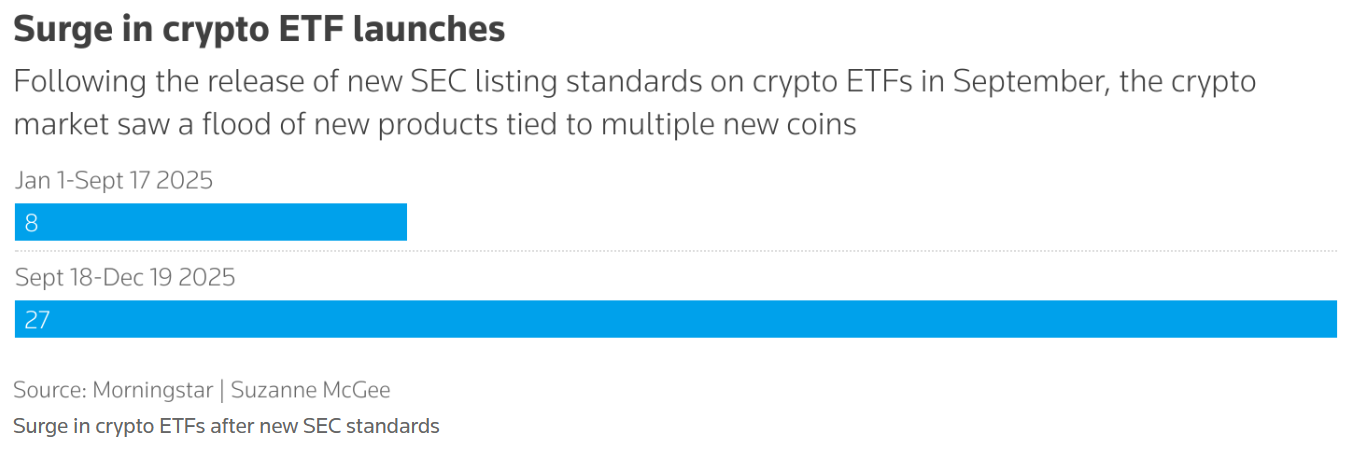
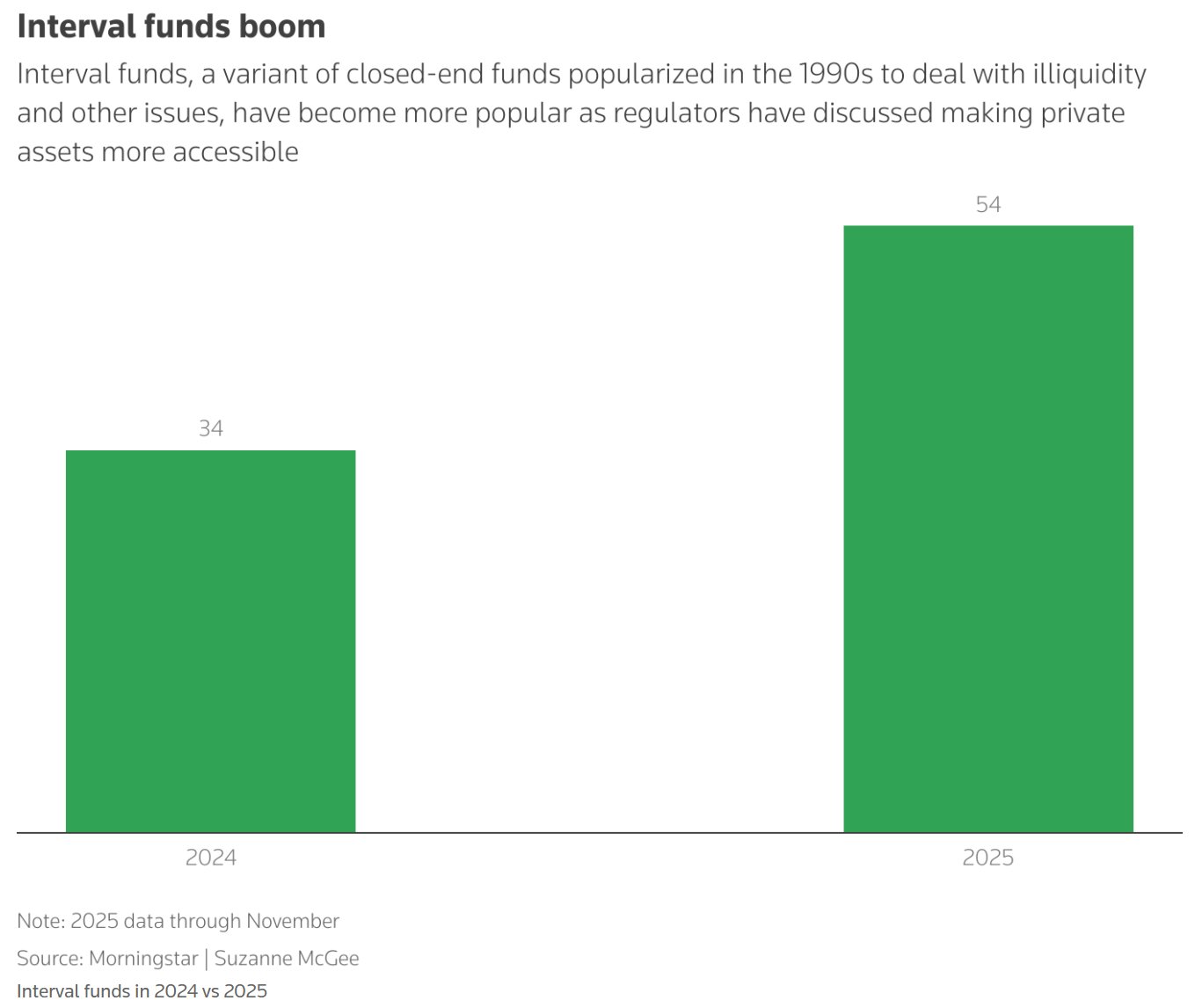
Morningstar's data shows that the number of new cryptocurrency ETFs has increased since the General Listing Standard was introduced in September. Bitwise Asset Management recently predicted that another 100 related products may be launched in 2026. Additionally, interval funds (Interval funds, a closed-end fund that invests in private assets) have also increased because they are seen to benefit from the opening up of retirement plans.
Morning Star analyst Brian Ammer said, “I expect a massive influx of funds holding private assets in 2026.”
Although ETFs, interval funds, or target-date mutual funds themselves do not represent excessive risk, risk depends on the nature of the underlying asset. In fact, some market participants said that opening up options would benefit investors.
Duncan Moyle, president of 21Shares, which launched 6 cryptocurrency ETFs in recent months, said cryptocurrencies “can play an important role in investment portfolios.”
Bruno Sosa, founding partner of crypto asset management company Hashdex, said that capital markets operate by providing people with “the information they need to make free and informed decisions.”